
The Five Single-Letter Particles of Jarr
بَاء · تَاء · كَاف · لَام · وَاو — inseparable huruf of jarr with pronouns
- Identify the five single-letter huruf of jarr (بَاء، تَاء، كَاف، لَام، وَاو) and understand why they are always written attached to the following word
- Know the specific meaning and usage of each particle — oath (تَاء، وَاو), comparison (كَاف), and belonging/for (لَام) and with/by (بَاء)
- Apply لَام and بَاء correctly with both nouns and all fourteen attached pronouns
- Recognise how the hamzatul wasl disappears when لِـ attaches to a word beginning with الـ, producing لِلـ
- Understand the phonetic rules that change the pronunciation of the attached pronoun هُ depending on the vowel that precedes it
Video Lesson
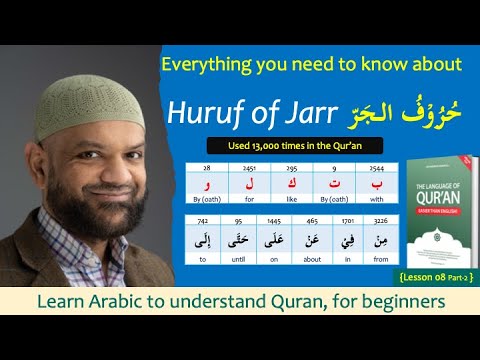 Click to play
Introduction
In Part 1 of Lesson 8, we were introduced to the concept of huruf of jarr and studied مِن in depth. Now in Part 2, we move to the five huruf of jarr that are single-letter words: بَاء، تَاء، كَاف، لَام، وَاو. Because they consist of a single letter, they cannot stand alone — they are always written attached to the word that follows them. This is a feature of Arabic writing that catches beginners off guard: what looks like one word in the Quranic text is often a preposition fused onto a noun.
The teacher organises all huruf of jarr into two groups: inseparable (single-letter, written attached to the next word) and separable (multi-letter, written as separate words). This lesson covers the inseparable group. Lesson 9 will complete the study by covering مِن، فِي، عَن، عَلى، حَتَّى، إِلَى — after which students will know every harf of jarr used in the Quran, words that appear nearly 13,000 times in total.
Lesson Notes
The five inseparable huruf of jarr at a glance
| Harf | Core meaning | Quranic frequency | Attaches to pronouns? |
|---|---|---|---|
| بَاء | by / with / in (also oath) | ~2,544 times | Yes |
| تَاء | by (oath only, with Allah) | 9 times | No |
| كَاف | like / as (comparison) | ~295 times | No |
| لَام | for / belonging to | ~2,451 times | Yes |
| وَاو | by (oath) | ~28 times as harf of jarr | No |
Every harf of jarr — whether single-letter or multi-letter — puts the ism that follows it into the jarr (majruur) case. This principle never changes.
تَاء — oath by Allah only
تَاء is the most restricted particle. It is used only when swearing by Allah, and it appears exactly nine times in the entire Quran. The noun اللهِ that follows it is always majruur.
> تَاللهِ — "By Allah" (e.g., تَاللهِ لَقَدْ كُنَّا لَفِي ضَلَالٍ مُّبِينٍ — "By Allah, we were indeed in manifest error")
وَاو — oath by anything
وَاو is also used for taking an oath, but far more flexibly. Allah swears by time, the morning light, the Quran, the sun, and the moon using this particle. It appears about 28 times in the Quran as a harf of jarr (and thousands of times as the conjunction "and").
When وَاو is a harf of jarr (oath), the ism after it is majruur. When it is the conjunction "and", the following noun keeps its own i'rab. Look at the kasra ending on the noun to identify the oath usage.
Examples of divine oaths in the Quran: وَالعَصْرِ (by time), وَالضُّحَى (by the morning light), وَالقُرْآنِ الحَكِيمِ (by the wise Quran).
كَاف — comparison
كَاف means "like" or "as" and is used purely for comparisons. It does not attach to pronouns. When it joins a word beginning with الـ, the hamzatul wasl is present in writing but dropped in reading — producing a compound that looks like one word.
> كَالفُجَّارِ — "like the wicked" > كَالفَرَاشِ المَبْثُوثِ — "like scattered moths" (Al-Qari'ah, 101:4)
Note: when كَاف precedes a descriptive phrase (مُرَكَّب تَوْصِيفِي), the adjective copies the jarr of the noun it describes — for example, كَالفَرَاشِ المَبْثُوثِ, where مَبْثُوثِ is jarr because it copies from فَرَاشِ.
لَام — for / belonging to
لَام has two written forms depending on what follows:
- لِـ — used before any regular noun: لِطَالِبٍ (for a student)
- لَـ — used before attached pronouns: لَهُ (for him / belonging to him)
When لِـ is added before a word beginning with الـ, the hamzatul wasl is not written. The result is لِلـ: لِلْكِتَابِ (for the book), لِلْمُتَّقِينَ (for the pious). With the word اللهِ specifically, the two laam letters merge in writing: لِلَّهِ.
لَام with the fourteen attached pronouns
When لَام attaches to an attached pronoun, the vowel on the laam changes from kasra to fatha (لَـ). There is one important exception: the first-person singular يَاء always requires a kasra before it, so instead of لَايَ the form contracts to لِي.
| Form | Meaning |
|---|---|
| لَهُ | for him |
| لَهَا | for her |
| لَهُم | for them (m. pl.) |
| لَهُنَّ | for them (f. pl.) |
| لَكَ | for you (m. sg.) |
| لَكُم | for you (m. pl.) |
| لَكِ | for you (f. sg.) |
| لَكُنَّ | for you (f. pl.) |
| لِي | for me |
| لَنَا | for us |
لَهُ appears very frequently in the Quran — for example: لَهُ مُلْكُ السَّمَاوَاتِ وَالأَرْضِ (to Him belongs the kingdom of the heavens and the earth).
بَاء — with / by / in
بَاء is one of the most commonly occurring words in the Quran (2,544 times). Its meanings range from "with" and "in" to "by" when used for oath (بِاللهِ — by Allah). Its most famous occurrence is at the opening of every surah: بِسْمِ اللهِ الرَّحْمَنِ الرَّحِيمِ.
Unlike تَاء، كَاف، and وَاو, بَاء attaches freely to both nouns and all fourteen attached pronouns.
Phonetic rule for هُ when preceded by بِـ
The attached pronoun هُ (him/his) changes its vowel depending on what immediately precedes it:
- Preceded by a fatha or dhamma → read with elongation: لَهُو → لَهُ, رَسُولُهُو → رَسُولُهُ
- Preceded by a kasra or a sukuun on يَاء → the هُ shortens to هِ: بِهِ (not بِهُ)
When يَاء ساكِن or a kasra immediately precedes هُم/هُمَا/هُنَّ, they become هِم/هِمَا/هِنَّ for phonetic reasons: بِهِم، عَلَيْهِم، إِلَيْهِم. This pattern repeats throughout the Quran.
Summary
- The five inseparable huruf of jarr — بَاء، تَاء، كَاف، لَام، وَاو — are single letters always written attached to the word that follows. What appears as one word in Quranic text is often a preposition fused with a noun.
- تَاء is restricted to oath by Allah only (9 times in Quran). وَاو takes oath by Allah or any phenomenon Allah swears by (~28 times as harf of jarr). كَاف means "like/as" (comparison, ~295 times) and does not attach to pronouns.
- لَام (~2,451 times) has two forms: لِـ before nouns and لَـ before attached pronouns — with the exception of لِي for the first-person singular. Before words beginning with الـ, the hamzatul wasl disappears, giving لِلـ.
- بَاء (~2,544 times) is the most versatile: it means "with/by/in" and attaches to both nouns and all fourteen attached pronouns. It is visible from the very first word of every surah in بِسْمِ اللهِ.
- When هُ (and هُم، هُمَا، هُنَّ) is preceded by a kasra or يَاء ساكِن, it shifts to هِ/هِم/هِمَا/هِنَّ for phonetic reasons — a pattern that recurs constantly throughout the Quran in forms like بِهِم and عَلَيْهِم.
Terminology Reference
| Arabic | Transliteration | Meaning | Type |
|---|---|---|---|
| حَرْفُ الجَرّ | harful jarr | particle of jarr (preposition that puts the following noun into the jarr case) | grammatical term |
| بَاء | baa | by / with / in (also used for oath — billahi) | harf of jarr |
| تَاء | taa | by (oath — used exclusively with the word Allah, 9 times in Quran) | harf of jarr |
| كَاف | kaaf | like / as (comparison) | harf of jarr |
| لَام | laam | for / belonging to | harf of jarr |
| وَاو | waaw | by (oath — used with Allah or anything else sworn by) | harf of jarr |
| مَجْرُور | majruur | a noun in the jarr (genitive) case | grammatical term |
| مُرَكَّب جَارِّي | murakkab jaarri | the jarr-majruur construct (preposition + noun in jarr) | grammatical term |
| تَاللهِ | tallaahi | by Allah (oath with تَاء) | example phrase |
| وَاللهِ | wallaahi | by Allah (oath with وَاو) | example phrase |
| لِي | lii | for me / belonging to me (لَام + first-person pronoun) | example phrase |
| بِسْمِ اللهِ | bismillaah | in the name of Allah | example phrase |
Linked Arabic terms open their full entry in the Arabic Grammar Guide.
📖 Grammar guide. Grammar terms are explained in the Arabic Grammar Guide — fully vocalised, searchable in Arabic, any transliteration, or the English meaning.
Lesson Transcript
Read the full transcript (6,511 words)
Auto-generated from the lesson video. Timestamps jump to that point in the video. May contain transcription errors.
0:00 The language of Quran easier than English lesson 8 part 2. Alhamdulillah in part 1 of the video. We looked at the Introduction to the topic of the huruf of jar and we looked at many examples of how min is used To put the ism after in jar making the murakab jari Of course every single half of jar behaves exactly the same way in this part now part 2 of lesson 8 We're going to look at ba, ta, taf, lam, wa. These are single letter huruf of
jar and inshallah We're going to look at many many examples of them in lesson number 9 inshallah We will conclude the subject by studying min, fi, an, ala, hatta and ila So let's begin with the blessed name of Allah bismillahirrahmanirrahim Making the dua rabbi zidni ilma. Oh my Lord increase me in knowledge Review of the huruf of jar In order to facilitate the study of the huruf of jar I've divided them into two groups and it'll make our study a little bit easier the first group.
I'm calling them Inseparable and the second group. I'm calling them separable. Don't worry about the terminology Separable what I mean is that because the inseparable are single letter words, please note ba, ta, kaf, lam, wa the single letter words So we're going to call them inseparable and the rest of them are more than one letter So mun, thu, mud, khala, rubba, hasha, min, ada, fi, an, ala, hatta, ila All of them are more than one letter. So they I've called them in Separable what I mean
by that inshallah the separable ones are written separately So they're easy to recognise and we will study those that are used in the Quran which are highlighted with the numbers above That is min, fi, an, ala, hatta, ila in lesson number nine But in this lesson, we are going to tackle the first five and they are ba, ta, kaf, lam, wa Please note in Arabic whenever you have a single letter word like fa, fa is a single letter word It's not part of this group. It
is one of the joiners Okay, fa, when it's written you write it with the word joined afterwards So even though detached pronouns are written separately But because the word preceding is a single letter word you have to join the single letter word to the The coming word that is after it. So it is fa huwa, fa huwa. Please pay attention to that inshallah Wa hum is actually this again written attached to the next word But the wa does not allow itself to be joined to a
letter after It's one of those letters that don't allow there are only a few of them in Arabic like daal, dhaal, raaza It doesn't allow something to get written next to it. So wa is written without any separation So that is wa hum. So this is why they call inseparable single letter words in Arabic are always written Attached to the following word or in the case of wa written without any space in between Now in English, we have two words which are single letter. That's the
entire language We have for example, I and am so I have I and am so I is a single Word in its own right. A is also word in its own right, but they're made out of single letters But in Arabic, there's quite a few of them five of them You can see on the top ba, ta, ka, fla, mua and of course there are others like fa, wa and so on So we need to make sure that we know this principle in Arabic that when
we write them We always write them attached to the following word Harf of jar, ta Ta is only used with the word for Allah. That's it. No other time It's used it has been used nine times in the Quran and I've given you all the references here Inshallah, you can take a screenshot and check for yourself Open up the mushaf or any of the online Quran like Quran.com and they put those references in inshallah You'll find them there. So ta is used only with the word
Allah as a harf of jar and you can see afterwards What happens to it? So ta And you put the word lafza jalala afterwards. It becomes tallahi Tallahi and you can you can see that ta joining the Hamzatul wasl, which is here So this becomes that you can see here So that's how it's written. Ta is attached to the following word. So it is taken for oath Literally by Allah by Allah or I swear by Allah that kind of meaning and I've given you two examples
From the Quran first they said by Allah indeed. You are in your same old era Second example by Allah we were indeed in manifest error So you can see here two example of has been used and that's the only time you're gonna see them Nine times in the Quran in total and the two references is there So this one's an easy one tallahi by Allah Harf of jar wa Wa we've used already as a and d and for example, I have on the screen Kabirun wajadeedun
big and new then I have anta wa ana you and I Then I have hamidun wazaidun Hamid and Zaid Al muallimu waz talibu The teacher and the students, of course, I could do a lot more we could attach two sentences together. For example al baitu kabirun wal masjidu saghirun The house is big and the mosque is small. We could add verbs we could do many things but wa is used primarily as a and d and Joining two parts together can be words sentences adjectives, etc, etc
So this is the wa that we use so far. Wa is also a harf of jar. How do you tell the difference? Well, this is why we're going through this process Inshallah, you will not have any difficulty provided you've done the first few lessons in the sequential order now here I have was shamsu Was shamsu walqamaru This would mean in Arabic and the Sun and the moon I forgot to mention it's used 28 times in the Quran as a harf of jar and Thousands of times
as wa for and so was shamsu and the Sun walqamaru and the moon But when it is used as a harf of jar it become was shamsi by the Sun walqamari By the moon so oath is now being taken by the Sun and the moon So when it is used as a harf of jar the ism after will always be majroor Please note that and the wa basic meaning is to take an oath Now the law here example we saw earlier can be only used with
the word for Allah Whereas wa can be used to for taking oath by any Word that comes after the Sun the moon the stars etc or by Allah, of course So you can take oath by anything with this word wa wa is more flexible in its use So I have here now the word wa harf of jar Followed by the ism in front. I would like you now to make the muraqab jari yourself jar or majroor by Using those words in the brackets in the boxes
very very easy. I hope inshallah Please complete the task do not continue until you completed it and then come back and see the results. So the first example Wa and the word for Allah We have wallahi Second example wa laasri again. I hope you can see which surah is from we all know this surah wa laasri Inna linsana lafee khusf here oath is taken by time oath is taken by time and then we have wa dduha wa dduha Again, please note the extra alif at the
end These don't change their endings and that's why we have this example here just to illustrate it for you But the next one is actually we have two words after we have al-qur'anul hakeemu The wise Quran. So what is going on here? Look wal qur'ani al hakeemi so what's going on here this word hakeemi is a Description of the word Quran. It's an adjective. We've done that Muraqqab tawsifi many times and therefore it will copy. This is jar So it will copy the arab and the
four properties over So that is why the second word has to be in jar also So it is not because on its own right is jar because it is copying from the word wal qur'ani wal qur'ani al hakeemi Again, you can see alhamdulillah this illustration. So I hope this is easy you finding it Okay, if not, write them down and repeat the exercise again word of advice for you and me Just a reminder inshallah Allah subhana Allah in the Quran takes oath by many things It's
used about 28 times in the Quran. These are phenomenons These have some link in the surah some meaning and to explain the lesson For example Allah, of course That is the greatest. There is nothing greater than Allah to take oath by So Allah subhana Allah uses these terms in the Quran But in each surah they have some relevance to the subject being discussed We as human beings are forbidden from taking oath willy-nilly and we should avoid that under any circumstances When we do have to then
we can take an oath by Allah Wallahi so that it is why I put it there inshallah as a reminder for you and I But don't take oath all the time whenever you speak when it's necessary you do it Wallahi, we do not take by oath by anything else other than Allah harf of jar kaaf The harf of jar kaaf is used in the Quran 295 times it's a single letter word. And of course, it's a harf of jar It will attach to isms, but please
note just like ta and wa they do not attach to pronouns We've seen min attached to pronouns. Kaaf does not attach to Pronouns like wa and ta. Some of the prepositions do these are the three that don't So we have here with kaa dhulumaatin, dhulumaatun, it will become kaa dhulumaatin It has to be jar. Now the difficulty with recognising these when you first start learning Arabic That word looks like one word the fact that there are two words It's not easy for us to know so
we have to pay a little bit of attention at the beginning when we become familiar We'll be able to tell them. No, this is actually two different words kaaf first and dhulumaatin is afterwards Kaa dhulumaatin. The meaning of kaa as a harf of jar is like a comparison So the others we dealt with were oath. This is something completely different Compare for example, I say The word like in English and when I say I was the word like it could be that I like strawberries This
is not the like it's meant. For example Hamid is like a lion meaning is very brave. So this is the comparison Okay likeness and this is how it's used kaa and so we have kalfujjaru becomes kalfujjari Again, you can see the kaaf now joining with the hamzatul wasl. Again, if you look at the Look at the hamzatul wasl here. It is from here The hamzatul wasl is written, of course not read Kalfujjar. So you can see here kalfujjari So, please note these points inshallah at the
beginning of our study. These things are quite difficult I know we've been reading Quran without of course knowing any Arabic So we just read it and look like one word to us. But here inshallah I hope you can see There is two words in the first one and technically could say there are three words in the next one kaaf then al Then fujjar. So they combine together here in this beautiful form, which you can see kalfujjari and just to remind you the translations if I have
not given it to you already like or as darkness and Like the wicked so you can see the true translation of kathulu matin and kalfujjari Another exercise for you inshallah, the more practise you do the quicker you learn so you have now no run and no ru and al farashul Mabthuthu Again, you can see here inshallah Probably you can recognise the surahs at the bottom which surah comes from but anyway Take your time pause the video rewrite the answers before continuing. So the first one kaaf.
What will it be? Kaa noorin next one Kal noori Kal noori like the light the other one like light Indefinite like the light and of course Kal farashil mabthuthu You can see here mabthuthi because it is copying the i'rab of Farashi, okay, so it's kal farashil mabthuthi and you can see here. This is from of course Surah 101 ayah number 4, please do look at it in your own time inshallah So you can see here how easy it is for us at the beginning to get
lost We don't know what's going on But a little bit of an attention will help us find this kaaf Especially if you see the ism in jar and you look at the beginning and there's a kaaf there You can safely assume that it is because of that unless there's something before it, of course So pay attention to these hints I'm giving you These are little trappings that I got lost with when I was doing my journey and I'm sharing them with you too inshallah ta'ala So
you can make quick progress and I don't know how many times I'm going to repeat to you But I'm going to tell you again until you pick up the Quranic text. You're not going to learn anything So, please practise in Quranic text. I'm giving you a hint to the 295 times So you should be reading especially the surahs that you already know and see if you can recognise something that you're learning in the lessons Harf of jar laam The harf of jar laam is used two
different ways either as li or la La when it is attached to a pronoun so inshallah, we look that shortly Let's first look at li. Li is used when it is used with any ism any standard ism noun It is li. So this harf of jar laam is one of the most commonly used words in the Quran 2451 times so it's very important for us to grasp and it's a very simple one inshallah if you've done the Lessons on the previous one to recognise an ism
in jar this subject should be relatively easy for you. So I want to say li Then I have got the word talibun So I have now talibun and li to join together the basic meaning that this harf of jar gives is things like for Possession belonging to so that this kind of meaning. So for example, I said this is for me This pen is for me. Somebody's left it for me or I can say this pen is for me I it belongs to me that kind
of basic meaning is given by li or la So li plus talibun will be li talibin Li talibin and I hope now by now inshallah, you have no problem recognising that this is jar Okay, this is in the jar status or majroor when I add la To or li to a harf to an ism that has al in front. Please note the following happens li Talibu Talibu is all there. What will happen? Is that the Hamzatul wassul when it is written? It's actually removed. This is
one of the very rare occasions in Arabic that the Hamzatul wassul is not written Normally, as you know if there's something before it we don't read the Hamzatul wassul, but we write it For example, I say al kitabu. I'm reading it. I'm writing it But if I say wal kitabu, I don't read the Hamzatul wassul, I go straight to the laam This is the basic rule of Hamzatul wassul. Here Lil it comes it becomes lil of course in this occasionally. I read it as li talibi
because it is a Shamsi letter So the Hamzatul wassul is not written and I hope inshallah This is clear from this example and therefore the Hamzatul wassul that's supposed to be there is not written So the laam joins the next laam and this is very common in the Quran so please pay attention to it whenever you see li and then another laam afterwards is most likely it is the laam of the harf of jarb and Because it looks like one word at the beginning of our
study with we find it very very difficult Difficult to recognise so please pay attention Li when it is attached to al the Hamzatul wassul will not be written So you'll get lil in this case, of course li talibi, but if it was for example For the book lil kitabi, and that's how we would do it So li talibin for a student li talibi for the student Li is of course all also attached to the word for Allah nafsul jalala So we get in the writing lil
lahi of course The Hamzatul wassul is not written, but this laam actually assimilates in writing joins it in the following laam So it's written like so one of the giveaway to recognise it is that the Hamzatul wassul is not written before the word for Allah, which you normally know that it is Second of course with you'll have a vowel sign underneath the laam normally in modern standard Arabic. This is not written So you have to know To recognise this lil lahi belongs to Allah The best
way to learn anything in life is to through practise Just like you want to learn swimming you can do all the theory in the world unless you're in the water You'll never learn to swim. So inshallah before I go through the answers. I would like you to add Li to the following words pay attention to what I've told you as a hint and please complete The muraqab jari as you can see and I've taken examples from the Quran and references there for your benefit inshallah So
pause the video do not continue until you've done the exercise So the first one li plus waladun li plus waladun will give me li Waladin, I hope this is easy for you. These are your of course munsarif words, which is your 85% So you can clearly see the two kasras there telling us that it is majroor Al waladu if I add li to it, of course, the Hamzatul wassul will disappear I'll end up with lil waladi lil waladi And al mutaquna and if you learnt the
Muslim table in lesson number four this this part will be very easy So it will be lil mutaqina lil mutaqina Again, I hope you can easily see that this is could be nasab or jar But in this occasion, of course is jar because it is attached to a half of jar Then we have fuqara'u I put in bracket people, but it means the poor people persons in plural Now, of course, you should recognise that this is a broken plural. So when I add li to Fuqara'u
I end up with li fuqara'a. Please note. It is a Ghairu munsarif broken plural also, but it is also ghairu munsarif It does not take tanween does not take a kasra when it is jar Then we have al fuqara'u wal masakinu What is going on here? I'm adding li to the front Of course hamzatul wasl disappears but it is taking a kasra because as you as I've told you in the previous lessons that whenever a ghairu munsarif word comes and it is taking al it will
become or it will act like fully munsarif fully Declining and it will take a kasra. So lil fuqara'i wal masakinu both of them are broken plurals and they're taking kasra because they've got al in front Now, let us see what happens when we add them to the pronouns la When it is when it is attached to a pronoun and I've got a pronoun here hua Remember I said so many times that these are only rafa Only rafa, so they cannot be attached to a harf of
jar because needs to be jar So what do we need? We need the attached version. So attached version of hua is who so it becomes la hu for him la is your harf of jar and Ism majroor is the pronoun itself So now the pronoun has become jar because it can be either but when it when it is attached to a harf of jar It will be majroor. So we have jarun wa majroorun giving us our Full construct la hu for him or belongs to him
and it is very commonly used in the Quran la hu Okay, la hul mulkus samawati wal ard to him belongs the heavens and the earth So, please pay attention to this example very very important attached pronouns. Let's quickly review again our attached pronouns We've done it previously with min so you can see here hua version is hu, huma, hum and then we have ha Huma, hunna, then we have ka, kuma, kum and we have ki, kuma, kunna and of course for I it's e and for
nahnu is naa So let's do it one more time the detached versions are hua, huma, hum here huma, hunna anta, antuma, antum anta, antuma, antumna, ana, nahnu. The attached versions are hu, huma, hum ha, huma, hunna ka, kuma, kum ki, kuma, kunna e, naa. Please practise make sure that this is second nature to you the detached pronouns occur in the Quran 1370 times the attached pronouns are 9,000 times very very important for you to grasp these inshallah and we'll do them through practise So when we
add the laa to any of these attached pronouns what happens? Let's take a quick look inshallah at the first set laa plus hu, laa hu laa huma laa hum, laa hu, laa huma, laa hum and for the feminine version of the third person laa ha laa huma, laa hunna. So practise one more time laa hu, laa huma, laa hum laa ha, laa huma, laa hunna. And for anta version ka, laa ka, laa kuma, laa kum laa ka, laa kuma, laa kum and for the feminine version
of the second person laa ki, laa kuma, laa kunna laa ki, laa kuma, laa kunna. For me lii and for us laa naa lii laa naa. Please memorise them in this order practise them in cycles of three Three times a day one minute at each time and once a day write it down for two three days inshallah And this will become second nature to you. Do not write down in one occasion Take a break next day, etc So these are very very important set of words
lii which occurs in the Quran nearly 2,500 times so many of the times is with attached pronouns So inshallah if you do this later on when you go to Quran analysis your job will become a lot easier Please pay attention to all the advice. I'm giving you One important thing to note that when we attach the laa to yaa mutakallim Which is the yaa for the first person it became lii not laa i lii Why this yaa mutakallim whenever you see it the yaa of the
first person of me my Always prefers to have a kasra before it and that is why instead of being laa then yaa laa Sort of sound it becomes lii Lii always prefers a kasra before it. So that is instead of that. So on one occasion, you'll see it as lii on The other occasion everywhere else will be laa laa laa laa. So pay attention to that one variation, which we saw lii By now, you know exactly what to do Please Translate in Arabic the English that
I've got on the last column under English for her or it for you, etc I put masculine plural and so on to help you. So please complete the task pause the video before continuing First one here. What is the attached version is this way? What is the attached version? laa Antum you all masculine plural laa kum Laa kum laa kum deenu kum waliya deen. That's your reference inshallah hum laa hum laa hum laa hum laa hum for them Ana will be lii Li for me nah
no Lana for us. So these are for your practise only please do Practise reading writing and that you're able to recall from memory and you have to able to write from memory Then you know that you've done it all correct Alhamdulillah after doing it for a cycle practise again in a week's time and you'll never ever forget it again. Inshallah The half of jar but but as a half of jar is used also very frequently in the Quran 2544 times its meaning can be very in
from in at with Because it can also be used for making oath. For example billah. I Taken oath by Allah. So again, please note variations of meaning but principle is exactly the same It is a half of jar the ism afterwards will be in jar One of the most famous use of it is you all know? aruzu billahi billahi Mina shaytan irrajeem mean you can see from where we started again another example for you to see Both of the propositions in practise. So billahi I stake
refuge with Allah Mina shaytan irrajeem from shaytan the outcast so take a quick look at what's going on here be and then of course The loves the jalal of the word for Allah is Allah joining it together. We have Jar plus majroor, which is your murakab jari. And of course the Hamzatul Wasil is still written billahi Billahi okay with Allah in also can be a meaning but I take refuge with Allah from shaytan the outcast So billahi is your murakab jari. Please pay attention to this
one Do rewrite it out be Allah and then join it together billahi This will help you remember the basic rules again another exercise for you and I've given you Quranic references These are all from Quran except for one So I want you to complete them inshallah taala pause the video don't continue until you have completed the task The first one is ayatun, which means a sign miracle Of course in a unit of Quran we add be and we say be ayatin Ayatin, please pay attention to
that be ayatin with a sign as you can see in the screen Inshallah next one be qalamin be qalamin and then we have this is from the Quran Bill again, remember the Hamzatul Wasil is written. So it becomes bill qalami bill qalami with the pen or by the pen Al-walidani What is that? What type of word is that? That is a dual word. So it become bill walidayni bill walidayni if you've forgotten go back and revise the Muslim table go back and revise lesson number four
be Plus whom becomes be him Be him we look at that in a second. Inshallah Just wanted to check if you could do it without doing the actual practise So inshallah be plus him very similar to lahum, but we look at the change in a second. Inshallah be rasoolun Rasoolun becomes be rasoolin be rasoolin with a messenger So I hope these examples inshallah help illustrate the example. There are many many times Two thousand five hundred and forty four, of course, it is also found in bismillah
ar-rahman ar-rahim Be ism bismi Okay, so you can see it there as well Be when attached to pronouns again, it happens very frequently in the Quran the same principle We cannot attach it to Hua because it is only Rafa it is only Rafa so cannot be nasab ojar. So we attach it to the attached pronoun. It becomes be he Be he half of jar and this is our ism majroor This is our ism majroor, which is in the jar status So we have be he you
may have noticed that the ha at the end is been pronounced differently la who I elongated the sound instead of saying Be who I change it to be he what's going on The rule is as follows. This ha is pronounced differently depends on what it is attached to So when it attached to be and a ha it becomes be he if there's a kasra before the ha it is read with an Elongated sound inshallah. We'll do them in detail later on but for now it is
read with as be he and of course be he ma Now this one changes again for phonetic reason because there's a kasra before it and instead of be whom it becomes be him Be him and so becoming be Hunna becomes be hinna be hinna. So please note these changes inshallah. I'll go through the rules in a second with you So be he instead of be who that's the change. So let's practise now with the attached pronouns We have them on the screen here. You can see
inshallah I hope it's large enough for you to read and let's quickly go through the example So be who will become be he it is for phonetical reasons be he be him Be him be he be him a be him be he be him a be him and then we have Be ha be him a be hinna be ha be him a be him The changes are due to the kasra on the be Bika Bikuma Bikum Bika Bikuma Bikum and then we have Biki for feminine
single singular or second person Biki for in you and Bikuma and Bikuna Biki Bikuma Bikuna Biki Bikuma Bikuna B Bina B Bina B Bina one more time be he be him a be him be ha be him a be hinna Bika Bikuma Bikum Biki Bikuma Bikuna B Bina, so these are your 14 attached pronouns with the half of jar B and again practise them to changes I've already explained we'll go through the rules in a second inshallah. So take a quick look at this Please please
practise and make sure that you are able to read all of them Inshallah Tala and rewrite them all from memory Just don't need to write it like I have only the be he be him a be him part in your book and I've given You the template of this in the book as well And I told you before when we did the pronouns to design this table inshallah. You'll find it very very useful be Added to here becomes be ha be ha be added to anthem
becomes Bikum Bikum Be added to home becomes be him be him Be added to here becomes B and be added to national becomes Bina so again Bikum Bika be him be ha etc Very commonly used please do memorise the previous chart and this will be relatively easy for you Now let's quickly go through the rules for reading attached pronouns. They do change. So let's go through the rules inshallah First very simple once you've done a couple of times it becomes second nature Of course You don't
need to know these rules Because in the Quran everything is marked for us to make it easy to read since we are learning Arabic you'll find these rules useful inshallah So we have the first one who the second one who without elongation Third one he without elongation fourth one he so the attached pronoun who for Him or his is read in four different ways. When do we read it? Well, how let's quickly take a look inshallah. So when before the ha We have either fatha or
dumma It will be read with an elongated sound. So we have la who? read with elongation Rasoolu who his messenger read with elongation So the vowel sign before the ha if it is a dumma fish or fatha Zabar it is read with elongation on the other hand if the haraka before it is Sakin meaning as a sookoon then it is read Normally as a who so we have min who no elongation Min who and then if before it we have ya Sakin, please note ya sakin
before it was anything else sakin, but only with the ya sakin we read it as he he he he he If it has a kasra on the other hand, it is always read with elongation. So we have be he Be he why there's a kasra before Be he why because yeah has a sookoon on it min who why because the noon has a sookoon on it la who Why because the lamb has a fatha on it is read with elongation So, please take a note note
of these inshallah very very important basic rule for reading Ha, which is the pronoun for? Him or his the attached pronoun Umma whom and hunna also change in the reading just like we've seen some changes to who What happens here is when we have either ya sakin or a kasra before the word So pay attention to this inshallah ta'ala. Ya sakin or a kasra before the word what happens? huma becomes Be he ma be he ma play attention to this So if you see a kasra
before or ya sakin you get be he ma or be him Instead of whom becomes him and of course Hunna becomes him be him and of course we get that with the a sakin also I lay him ah, which we will see inshallah in the next lesson. I lay him and I lay him So ya sakin or a kasra will change also these three and these are for phonetic reasons So please note this also as a side rule very very important very beneficial inshallah, and you
will see it occurring in the forthcoming lessons The ya mutakallim which we mentioned before ya when it's attached to Prepositions also happens in other places, but let's take a lesson what happens here la which Forced it to become li remember the ya mutakallim prefers a kasra before Ba also became be be is already be in the first place But it's be the rules being followed over kasra being before that's what it prefers with ala We have we can see which we're going to learn in next
lesson We have an alif maksura which changes to a ya when it is joined to something before so there is a double ya and that Is indicated by the shadda alayya alayya and the same thing with fee you got ya sakin here another ya for me Or my becomes fiyya fiyya, so please note these changes so alayya Fiyya alayya fiyya li be alayya fiyya So you can see here the changes that happens to these when they're attached to Ya mutakallim again ya mutakallim will make many
changes These are the ones that you should be familiar with and it'll help us cover the next coming lesson also Alhamdulillah brothers and sisters we've reached the end of lesson number eight we've covered ba ta ka fla mua The five roof of jar that are written attached to the word that comes after it the ism that comes after it as you already know Now lamb and be ba can be attached to Pronouns also the others do not attach to pronouns. I've gone through each one of
them in detail inshallah tala now We have enough ammunition to be able to recognise Something in every almost every line of Quran by the time we finished next lesson lesson number nine You would have learnt all the whole roof of jar that are used in the Quran and through some practise and some efforts on Your part you will be able to recognise nine from from the 9,000 lines of Quran at least one or two in every line of Haruf of jar that you will see because
as I said, they're almost 13,000 times So in every line, you will see one two in some places three in some places Of course on the law of average and zero or one so it will see them in every line of Quran on the average Very very important lesson. This is the moment inshallah tala when we go through this lesson students eyes open up Please please go back to any surah that you know already memorised or even the Arabic you use in your salah You know
and see if you can recognise Any of the whole roof of jar or any of the other things that you've learnt write it out in front of you Or a print out of it and try to mark out where what you've studied with me so far you're recognising This will give you the confidence that we are learning only that which relevant to understanding Quran number two It will give the motivation to carry on because if you're able to see at least one percent, you know You
want to see 2% maybe 3% maybe 4% your desire will grow more and more to be able to see because there is nothing More worse than being blind to the Quran itself and to the message of Quran because we are not learning Arabic May Allah grant all of us Tawfiq myself first May Allah bless you and reward all of you for watching my videos Give me all your kind comments and all the support that you're giving me Through the website ilmhub.net all the details that you
need is in the description Please continue to support so that we can produce more and more videos until the next video As-salamu alaykum wa rahmatullahi wa barakatuh
Test Yourself
After every lesson it is essential to test what you have learnt. Take the quiz, then check your understanding against the model answers provided.
Updated