
Demonstrative Pronouns and the Demonstrative Phrase
Asmaa' ul-Isharah and Murakkab Ishaari
- Name and use the six essential demonstrative nouns — three for near (هَذَا، هَذِهِ، هَؤُلَاءِ) and three for far (ذَلِكَ، تِلْكَ، أُولَئِكَ)
- Explain why demonstrative nouns are always definite and always mabni (do not change their endings for case)
- Form a correct demonstrative phrase (مُرَكَّبٌ إِشَارِيٌّ) by matching the pointing word with a noun that carries ال, and make both agree in gender, number, and case
- Apply the broken-plural rule: non-rational broken plurals are treated as singular feminine when using demonstrative nouns
- Recognise the added detail encoded in the fuller forms of ذَلِكَ (ذَلِكُمَا، ذَلِكُمْ، ذَلِكُنَّ) — what the person being addressed and the pointed-to object tell us separately
Video Lesson
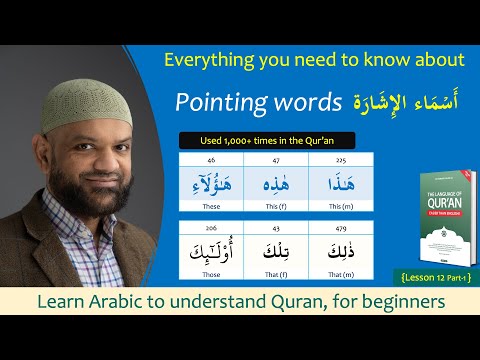 Click to play
Introduction
Having studied the four properties of the ism, the nominal sentence, and the idafah in detail, lesson 12 introduces an entirely new category of noun: the demonstrative (اِسْمُ الْإِشَارَةِ — the noun of pointing). Demonstratives are words used to direct attention to something specific — "this" or "that" in English. In Arabic they are treated as a fully-fledged category of ism with their own gender, number, and grammatical behaviour.
These words matter enormously for Quranic study: the demonstratives for near and far are used more than 1,060 times in the Quran — enough to encounter one or two on nearly every page of the mushaf. Understanding how they work also unlocks the demonstrative phrase (مُرَكَّبٌ إِشَارِيٌّ), a very common Quranic construction that is distinct from both the descriptive phrase and the idafah.
Lesson Notes
Demonstratives Are Always Definite
Demonstrative nouns are permanently definite. When you say "this pen," you are pointing to something specific — a particular pen — so it is by definition definite. This is one of the seven categories of definite nouns introduced in lesson 2. Because they are always definite, they can never take tanween.
The Six You Must Know
Arabic has a full grid of demonstratives — singular, dual, and plural; masculine and feminine; near and far. However, the dual forms are almost entirely absent from the Quran (only one or two instances), and the plurals serve both genders. In practice, only six forms carry significant Quranic frequency:
| Distance | Masculine singular | Feminine singular | Plural (both genders) |
|---|---|---|---|
| Near | هَذَا (225 times) | هَذِهِ (47 times) | هَؤُلَاءِ (46 times) |
| Far | ذَلِكَ (479 times) | تِلْكَ (43 times) | أُولَئِكَ (206 times) |
Demonstratives are mabni — their word ending does NOT change for case (raf`a, nasab, jarr). The grammatical case is determined by the role the demonstrative plays in its sentence, not by any visible change in the word itself. Context is the guide.
Writing and Pronunciation Notes
- هَذَا is written without the final alif in standard Arabic script, but the alif is read — aided in the mushaf by the dagger alif (الأَلِفُ الْخَنْجَرِيَّةُ) written above the ذ.
- The واو in أُولَئِكَ is written but silent — read as أُولَئِكَ not وُولَئِكَ.
- هَذِهِ and هَؤُلَاءِ are read with elongated initial syllables; the mushaf uses special symbols to mark this correctly.
The Demonstrative Phrase (مُرَكَّبٌ إِشَارِيٌّ)
The demonstrative phrase is the structure formed when a demonstrative noun is followed directly by a noun carrying ال. It means "this [noun]" or "that [noun]" — a phrase, not a complete sentence.
For a valid مُرَكَّبٌ إِشَارِيٌّ: 1. It begins with a demonstrative noun (اِسْمُ الْإِشَارَةِ) 2. It is followed immediately by a noun with ال (the مُشَارٌ إِلَيْهِ) 3. Nothing separates them 4. Both parts agree in gender, number, and case WITHOUT ال on the second word, you have a sentence, not a phrase: هَذَا مَسْجِدٌ → "This is a mosque." (jumlah ismiyyah — sentence) هَذَا الْمَسْجِدُ → "this mosque" (murakkab ishaari — phrase)
The مُشَارٌ إِلَيْهِ copies the grammatical case of the demonstrative, just as an adjective copies the case of the noun it describes in a descriptive phrase.
Broken Plurals of Non-Rational Nouns
A key rule from lesson 4 applies directly here: broken plurals (جَمْعُ التَّكْسِيرِ) of non-rational nouns (things that are not human, jinn, or angel) are treated as singular feminine in Arabic grammar. This affects which demonstrative to use.
Broken plurals of non-rational nouns → use هَذِهِ or تِلْكَ (singular feminine) even when the noun refers to many objects. Example: أَبْوَابٌ (doors — broken plural of بَابٌ) → هَذِهِ الْأَبْوَابُ (these doors — treated as sing. fem.) كُتُبٌ (books — broken plural of كِتَابٌ) → هَذِهِ الْكُتُبُ (these books) Broken plurals of RATIONAL nouns (humans, etc.) may use either: → the plural demonstrative (هَؤُلَاءِ / أُولَئِكَ), OR → the singular feminine (هَذِهِ / تِلْكَ) Both are found in the Quran.
The Hidden Detail of ذَلِكَ
The word ذَلِكَ is actually three components fused together: ذَا (the core pointing word) + لِ (indicating distance) + كَ (the pronoun representing the person being addressed). The كَ ending is not fixed — it changes to show whether the speaker is addressing a male, female, two people, or a group:
- ذَلِكَ — addressing one male
- ذَلِكِ — addressing one female
- ذَلِكُمَا — addressing two people
- ذَلِكُمْ — addressing a group of males (or mixed)
- ذَلِكُنَّ — addressing a group of females
This means Arabic encodes in a single word: (1) what is being pointed to, (2) how far away it is, and (3) who is being spoken to. English can only translate all of this as "that." Similarly, كَذَلِكَ (like that / similarly) adds a كَ harf of jarr at the front; since ذَلِكَ is mabni, the harf of jarr does not change its ending.
Summary
- Demonstrative nouns (أَسْمَاءُ الْإِشَارَةِ) are a category of ism that is always definite and always mabni — their endings do not change for case. Grammatical role is determined by context.
- Only six forms carry significant Quranic frequency: هَذَا، هَذِهِ، هَؤُلَاءِ for near; ذَلِكَ، تِلْكَ، أُولَئِكَ for far. These appear over 1,060 times combined in the Quran.
- A demonstrative phrase (مُرَكَّبٌ إِشَارِيٌّ) requires a demonstrative noun followed immediately by a noun with ال, with both agreeing in gender, number, and case. No separation is permitted between the two parts.
- Non-rational broken plurals take the singular feminine demonstrative (هَذِهِ / تِلْكَ). Rational broken plurals may take either the plural or the singular feminine — both usages occur in the Quran.
- ذَلِكَ encodes three pieces of information: the pointing word, the mark of distance, and the pronoun of the person addressed. English renders all of this as simply "that."
Terminology Reference
| Arabic | Transliteration | Meaning | Type |
|---|---|---|---|
| اِسْمُ الْإِشَارَةِ | ismu l-isharah | demonstrative noun (noun used for pointing) | ISM |
| مُشَارٌ إِلَيْهِ | musharun ilayhi | the thing being pointed to — the second part of a demonstrative phrase | ISM |
| هَذَا | haathaa | this (masculine singular — near) | ISM |
| هَذِهِ | haadhihi | this (feminine singular — near) | ISM |
| هَؤُلَاءِ | haa'ulaa'i | these (plural, masculine or feminine — near) | ISM |
| ذَلِكَ | dhaalika | that (masculine singular — far) | ISM |
| تِلْكَ | tilka | that (feminine singular — far) | ISM |
| أُولَئِكَ | ulaa'ika | those (plural, masculine or feminine — far) | ISM |
| مَبْنِيٌّ | mabnii | indeclinable — a word whose ending does not change due to grammatical case | ISM |
| كَذَلِكَ | kadhaaalika | like that / similarly (كَ is a harf of jarr here) | HARF |
Linked Arabic terms open their full entry in the Arabic Grammar Guide.
📖 Grammar guide. Grammar terms are explained in the Arabic Grammar Guide — fully vocalised, searchable in Arabic, any transliteration, or the English meaning.
Lesson Transcript
Read the full transcript (6,368 words)
Auto-generated from the lesson video. Timestamps jump to that point in the video. May contain transcription errors.
0:00 The language of Quran, easier than English. Assalamu alaikum, welcome to lesson number 12. A new topic, this lesson we're going to be discussing the demonstratives. Demonstratives are words that are used to point to something. For example, I say this is a pen when I point to something near and I say that is a mosque or that is a door when I point to something far away from me. So this is how demonstratives are used in the English language.
0:27 Similarly, they're very commonly used in Arabic. And of course, in the Quran, they use more than a thousand times. So demonstrative phrase is something new, which I mentioned to you in the mapping of Arabic session right at the beginning of this course.
0:42 And we will also study the A'rab as well as how they work within the Idhafa phrase, which we've studied previously in lesson number 10 and 11 in some detail. And then we look at the Jumla Ismiya and demonstratives, how they work within the Jumla itself. And we're going to learn something also called the pronouns of separation, how pronouns are used within that structure.
1:08 So a lot to cover in this lesson. So let us begin with the blessed name of Allah, seeking the help of Allah, making dua to Allah Azza wa Jal. Oh my Lord, increase me in knowledge. Review of the map of Arabic. Alhamdulillah, if you recall back to the first session, when I introduced you to the map of the Arabic language, we have already seen in some detail how the nominal sentences work in Arabic. We've also started doing the Muraqqab Tawsifi, which we started off with.
1:42 We've also done the Muraqqab Jari and Muraqqab Idhafi in some detail. And now we're going to be looking at the pointing phrase, which is called the Muraqqab Ishari in Arabic. You can see the big pictures or the big boxes within our map. We are covering very, very, very, very well. Of course, we have done some examples and continue to use them, but they will be covered in detail in book number two. So now, Alhamdulillah, you're getting a very good overview of the structure.
2:10 Now let us focus our attention on Muraqqab Ishari or the pointing phrase. Words like this, that, these, those, they are used in English or they're called in English demonstrative pronouns. In Arabic, they're actually a category of Ism, and therefore the name of them is pointing nouns.
2:32 Asmaa ul-Ishaarati, nouns or the nouns of pointing, meaning you use them to point to something specific. So they are a category of Ism, and of course, we've been introduced to them already when we talked about definiteness, and they're one of the categories of Ism that are always definite. So please remember that.
2:52 And this includes words like this, that, these, those, when we point to a noun. And again, in Arabic, the two terminology you need to remember, Ism ul-Ishaarati, which means a single one. Asmaa ul-Ishaarati, names literally or pointing or a name of pointing. That's the technical terminology for them. And in Arabic, we've covered some of these already. Haatha, when pointed to something near, this.
3:17 And of course, in Arabic, we have masculine and feminine version. So Haatha, this, or Haathi, when we point out to something feminine, both meaning this. When I'm pointing to something far, I say that. So in Arabic, that is Thaalika. And if it's something feminine, I will use Tilka. So these are the differences between the Arabic and the English.
3:40 So again, remember, very important, they are one of the categories of Ism, and therefore they will have the four properties. What we mean by that is definiteness, gender, number, and of course, Arab. These four properties will be there. And as far as definiteness is concerned, they're always definite. Why? Because when I say this pen, I'm pointing to something specific. Again, review back to lesson number two, where we talked about the seven categories of definites.
4:08 And this is one of the main categories of definites, which is pointing words. There are essentially two types of them, one for pointing to something near, just like in English, and one for pointing to something far. So this, that, this, that.
4:26 So that we have two sets of them, one for pointing near and too far. And of course, there are other words like here, there. These are going to also be used for pointing, but these are the ones we're going to be focussing on in this lesson, inshallah. Asma'ul isharati lilqareeb. Demonstratives or near. On the screen, inshallah, you can see very clearly what looks like the Muslim table that we studied in lesson number four.
4:57 So we have here the word hatha. Hatha means this. And then we of course have the word hadihi, which also means this. Now in Arabic, the pointing words are a category of ism. They are a category of ism and therefore they will have the four properties. Since we have two genders in Arabic, we will have a masculine version and a feminine version.
5:21 So please note that masculine and feminine version. So as you recall from lesson number four, when I say a school in Arabic, it is madrasah or madrasatun. Madrasah is feminine. Whereas if I say mosque, masjidun, a mosque is masculine. So when I'm pointing to a mosque, I will say hatha masjidun. This is a mosque.
5:44 When I'm pointing to a school, I will say hadihi madrasatun. So the masculine and feminine, we have to use the correct one when pointing to something masculine or pointing to something feminine. Also in English, we have this for pointing to one, this. But if I'm pointing to two, I will also say in English, these. So these is plural. If I point into three, four, one million, I will still use these.
6:14 So in English, we have this and these. In Arabic, of course, we have also a dual version. And hence, you can see here the singular, the dual, and also we have a plural. So with the demonstrators for nir, a few points that you need to note. One, you will note that whether it is rafa, nasab, or jar, it is the same version for the singular, meaning they are mabni. Again, if you've forgotten this term, please go and look at lesson number six.
6:48 i.e. they do not change their ending, whether they are rafa, nasab, or jar. How will you know whether they are rafa, nasab, or jar? i.e. marfu, mansub, or majroor. You will know them in the context they have been used. So again, remember the terms I used before. Rais. Rol will indicate the a'rab. And of course, the category of ism will show us how it expresses a'rab. So rol, a'rab, and we have category, and we have expression. So rais.
7:18 If you remember that, you will not get confused, inshallah ta'ala. So we have a set here which does not change in the three different cases, or a'rab, and they remain the same. So hatha, hatha, hatha, written separately for you, just to illustrate that point. Duals, on the other hand, they do change their ending, like all duals in Arabic. Again, I mentioned this to you before. So you have the hathani, hathayni, hathayni, similar.
7:47 And then we have for the feminine, hatani, hatayni, hatayni. Then for the plural, the good news, we don't have to learn a separate version. The plural is the same, whether it is masculine or feminine. And this is again, you will see, the same. So it's ha'ulayi and ha'ulayi. Both of them the same. And they're both of them are also, in both cases, they're the same. And please note, they're also mabni, i.e. they do not change, whether they're rafa, nasab, or jarab. They remain the same.
8:21 The good news for you and I, alhamdulillah, the singulars are the most commonly used, 225 times. And then of course, the feminine version, 47. And ha'ulayi, 46. The duals are not used in the Quran at all, except for one occasion, which is hathayni, hathayni. So we have here, the only three words you need to remember, hatha, hathihi, and ha'ulayi. So not that difficult, but these three words you must learn.
8:51 So write them down, make a note of them, inshallah ta'ala. And their translation, hatha, this, for pointing to something masculine. Hathihi, to point to something feminine. Ha'ulayi, pointing to something feminine, plural. Or pointing to something masculine, plural. This is all you need to know. And inshallah ta'ala, this is why this table is very, very helpful. You have the full set of the pointing words for something near. Please note, pointing to something near.
9:21 A few points about how Arabic is written. Now of course, as you know, in modern standard Arabic, or any Arabic text outside the Quran, they don't really write any vowels. So hatha, in most cases, would be written like so. Sometimes you will see some books with vowels on them. So it is read, written like this, so, hatha. But it should be read as hatha, as if there's an alif afterwards.
9:48 But this alif is never written. So the reading of the, in the Quranic script, to make it easy for you, this alif, which I've spoken about before, in the introductory sessions, this one here, which is called the dagger alif, or in the Indian subcontinent, khara, zabar. So this means standing, zabar.
10:08 So hatha, this. So it is read hatha, but is always written in normal Arabic, as you can see here, in Quranic script, to make it easier for those who don't know that this is how it should be read. But again, please note, standard Arabic, this symbol is not used. And it is used to help us read it correctly. So hatha, this, hatha, this. Please note, make a note of that in reading, as well as, of course, in writing, the differences between the way.
10:42 It should be, please note, it is never written like so. I've only put it there for illustration purposes. So make a note of that. Inshallah, when you write for practising learning, you can write like so, or like so. But knowing how to read it correctly is very, very important. Also, the same thing with haa, the hee.
11:03 Haa, the hee, again, is read with an elongated haa. And this also is read elongated. Again, there are symbols available in the Quranic script to make sure that we do not read it incorrectly. So it's haa, the hee, this, which is feminine. Haa, ulaa, is also similar. We have a symbol after the haa, haa, ulaa, ee.
11:25 And again, you can see the elongation there to make it very, very clear for you. And of course, this needs to be extra elongated when you're reading the Quranic text. So these are the writing rules for specific to the Quran. And again, note them down, inshallah ta'ala, as you go through the lessons. And of course, when you see them written in the Quranic script. So summary, these are the three that you need to learn.
11:50 Haa, the hee, and haa, ulaa, ee. Please note their writing and their pronunciation for the sake of practise. So these three are the most important for us. Asma'ul isharati lil ba'eed. Demonstratives for pointing to far. The next table is exactly the same as the one we've seen for near. This is for far. So thalika is used for pointing to something masculine, far away. So for example, if the mosque is far away, I say, thalika masjidun, thalika masjidun.
12:26 If the school is far away, I'm pointing to it, I say, tilka madrasatun, tilka madrasatun. Again, we have the dual version. Dual version, as you can see here, thanika, thaynika, thaynika, thaynika, thaynika, thaynika. Again, the dual is not used in the Quran extensively. Only one I could find, which is for thanika, and the others are not used. Similarly, ulaika is also used for masculine and feminine.
12:55 Okay, so it's used for masculine and feminine. There is no difference. And they are singular and the plural, like the ones we've seen before, are mabni. i.e. whether it is in the rafa, nasab or jar, there will be no change to the ending. These are 2% of rare words where there is no change in whichever a'rab, the noun or the ism, pointing noun is used. And of course, again, a reminder of what I said earlier, if you remember rice, you will not get confused.
13:28 Role will indicate the a'rab, and the category will indicate how it expresses a'rab. So in this case, because they're mabni, there will be no change. We have to look at the role to identify the a'rab. So again, that is showing you the numbers. And thalika is used 479 times in the Quran. Tilka is used 43 times.
13:50 And ulaika is used 206 times. Just to show you, just from the first page of the Quran, how frequently these are used, you can see them being used in the beginning of Surah Al-Baqarah. I've taken up to ayah number 5. Just to give you an example, you see thalika there, which I've enlarged for you just to show you how they're written. And ulaika, please note the waw here is not read. So it's ulaika, not ulaika. So again, when reading, ulaika.
14:21 Please note those points, inshallah ta'ala. Thalika, ulaika, very commonly used. And as I mentioned so many times to you, there are roughly 600 pages in the mushaf, the printed copy of the Quran. And if something is used more than a thousand times, you'll find one or two in every page. So the demonstratives both for near and far are used around 1060 times in the Quran. So very, very important set of words to learn.
14:47 And in reality, we only have to learn six of them. Okay, six, not an endless list of the whole set. The six of them inshallah, three for near and three for far. So in conclusion, here are the two sets of pointing words. One's for pointing to near, one's for pointing to far. In both of them, please note that the singular and the plural are mabni.
15:12 They do not change their word ending due to irab. They remain the same. Again, you'll find what they are based upon context. And then we have singular, dual and plural. The dual is changing, but they're very rarely used in the Quran. So you don't really need to memorise them. All duals in Arabic will follow the similar ending, ayni, ani, ayni, ayni, etc. So you can see that alhamdulillah demonstrated there. Please note the plural is used for both for masculine and feminine.
15:43 And these are the details that you need to remember. So these are your demonstratives, only six of them you need. And they've been used in the Quran more than a thousand times. Amazing Arabic. There is so much detail in some Arabic words. In fact, it is almost impossible to translate them into any other language, be it English.
16:06 There are very few languages that have so much depth, far as I know. Now we have words here, which you can see they look identical, but there is a change in the ending. They are all translated in English as that. So I have no choice. There is no other option in English to translate them in any other way. All of them will be translated as that.
16:36 Whether I say that, So what is going on? What is the difference? There must be a difference. So what is the difference between them? And this is to do with the detail of the words. Now take a look at these two examples. Both I'm going to translate as that. Both are used in the Quran. So the word you see, this word is actually a combination of three words, three separate words, which have come together to form this word.
17:11 So that is the actual word which we use to point to something in Arabic. Li, on the other hand, it tells me I'm talking about something far away. That is the word for distant, pointing to something distant. Ka is the person I'm speaking to. Remember the pronouns we learned before? We did Of course, This attached pronoun Ka is for you masculine. So imagine I'm talking to you, one male person, one brother, and I'm pointing to something.
18:01 So I'm talking to you, I will say, So I'm talking to you, Ka, that Ka represents you, the person I'm speaking to. Very, very important. On the other hand, if I'm speaking to a sister, instead of saying, I would say, The key here is to demonstrate feminine. So again, second person, feminine. So how will you translate that in English? You cannot, right? So that is also that. But in one case, the reader knows I'm speaking to a male person.
18:37 And the other case, I'm speaking to a female person while pointing. So if I point to a house, and I'm talking to my son, I would say, If I'm talking to my daughter, I would say, Even though I'm pointing to the house, the house itself is masculine. So therefore I use the Li.
18:55 But the Ka and the Ki bit represents whether I'm speaking to a male person or a female person. Such detail, as I said, is not to be found in the English translation. So again, let's look at these. And these are all from the Quran. I've given you the rough number of times they occur. And with some brief notes there for you. So that is the demonstrated pointing word. Li represents something distance. And the Ka, Kuma, Kum, Kuna represents the pronoun.
19:23 So let's look at the first example. Which is used five times in the Quran, simply means that. But that, while I'm speaking to a male person, and that is used predominantly in the Quran, 305 times. Then when I say, I'm talking to a female person. And that's been used three times in the Quran. And then we have, I'm talking to two of you, male or female to two of you.
19:52 So when I'm talking to two of you, I'm saying, Even though I'm pointing to the Masjid, which is singular. That mosque, two of you are asking me, I say that mosque. Again, we have, And again, that's been used in the Quran 46 times.
20:10 Many, many times you and those who read regularly in the Quran, I'm sure become familiar with these words. So, I'm talking to three or more of you, pointing to something which is masculine and singular. And again, when I'm speaking to a group of sisters, three or more, I will use again the same pointing word, but I will change the ending to indicate that I'm talking to or conversing with three or more female.
20:40 And this is the beauty and the detail, which is often lost in the translation, inshallah. So again, these are advanced stuff, but I'm sharing it with you now. So you can tell the differences between them, because you are going to find them in the Quran.
20:52 And when you look into the ayat where they're mentioned, you will see who's being spoken to. And that, if we look at the translation, you'll see that detail, of course, in the tafsir and other commentary, you'll find them, but that detail is lost. So it's one of the advantages of learning Arabic grammar that you get to see some detail, which is often lost in the translation, because the translator's main aim is to deliver the message that they understand from the ayah for our benefit.
21:18 May Allah reward them all. But you can see here how difficult that would be to translate it into English. Similarly, with tilka, the same thing happens. Tilka, again, when I'm pointing to something feminine, I'm pointing to something feminine, but I'm talking to a male person. So tilka, I'm talking to a male person, I say tilka madrasatun. Even though I'm speaking to a male person, the thing I'm pointing to is female, I have to use tilka.
21:47 And then we have, of course, tilkuma, which is again the same thing, I'm pointing to something feminine, I'm talking to two persons. And then, of course, we have tilkum, I'm talking to a group of you, group of you, plural, so I'm using tilkum, once used in the Qur'an. Ulaika is very commonly used in the Qur'an, 204 times.
22:08 And ulaikum, again, you can guess from here, I'm talking to a group of people and pointing to something fa, which is masculine and plural, or feminine and plural. So the group that I'm talking to, represented by kum. Please note those points, inshallah. And if you see the differences, now you know the details why the ending is different. There's another word, kathalika, which is again similar to zalika, but ka in the front. Remember this ka is a harf of jar.
22:39 So the translation of it is like that, kathalika, kathalika. Ka, harf of jar, and then, of course, after that, zalika is coming, and zalika is mabni, it will not change because of i'arab. So again, it will be the same. Otherwise, it is jar. Why? Because of the ka, ka is a harf of jar, as you've studied back in lesson number 8 and 9 in some detail, alhamdulillah. So kathaliki, again, when I'm talking to a sister, I want to say like that.
23:12 And of course, kathalikum, when I'm talking to a group of people. So please note that, some more additional detail, which you will not see within the rough translations that we will make or we will read ourselves. So some details there, alhamdulillah, for our benefit.
23:30 So kathalika, exactly the same, but the meaning will be something similar to like that. And the ka, ki and the kum endings are there to represent the person I'm speaking to while pointing to or referring to something using the word like that. So again, brothers and sisters, please note this very, very important additional note, which I hope inshallah, you're all finding beneficial. Zalika, three parts. Zalikum, three parts. The difference between ka and the kum is the person I'm speaking to while pointing.
24:05 So the ka is one male person. Kum is three or more group of people while I'm pointing to something far away that is masculine. And that's how amazing the language is and how much amazing details there are within the words. And this is just one very beautiful illustrative examples. Though, as I said, this is studied in more advanced details, lessons, I wanted to share it with you. And I hope inshallah, you'll find this beneficial.
24:31 The demonstrative phrase, Muraqab Ishaari. What is the demonstrative phrase? Now, we've used other phrases. We will use the Harf of Ism Majroor. We've done Mudaah, Mudaah ilayhi. But this is also a very important phrase. And a phrase, remember I said, is always different from a sentence where a sentence gives us a complete meaning. A phrase gives us a partial meaning. Meaningful, valuable, but it's partial. It's not complete. So this is a mosque. This is a mosque in Arabic is Haaza Masjidun. This should be very easy.
25:07 It's a normal Jumla Ismiya. And of course we have the Muqtada is definite and Rafa, which you can see very well here, marked with an arrow pointing up. And the Khabar is indefinite and Rafa. So this is a sentence. But how do I say, instead of this is a mosque, I want to say this mosque, the one in front of us, this mosque is new. Or this mosque is very old.
25:35 Or this mosque was built by so and so, so many hundred years ago. Or hundreds of years ago. So how do I say this mosque as opposed to this is a mosque? So again, this one is very easy. Muqtada and Khabar. And that is giving us our Jumla Ismiya. But I want a phrase instead.
25:54 So what I want to say is this mosque. Not this is a mosque. The way to do that in Arabic is to use the pointing word for close, because I want to point to something close. This which is Haatha. And then put the Masjid as a definite with Al. Please note is very important has to have Al in order to be a demonstrative phrase.
26:16 So again, we see that this is now definite, of course. And it is Rafa because of the context that we see it in. And we will say that Al is definite, meaning the word Masjid is indefinite, but Al has made it definite. So Mu'arraf Billam. This is technical. So Haathal Masjidu. And the Masjidu is Rafa because it is copying the Arab of this. Remember the descriptive phrase copied. The same thing is happening here.
26:52 So we have here our Ismul Ishaara. The noun of pointing. And this is called Mushaaron Ilaihi. Literally means something being pointed to. That which is pointed to. So Murakab Ishaari. The pointing phrase. This is probably the easiest way to remember it. Pointing phrase or demonstrative phrase. Murakab Ishaari. So please note for something to be Murakab Ishaari. It has to have an Ismul Ishaara there at the beginning. Followed by a Ism with Al. It doesn't work if it's anything else. So if I said Haatha Haamidun.
27:28 Haamidun is of course definite because it is a proper noun. This will not be a demonstrative phrase. Demonstrative phrase only when we have Haatha, the pointing word at the beginning. Followed by a word that has been made definite with Al. So this is very very important for you to know the basic rule of Murakab Ishaari. So again just as a different example here.
27:52 Haathal Waladu is Ismul Ishaara Mushaaron Ilaihi or the thing that has been pointed to and it is beginning with an Al after demonstrative. This is your sign that is to be translated not as a sentence but as a phrase. But whereas I've got here Haatha Waladun. This is a boy which is of course a sentence. So the Murakab Ishaari has two parts. The first part is the noun being used to point.
28:21 So that can be singular, dual, plural depending on what you want to say and it can be for distance or far. It does not really matter but it has to have a Ism of pointing. So Ismul Ishaara and the Mushaaron Ilaihi that is which been pointed to and of course that needs to be the Mushaaron Ilaihi must have Al.
28:43 Please note that. If it hasn't got Al it will be something else and we'll talk about that a little bit soon. But for now note Haatha followed by something with Al. Haathihi followed by something with Al. Haoolaai followed by something with Al. Dhaalika followed by something with Al. Oolaika followed by something with Al. So the two parts agree in the four properties. So whatever the properties of this is this will agree.
29:09 So masculine, masculine, feminine, feminine, singular, singular, plural, plural etc. And of course the Arab will be copied depending on the role that Haatha is playing in that structure. Again that's all you need to remember InshaAllah Ta'ala and Mushaaron Ilaihi comes after the Ismul Ishaara. No separation, nothing can come in between. So they have to be together. These are the few points and now InshaAllah you're ready to master every single Murakkab Ishaari that you see.
29:38 So note this down in your notebook. InshaAllah the basic rules of forming Murakkab Ishaari. Back to our exercise Alhamdulillah. I hope you can do this yourself. You don't need me. So pause the video. You know what to do. InshaAllah translate the following into Arabic. This boy. These boys. I want dual. Then these boys. This girl. These two girls. Feminine dual. And these girls. I've given you the singular and the plural. Dual I'm sure you can work out by now.
30:15 So Waladun, Auladun. Bintun, Banatun. Pause the video. Have a go InshaAllah. See how you get on. Alhamdulillah. I hope you've done the exercise. Let's continue with the answer. Okay. I will say this boy. So what will it be? Remember has to have Al. Then for the dual I have Two boys. These two boys. These two boys. And for these the word is Because it's plural. Aulad is singular. Sorry plural. Indefinite and Al will make it definite.
31:10 This is the bit that you need to get. This girl has to be And of course the dual. Which you can see there. Feminine, plural. These girls. Don't worry if you got them wrong. Rewrite them down again InshaAllah. If you got them right Alhamdulillah. Well done. Either way practise is the only way to learn. So you can see here the basic pointing words I've mentioned before. The pointing word and the word that you're pointing to will match in gender, in number, in Arab.
31:48 And of course the noun that you're pointing to must have Al. And prior to that you will have the noun of pointing. No separation allowed in between. Now if you're pointing to something which is a broken plural. Remember what I said about broken plurals? Okay example. Broken plurals which are non-aqil. How are they treated? Have a go. I've given you the singular and the broken plural for both words. Baab means door. And abwaab doors. Daar means house. Diyaar means house.
32:27 But remember daar is feminine. Again go back if you've forgotten the lesson. These are one of the miscellaneous set of words that are feminine. Have a go. Pause the video. You know what to do. So this door in Arabic will be haathal baabu. These doors will be haathihil abwaabu. Again why? Because broken plurals in Arabic are treated singular feminine. So both of them are masculine words. But here I'm treating this one as if it is feminine and singular. Of course I'm pointing to something close.
33:11 Then we have haathihil daaru. This house. Why haathihil? Because this is actually feminine. This word is masculine. I forgot to mention. Okay and then we also have haathihil daaru. Again this is singular feminine. Even though this is feminine and of course it's plural. But in Arabic it is used as if it is singular feminine. So please note this. Inshallah ta'ala you'll see it in the Quran. And therefore it's important point to note. Now easy one for you for distant. Distant. Okay that.
33:50 You'd remember what the word for that is. And those. And for the feminine. So please complete the six. Should be relatively easy inshallah. Let's quickly go through the answers. First we have. That Muslim. And then we have of course. Again. Hopefully inshallah I'm making dua. That you're finding this relatively easy. Don't worry if you're not. Do it couple of times. Until the rules sink in inshallah. And then the same thing. This time. These are your four vocabulary. With this remember we're dealing with broken. Plural. Non-rational.
35:02 So they by default. They'll be treated as singular feminine. Have a go. So the answers are. That school. And then of course we have. I hope this inshallah ta'ala makes sense. And you've got them right. Again do rewrite them down in your notes. Otherwise you'll just listen. And after an hour or so. You'll forget what you have seen. So do write them down in your notebooks inshallah. Now when it comes to broken plural of rational being. There is a rule in Arabic.
35:46 Where both can be used. So let me go through them. Okay men. Then I would say these men. I can also use. So for example. Or I can say. Both is done. So broken plural of rational. You have the choice. Of either treating it as it is. Or treating it as if it is singular feminine. It's a bit weird. But inshallah you'll get used to the rule. So. The messengers. The messengers. Again this is from the Quran.
36:25 Those messengers. Both examples are there inshallah. And is in use. So rajulun singular. Rijalun plural. But it's a broken plural. Not una, ina ending. Therefore it is also a'aqil. Meaning an intelligent being. Rational being. That is angels, jinns and humans. Therefore in that case we have the choice. Both are used in Arabic. And inshallah when you see them. You should be able to recognise. As you'll note all of them have al afterwards. And there is a pointing word before. With nothing in between.
36:58 So that's the basic rule. And the noun being pointed to the ism. Will copy the four properties of the word. That is used for pointing. Alhamdulillah this is the end of part one. Of the video for lesson 12. I'm going to do another one. To continue the topics that are listed. That we have not covered so far. So alhamdulillah we looked at the demonstrators. For near and far. As I said you only need to learn six of them.
37:23 They're not difficult. And of course how to form the muraqab ishari. You should now be very familiar with that. The basic rules. Again review them. Make sure you've written the exercises down. And if you have to watch the video pause. And write them down inshallah. Make sure you keep a notebook with you. Or the key points. Remember what I've done in this course. I've always tried. Is to remove the unnecessary. Only keep that which absolutely essential. For you to learn.
37:48 And so that you can start practising it. Inshallah ta'ala through practise. You'll remember all the basic rules. I hope and pray inshallah. That you found this video very very useful. May Allah bless you for watching. May Allah reward you immensely for your time. And your effort that you're spending. In learning Arabic to understand Qur'an. May Allah subhanahu wa ta'ala. Make our journey of learning easy. And may the Qur'an be a blessing for us in this dunya.
38:11 And may it be an intercession for us in the akhira. Until the next lesson. Asalaamu alaikum warahmatullahi wabarakatuhu.
Test Yourself
After every lesson it is essential to test what you have learnt. We are working hard to produce the full set of resources for every lesson — thank you for your patience.
If you would like to support the production of content and the running of this site, you can do so on our support page.
Updated