
Harf of Jarr — Introduction and the Preposition Min
Murakkab Jarri · Harf of Jarr · Attached pronouns · Min with all noun types
- Define the murakkab jarri (prepositional phrase) and identify its two components — harf of jarr and ism majruur
- Know that there are 17 haroof of jarr in Arabic, 11 of which are used in the Quran
- Apply the rule that any ism following a harf of jarr is always majruur — with no exception
- Form the murakkab jarri with munsarif, ghayru munsarif, mabni, dual, and plural nouns correctly
- Distinguish detached pronouns (always raf') from attached pronouns (nasb or jarr) and know when to use each
- Attach all 14 attached pronouns to the preposition مِنْ and produce the correct forms (minhuu, minhaa, minka, etc.)
Video Lesson
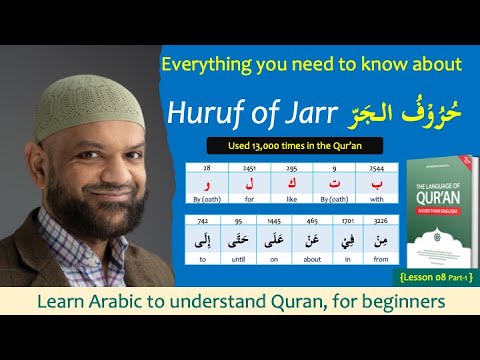 Click to play
Introduction
All the grammatical theory from Lessons 1 to 7 now meets its most practical application: the prepositional phrase (مُرَكَّبٌ جَرِّيٌّ). This single construct — a preposition followed by a noun in jarr — appears in the Quran approximately 13,000 times. That means you will encounter at least one on every single line of the standard Mus-haf (which has 600 pages, 15 lines per page — approximately 9,000 lines).
Lessons 8 and 9 are therefore among the most high-impact lessons in the entire course. After mastering them, you will be able to recognise something on every line of the Quran. This lesson covers all the theory of how the murakkab jarri works, works through the preposition مِنْ in exhaustive detail with every type of noun, and introduces a critical new element: attached pronouns — the second set of pronouns you need alongside the 14 detached pronouns studied in Lesson 5.
Lesson Notes
What is a murakkab jarri?
A murakkab jarri consists of exactly two elements, always adjacent:
حَرْفُ الْجَرِّ + اِسْمٌ مَجْرُورٌ = مُرَكَّبٌ جَرِّيٌّ (preposition) (noun in jarr) (prepositional phrase) Nothing may come between these two elements. The ism after a harf of jarr is ALWAYS in jarr — no exceptions.
Examples:
- سَلَّمْتُ عَلَى إِمَامٍ — I gave salam to an imam
- سَلَّمْتُ عَلَى الْإِمَامِ — I gave salam to the imam
The prepositional phrase (عَلَى إِمَامٍ / عَلَى الْإِمَامِ) is the murakkab jarri. It does not make a complete sentence on its own — it is a phrase (مُرَكَّب), a building block.
The 17 haroof of jarr — 11 used in the Quran
There are 17 haroof of jarr in Arabic. Only the 11 highlighted below appear in the Quran:
| Harf | Meaning | Used in Quran |
|---|---|---|
| مِنْ | from | yes — 3,226 times |
| إِلَى | to, towards | yes |
| عَنْ | from, away from | yes |
| عَلَى | on, upon | yes |
| فِي | in | yes |
| بِـ | by, with | yes |
| لِـ | for, to | yes |
| كَـ | like, as | yes |
| وَ (oath) | by (oath) | yes |
| تَـ (oath) | by (oath) | yes |
| حَتَّى | until | yes |
| رُبَّ | sometimes/many a | rare (literature/hadith) |
| حَاشَا | except | literature |
| مُذْ / مُنْذُ | since | literature |
| خَلَا / عَدَا | except | literature |
For this course, focus on the 11 Quranic ones. Lessons 8 and 9 work through each of them in turn.
A phonetic note on مِنْ
When مِنْ comes before a word beginning with a sukoon (i.e. with الـ), two sukoons meet and the rule of Arabic phonetics requires a helping vowel:
مِنْ + الْبَيْتِ → مِنَ الْبَيْتِ (fatha added to mim to avoid two sukoons meeting)
The word is still مِنْ — the fatha is just a phonetic helping vowel. Do not treat it as a separate word.
Forming the murakkab jarri — practice with all noun types
This table shows how مِنْ is used with every major category of ism:
Munsarif (fully declining):
| Type | With مِنْ | Translation |
|---|---|---|
| Indefinite masculine | مِنْ حَامِدٍ | from Hamid |
| Indefinite noun | مِنْ مُؤْمِنٍ | from a believer |
| Definite with الـ | مِنَ الْمُعَلِّمَاتِ | from the teachers (f.) |
| Broken plural | مِنْ كُتُبٍ | from books |
Ghayru munsarif (partly declining — no kasra in jarr):
| Type | With مِنْ | Note |
|---|---|---|
| Prophet's name | مِنْ إِبْرَاهِيمَ | fatha in jarr (NOT kasra) |
| Female name | مِنْ خَدِيجَةَ | fatha in jarr |
| Broken plural | مِنْ مَسَاجِدَ | fatha in jarr |
| Same + الـ | مِنَ الْمَسَاجِدِ | kasra returns with الـ |
Mabni (non-declining — ending does not change):
| Word | With مِنْ | Translation |
|---|---|---|
| مُوسَى | مِنْ مُوسَى | from Musa |
| هَذَا | مِنْ هَذَا | from this |
| الَّذِينَ | مِنَ الَّذِينَ | from those who |
Dual:
| Type | With مِنْ | Note |
|---|---|---|
| مُؤْمِنَانِ (raf') | مِنْ مُؤْمِنَيْنِ | dual changes to ayni in jarr |
| طَالِبَتَانِ (f. dual, raf') | مِنْ طَالِبَتَيْنِ | same rule |
| الْكِتَابَانِ (def. dual) | مِنَ الْكِتَابَيْنِ | tanween gone, ayni remains |
Sound masculine plural:
| Type | With مِنْ | Note |
|---|---|---|
| مُؤْمِنُونَ (raf') | مِنْ مُؤْمِنِينَ | una → ina |
| مُشْرِكُونَ (raf') | مِنَ الْمُشْرِكِينَ | same |
Sound feminine plural:
| Type | With مِنْ | Note |
|---|---|---|
| آيَاتٌ (raf') | مِنْ آيَاتٍ | atun → atin |
| الْمُؤْمِنَاتُ (def.) | مِنَ الْمُؤْمِنَاتِ | tanween replaced by kasra after الـ |
Attached pronouns — the second pronoun set
Detached pronouns (Lesson 5) — هُوَ، هِيَ، أَنْتَ etc. — are always in raf'. They cannot follow a harf of jarr. To say "from him," you cannot say مِنْ هُوَ — that is wrong in Arabic.
Instead, Arabic uses attached pronouns (الضَّمَائِرُ الْمُتَّصِلَة):
Attached pronouns: - Are ALWAYS written as a suffix — never standalone - Can be nasb or jarr — NEVER raf' - Are always definite - When attached to a harf of jarr, they are always majruur
The 14 attached pronouns — arranged by person, number, and gender:
| Person | Detached | Attached |
|---|---|---|
| 3rd m. sg. | هُوَ | ـهُ |
| 3rd m. dual | هُمَا | ـهُمَا |
| 3rd m. pl. | هُمْ | ـهُمْ |
| 3rd f. sg. | هِيَ | ـهَا |
| 3rd f. dual | هُمَا | ـهُمَا |
| 3rd f. pl. | هُنَّ | ـهُنَّ |
| 2nd m. sg. | أَنْتَ | ـكَ |
| 2nd m. dual | أَنْتُمَا | ـكُمَا |
| 2nd m. pl. | أَنْتُمْ | ـكُمْ |
| 2nd f. sg. | أَنْتِ | ـكِ |
| 2nd f. dual | أَنْتُمَا | ـكُمَا |
| 2nd f. pl. | أَنْتُنَّ | ـكُنَّ |
| 1st sg. | أَنَا | ـنِي |
| 1st pl. | نَحْنُ | ـنَا |
Attached pronouns with مِنْ — the full template
Memorise these in cycles of three. They are used ~9,000 times in the Quran:
مِنْهُ — from him مِنْهُمَا — from them two (m.) مِنْهُمْ — from them (m. pl.) مِنْهَا — from her / from it (f.) مِنْهُمَا — from them two (f.) مِنْهُنَّ — from them (f. pl.) مِنْكَ — from you (m. sg.) مِنْكُمَا — from you two مِنْكُمْ — from you all (m. pl.) مِنْكِ — from you (f. sg.) مِنْكُمَا — from you two (f.) مِنْكُنَّ — from you all (f. pl.) مِنِّي — from me مِنَّا — from us
Practice tip: Recite these in groups of three, three times a day (after Fajr, Dhuhr, and Maghrib for example), then write them once. A few days of this and they will be memorised permanently.
Summary
- The murakkab jarri consists of a harf of jarr immediately followed by an ism majruur. Nothing may come between them. The ism is always in jarr — no exceptions.
- There are 17 haroof of jarr; 11 are used in the Quran. Mastering them unlocks recognition of something on every line of the Quran.
- مِنْ (from) is the most common harf of jarr in the Quran, appearing 3,226 times. When followed by a word beginning with الـ, mim takes a fatha helping vowel: مِنَ الـ.
- Every category of ism behaves in jarr according to its own rule — munsarif takes kasra, ghayru munsarif takes fatha, mabni does not change, duals use ayni, sound plurals use iina/aatin.
- Detached pronouns (هُوَ etc.) are always raf' and can never follow a harf of jarr. Use attached pronouns (مِنْهُ، مِنْهَا etc.) instead.
- Attached pronouns are always written as a suffix, always definite, and when attached to a harf of jarr are always majruur. Memorise the مِنْ table as the master template.
Terminology Reference
| Arabic | Transliteration | Meaning | Type |
|---|---|---|---|
| حَرْفُ الْجَرِّ | harf al-jarr | a preposition that forces the following noun into the jarr case | particle (حرف) |
| مُرَكَّبٌ جَرِّيٌّ | murakkab jarrii | prepositional phrase — a harf of jarr plus the ism majruur that follows it | grammar term |
| اِسْمٌ مَجْرُورٌ | ism majruur | a noun in the jarr (genitive) case — the noun that comes after a harf of jarr | grammar term |
| مِنْ | min | from — the most frequently used harf of jarr in the Quran (3,226 times) | particle (حرف) |
| ضَمِيرٌ مُتَّصِلٌ | damiir muttasil | attached pronoun — a pronoun written as a suffix; can be nasb or jarr, never raf' | grammar term |
| ضَمِيرٌ مُنْفَصِلٌ | damiir munfasil | detached pronoun — a standalone pronoun (e.g. هُوَ); always raf', never used after a harf of jarr | grammar term |
| عَلَى | 'alaa | on, upon — a harf of jarr used in many examples throughout L07 | particle (حرف) |
Linked Arabic terms open their full entry in the Arabic Grammar Guide.
📖 Grammar guide. Grammar terms are explained in the Arabic Grammar Guide — fully vocalised, searchable in Arabic, any transliteration, or the English meaning.
Lesson Transcript
Read the full transcript (4,970 words)
Auto-generated from the lesson video. Timestamps jump to that point in the video. May contain transcription errors.
0:00 the language of quran easier than english lesson eight assalamu alaikum and welcome to lesson number eight alhamdulillah all the theory that we have been learning so far from lesson number one all the way to the previous lesson lesson number seven we are going to see now the practical implementation in particular of the irab of in particular of jarb now there are certain particles huroof in arabic that force the ism that come after it to be majroor or in jarb and they are called huroof of jarb
and there are 17 of them in the language 11 of them are used in the quran they plus the ism that comes after they form what's called the muraqab jari and this is what we're going to learn so these two lessons lesson number eight and nine are all about everything that you need to know to understand the muraqab that are used in the quran so inshallah in lesson number eight we are going to deal with the first five and in lesson number nine we're going to
do and they form the muraqab jari which i mentioned many times to you before are used in the quran around 13 000 times that means you will see at least one of them in every line of quran along with that they also attach two pronouns and this is something new completely for us so far we've been dealing with the detached pronouns now inshallah from this lesson onwards we're going to start looking at attached pronouns so let's begin with the blessed name of allah and making the
dua make it easy and not difficult and help me complete this task with goodness in the first introductory session i introduced you to the mapping of arabic and here we mapped out the key learning elements or the key milestones we're going to see in our journey alhamdulillah so far we have been looking at some detail at the ism one of the three types of words of course i did mention verbs we've done only few examples but we'll be dealing with them in detail in book two
here we're going to introduce now for the first set of huruf or harf which is a particle these are very short words now these combined together make our constructs and alhamdulillah so far you are familiar with the basic rules of jumla ismia which is called a nominal sentence begins with an ism and has two parts muqtada and khabar also alhamdulillah we have already started looking at the the descriptive phrase from lesson number two and from lesson number one we started looking at the sentences as well
anyhow the other phrases that are remaining we are picking the most important one up which is now the muraqab jari that is going to be used in the quran around 12 13 000 times and inshallah all of them we will pick up throughout the lessons that are forthcoming so we're making very very good progress in our milestones inshallah taala keep a note of this map it will help you inshallah plan your study journey so what is a prepositional muraqab jari we've already used this sentence before
if you recall salam to ala imam which means i gave salam to an imam or salam to ala imami i gave salam to the imam and i mentioned to you many many times that whenever an ism comes after a word like ala it changes the arab of that word to jar and i hope inshallah taala by now i do not need to explain those two points to you so the half of jar which is ala one of them it converts the ism into jar or makes
it become majroor and which you can see in the two examples so these two sentences you are familiar with so this part of the construct in arabic this part uh grammatically speaking is called your muraqab jari and if you again remember what i mentioned about the in the mapping that two or more words that come together to give us some meaning though the meaning is not complete a sentence i.e not a sentence it can be called a phrase so this is your muraqab jari i.e a
construct made of uh half of jar and ism majroor that follows afterwards and this is what is meant by muraqab jari so you've seen some of them now let's take a look at the details of how they work so the prepositional phrase is very very commonly used in the quran not only that in hadith or in any arabic literature you will find them just like in english words like on or in about these kinds of words are very common in the language and find them in
any book thousands and thousands of times they're used and they're very very powerful what do they do they link things together they even change the meaning of verbs so they're very very powerful very very important in sentences so these are in arabic one set of particles we're looking at and these are special and there are 17 of them in the language and they are now only the highlighted ones have been used in the quran some of them are very rare of course you will find them
in literature in hadith and so on but in the quran we've we will only find the highlighted 11 the highlighted 11 so we're going to start with min which is the most commonly used word in the quran almost as you can see here 3226 times used in the quran so we're going to use that one to learn and then we will look at all of them that are used in the quran in some detail so only note 11 of them we need to learn and inshallah
you'll them very very easy especially if you've done the previous lessons this lesson should be very very easy for you as it is a revision of most of the things that we have learned the only thing we're going to now master is how to put an ism into jar or how to how to make it majroor so take an example here i have two words min baytin so you can see min here and baytin now min is your harf jar harf of jar and baytin was
called your ism majroor the ism that is in jar that's all it literally it means and these two combined together make our muraqab jari so when i say muraqab jari i mean these two things combined together it's very important to note the following point there is nothing allowed to come in between these two so they'll always be next to each other min and the ism that comes after or any of the harf whatever it is it will be and the ism will be next to it
so they're always together and it is these two coming together they will make your muraqab jari so please note that a very important point and the ism after that will always be always always be jar there is no exception to this so whenever harf of jar comes the ism after will be majroor or in jar status so in the first example we have from a house and now the second example we have from the house the of course has al al has taken away the tanween
so we end up with a single haraka and then we have min and of course harf of jar and then we have our ism majroor coming after combined together they make our muraqab jari now what is important here to note is that min is now changed min is now changed to what we have here on the screen you can see from a sukoon to a fatha why because of the meeting of two sukoons in arabic when two sukoons meet you cannot read so in order to
help that we have the additional helping vowel so from min it becomes mina so exactly the same word please don't worry about it it is for phonetic reasons so min al baiti from the house both of them are muraqab jari now with muraqab jari it doesn't matter what the ism is it could be definite indefinite masculine feminine singular dual plural but it is arab has to be jar that is the most important point for you to note so that is in a summary all that you
need to know about muraqab jari now we're going to look at that with detailed examples the word for allah can be in three different arab as we can see rafa nasab and jar allahu allaha allahi you can see all three there on the screen when min comes in front it will be min and then the word allahu now of course it is rafa it needs to be converted to it will become min allahi of course you know now why the fatha is there it is to
help to read because the meeting of two sukoons so min allahi used used in the quran 85 times so even that simple construct that we just learned now it has been used in the quran 85 times 85 times so min allahi making a note of this one inshallah and it is again a very simple way of illustrating the muraqab jari on the screen now you have examples of words before it is min i put them all in rafa so you have hamidun mu'minun al muallimatu and
kutubun as you will know from now alhamdulillah you should be able to recognise which one is a broken plural which one is feminine which one is definite which one is indefinite etc etc but now what i'd like you to do is put them with min to get the translation which you can see in the box here so i want you to say from hamid from a believer from the teachers bracket feminine and of course from books so you can see all of them on the screen
i'd like you to pause the video and complete the task before continuing i hope you have done it let's go through the answers min and after the way of it has to be jar so it becomes min hamidun i hope you got that answer right it is very easy i hope inshallah mu'minun means a believer from a believer will be min mu'minin min mu'minin and then we have al muallimatu al muallimatu min al muallimati min al muallimati kutubun broken plural put min in front from books
min kutubin min kutubin i hope this is easy and i hope now inshallah you can see why i took you through that journey where i wanted you to understand how different categories of ism they express their arab again go back and look at the example of rice roll arab and then we have category the type of ism it is and how it expresses this so here you can see all of them they are in jar with either two fathas two kasra sorry or a single kasra
which you can see here inshallah next set i have here in front of you is so translation from ibrahim from khadija from mosques from the mosques put min with them and form the muraqab jari for me please i'm not going to give you any more hint pause the video and don't come back until you've completed the task so let's quickly go through the translation and the examples that we've given you earlier min ibrahima please note these are the words ghayru munsarif partly declining they do not
take tanween or kasra in jar they express because they're category bin ghayru munsarif with u a a so in rafa u nasab a jar a so here we will say they're majroor or jar because of min then we have min khadijata then we have min masajida masajida why none of them will take kasra in jar in the next one we have from the mosques now here is become min al masajidi why is a jidi now and it's not before because it is taken al remember in
the previous lesson i mentioned to you that a ghayru munsarif word can take a kasra when it can take al otherwise no so it basically loses its quality of being ghayru munsarif behaves like munsarif so it takes a kasra that is the exception and one of the exceptions second exception it is when it is mudaf and we will look that look at that specific examples in lesson number 11 so i hope and pray you got them right again if you've got them right or not please
do write them down again this will help you remember the rules practise the rules recognise the rules when it comes to quranic text now the next set we have musa hadha allatheena admin to these words and from the translation from musa from this from those who do not come back until you completed the task pause the video so the answer for the first one from musa min musa min musa next one min hadha and the next one min allatheena min allatheena very commonly used in the
quran min allatheena from those who from this from musa why these words their ending does not change whether they're in the rafa nasab or jar so please note that inshallah those three example illustrating another very important point that we've learned earlier next we have mu'minani and i want you to translate from the two believers okay then we have from the two students i hope you can recognise that is feminine and is dual and from the two books where did you get this information from from the
two books so inshallah do the same pause the video don't come back until you finished the exercise don't worry about getting things wrong it's better for you to make a mistake and learn and then not to practise so the first answer from the two believers min mu'minani remember mu'minani mu'minani mu'minani nasab and jar if you remember memorise the muslim table as i told you in lesson number four you would not have this difficulty min mu'minani mu'minani mu'minani nasab mu'minani it has to be jar in this
case then we have two students again i hope you got this right inshallah from the two books it has to be jar i hope inshallah these exercises are proving to be fruitful for you please continue doing them and inshallah through practise you learn these very simple rules now we have from believers and then from the mushriks or polytheists please pause the video complete the task i think this one should be very easy especially if you've memorised the muslim table then you know what correct endings it
should have don't come back until you finish the task so the answers are min mu'minina from the believers from the idol worshippers or polytheists i hope inshallah these two you have got next to okay this is the plural of ayah singular i hope you can see that sound feminine plural and these are both in rafa give me the correct version with the translation from the ayat and from the believers okay let's quickly go through the answers i hope you recognise that these are sound masculine sound
feminine plurals sound feminine plurals as it therefore they express that arab either as atun for rafa atin for nasab and atin for jar so nasab and jar is the same therefore when we put min we have min ayatin min ayatin so please make a note of that inshallah it is jar in this case because of the half of jar that precedes it then we have al adit so same thing with any tanween word the tanween is removed al mu'minatu when we say min we get min
al mu'minati is jar because of min otherwise it could be nasab or jar so min al mu'minati again i hope and pray you did the exercise you've written them down please rewrite them again this will help you again learn and practise the rules and next on the screen i've already done it for you just wanted you to note these down inshallah to give you practise these are the rare examples or special cases of words you can see here min wadin from a valley this is the
special category mentioned in the previous lesson and with al it's min al wadi and then with from a stick min asan min al asaa and min al huda this is actually from the quranic examples so these are your special cases and again i have dealt with them in the previous lesson but please do write these down they will help you practically recall how they're used and once you've done them a couple of times you'll be able to recognise the few examples of words that have these
special endings in the quran attached pronouns so far alhamdulillah in lesson number five we went through the detached pronouns we should know them now alhamdulillah if you memorise them in detail because i told you they're used in the quran 1370 times so they are so these have been used 1370 times now most important thing to note about them is that always always definite i hope inshallah this information is now imprinted in your hearts they are always always marfor this set they're always marfor and they're fixed
they don't change so whatever they are ending is this fixed it's only rafa so if we go back to our original discussion on the four properties if you remember we had four boxes so in the first box we had definiteness gender number and arab so as far as the definite is concerned they're always definite they're always rafa but we have different ones to cater for masculine feminine we have also different ones to cater for singular dual and plural another extra thing that we have about these
sets is that we also have something called person i again i went through all of this in detail with you in lesson number five what do i mean person is when i'm talking about somebody that is the third person when i'm talking to somebody that is the second person when i'm talking i'm the first person or when i'm talking on behalf of a group we are the first person so again we we have that here the first person and these six are your second person sorry
up to here and all of these are your third person so you have your third second and first person i hope that's relatively easy for you now i went through these already with you but these are always always rafa always definite so how and do you get the nasab and jar version this is another set of pronouns and they are called attached pronouns please note that they are called attached pronouns why they never they are never written separately they always attach to the word that is
before it so they always come as a suffix please note that always a suffix at the end of a word so again let's go back to our four boxes and they are always always definite all pronouns are always definite but this set can be either nasab or jar so the other ones are always rafa this set never rafa but they can be nasab or jar please note that point inshallah very very important and this will help you avoid confusion of course definiteness is always there in
order for um the three different persons we have here okay person exactly the same principle we have third second and first and that's an overview of them most important about attached pronouns they're always written attached to something as a suffix and that is why they're called attached pronouns and they can be nasab or they can be jar of course they're at if they're attached to a half of jar they will be majroor so there is no way of getting confused whether it's nasab or jar so
these are your 14 equivalent to your huwa huma hum hiya huma hunna anta antuma antum anti antuma antunna ana nahno please memorise them and make sure you're able to rewrite them from memory attached pronouns can come as a suffix i.e. be attached to an ismun or harfun ismun a noun verb harfun a particle we are of course going to see the haruf of jar the particles of jar they can attach to other types of particles but when they attach to these they'll always be majroor so
the key points to note about them is that whenever they are attached to a harf of jar harf of jar please note harf of jar and this is going to be covered in this lesson seven and eight we're going to cover them in lesson number seven and lesson number eight they will always be jar or majroor whenever they're attached to an ism they will also be majroor and this is covered inshallah ta'ala in lesson number 10 and lesson number 11 whenever they get attached to a
harf of nasab we have got also harf of nasab which we will see in lesson number 12 inshallah sorry lesson number 13 we will see inshallah they will be nasab or mansub and whenever they're attached to a verb which you will see in book 2 they will be also be mansub so that's all you need to know about them even for advanced grammar that's all you need to know about the attached pronouns these are the four options that they have and as i said they cannot
be anything but nasab or jar we are going to now look at when they are jar by attaching them to the harf of jar so please note these basic bullet points they'll help you inshallah ta'ala avoid confusion in the future so to form muraqab jari we can do that with any ism and of course a pronoun is also an ism in arabic and you should know that by now so here i have the example we've seen before from hamid so i have here from hamid min
hamidin that your jar and your ism follows afterwards making the muraqab jari but if i wanted to say min hua from he this is wrong in arabic in english and also it is wrong i say from him so i cannot use hua why because hua is a pronoun yes but it is always rafa it is detached it is always rafa so it cannot come next to min it has to be the attached version so i use min hu so please note that jar majroor muraqab jari
exactly the same construct as min hamidin from hamid from him exactly the same grammatically speaking and of course i have to use an attached pronoun attached pronouns so again you can see as i repeat as i repeat many times to you why they're attached because they're they cannot be written on their own they are now attached to the word min in this example min hu from him so this is your muraqab jari one on the right hand side with a ism and the one on the
left hand side just above here is with a harf of jar again a muraqab jari so these are the two main types that you will see inshallah so the 14 attached pronouns i'm putting them in the table with the detached pronouns so you can see them detached you already know hua huma hum the attached version is hu huma hum now you may look here and say the well the huma and the hum look the same yes but there is a difference the huma on the right
hand side and the hum they are written separately whereas the other version is always written as a suffix so when you see them as a suffix you know they're the attached version so please make a note of that so we have hu huma hum for the here we have ha huma huma again the same principle applies the purple ones are always as a suffix so we have ha huma huma ha huma huma again you can see the differences on the screen their versions are again you
know the kum assalamu alaikum that's your kum there attached to ala we will see that in the next lesson so ka kuma kum and then of course we have ki kuma kuna so ki kuma kuna ki kuma kuna ka kuma kum ki kuma kuna and for me it is e and for we na e na please do write it down at least once next to each other and inshallah you will become familiar with this and i cannot emphasise how important the attached pronouns are they're around
9 000 times in the quran but more importantly the most important thing you need after learning arab in arabic to understand quranic text is actually pronouns so once you master the pronouns and you've started to learning arab that's it the ism is covered and inshallah we are ready for verbs so these are the two most common and most important please take a few minutes to learn them well now we're going to attach them to min you're going to use this as your template inshallah we're going
to go through this stuff in more detail as we go through each one but let's just quickly learn these as this will be the template from which we will develop the rest of our arabic ready minhoo minhooma minhoom minhoo minhooma minhoom and then we have minha minhooma minhoona so let's do the together six of them minhoo minhooma minhoom minha minhooma minhoona practise this in cycles of three inshallah and then you have minki minkooma minkoona minki minkooma minkoona minka minkooma minkoom minki minkooma minkoona and then minni
minna minni minna all of them inshallah do write them down if you write them down once practise loudly in cycles of three three three three separate them out throughout the day maybe after fajr after dhuhr and after maghrib or something like that whichever suits you the best and then write them once every day for a few days you'll memorise them forever and these min is used in the quran 3226 times most of the times you will see it with pronouns so please please take that time
inshallah memorise these urgently so let's go one more time for practise minhoo minhooma minhoom minha minhooma minhoona minka minkooma minkoom minki minkooma minkoona minni minna that's all you need to do to memorise this chart so what i'd like you to do now is add the attached version to what you see on the screen so i want the translation from him from her from you i put in bracket whether it's masculine singular and etc please make sense of that yourself and make sure you do this exercise
before continue pause the video so from him will be minhoo i hope you got that one right from her minha okay well done and from you would be masculine singular minka so of course it could be minka minkooma minkoom minki minkooma minkoona but here i'm looking for masculine singular from you all antum version will be minkum minkum and from me minni minni so you can see here all of them alhamdulillah i hope you've done it i hope you practised it please please please don't neglect the
practise alhamdulillah we've reached the end of the video i'm going to split it into two like i've done with the others because otherwise the lesson will be too long for you but i'm sure you can pause if you find it long and come back to it again and again inshallah ta'ala so in the second part we will continue and conclude our lesson number eight where we look at examples of huruf of jar and the ones we're going to look at is ba ta kaf lam and
wa the rest we will cover in lesson number nine please note what i've done in the first part of the video going through all the theory the same rule applies with any of the they will make the ism afterwards majroor so if you learn and practise min the rest will be relatively easy all i'm going to do is pick the specific specific features of each one some basic translation and then inshallah ta'ala go into practising them again may allah reward you and bless you for watching
the video may allah subhanallah reward you for your support and your duas and your encouragement and all the positive messages i'm getting may allah subhanallah bless you and many of you are coming forward with your support if you want to support this channel if you want to support us in covering our costs in products producing these videos and producing more courses and lessons the details are in the description kindly support as much as you can may allah subhanallah bless you with the very best in this
world and in the hereafter i look forward to seeing you in the next video assalamu alaikum
Test Yourself
After every lesson it is essential to test what you have learnt. Take the quiz, then check your understanding against the model answers provided.
Updated