
Demonstratives in the Quran — Pronouns of Separation and Quranic Examples
ضَمِير الفَصْل · far demonstratives for emphasis · seven Quranic examples analysed
- Understand what the pronoun of separation (ضَمِير الفَصْل) is, why it is used, and how to choose the correct pronoun form
- Recognise that far demonstratives (ذَلِكَ، تِلْكَ، أُولَئِكَ) are sometimes used in the Quran when referring to something near, for the purpose of emphasis
- Analyse real Quranic passages containing demonstratives and identify the murakkab ishaari, murakkab tawsifi, murakkab idafi, and jumla ismiyya structures within them
- Read Surah Al-Baqarah 2:5 in full and parse every grammatical structure it contains
Video Lesson
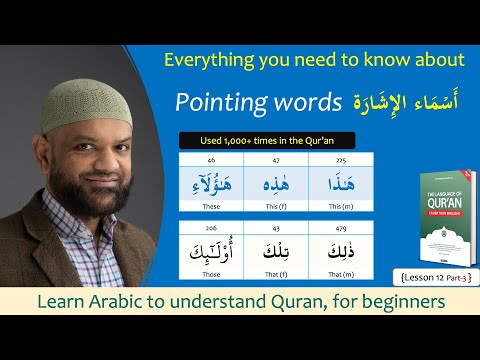 Click to play
Introduction
This is the third and final part of Lesson 12 on demonstratives. Parts 1 and 2 built up the full picture of how pointing words work in phrases (المُرَكَّب الإِشَارِي) and sentences (الجُمْلَة الاِسْمِيَّة), including the complex cases of pointing to an idafa construct. In Part 3, we complete the topic with two new ideas — the pronoun of separation (ضَمِير الفَصْل), which allows us to say "this is THE scholar" with emphasis, and the use of far demonstratives for emphasis even when referring to something near. The lesson then concludes with seven real Quranic examples that put every structure we have learned into practice at once.
Demonstratives appear in the Quran more than 1,060 times, so finding one on every page is the norm, not the exception. By the end of this lesson, you will be able to pause at any of these occurrences and parse it completely.
Lesson Notes
The pronoun of separation — ضَمِير الفَصْل
In Arabic, placing a pointing word directly before a definite noun creates a demonstrative phrase, not a sentence:
> هَذَا الْعَالِمُ — "this scholar" (a phrase, not a sentence)
To say "this is the scholar" with the definite article on the khabar, we need a device to signal that a sentence is intended and to prevent the phrase reading. That device is the pronoun of separation: a detached rafa pronoun placed between the pointing word and the definite khabar.
> هَذَا هُوَ الْعَالِمُ — "This is THE scholar"
The pronoun of separation must match the noun being pointed to in number and gender. It is placed between the ismul isharah and the definite khabar. The result carries two functions: (1) it signals a complete sentence, and (2) it adds emphasis — "it is specifically this person who is THE scholar."
Choosing the correct pronoun:
| Noun type | Pronoun of separation | Example |
|---|---|---|
| Masculine singular | هُوَ | هَذَا هُوَ الْعَالِمُ |
| Feminine singular | هِيَ | هَذِهِ هِيَ الْبِنْتُ |
| Broken plural (non-rational) | هِيَ | هَذِهِ هِيَ الأَقْلَامُ |
| Masculine plural (rational) | هُمْ | هَؤُلَاءِ هُمُ الْمُسْلِمُونَ |
Note: broken plurals of non-rational nouns are treated as singular feminine throughout, so هِيَ is the correct pronoun of separation even for masculine broken plurals (e.g., أَقْلَام — pens).
Far demonstratives used for emphasis on what is near
Arabic (and the Quran) sometimes uses ذَلِكَ، تِلْكَ، أُولَئِكَ when referring to something that is physically near or has just been mentioned, in order to elevate its importance and create greater emphasis in the reader's mind.
When a far demonstrative (ذَلِكَ، تِلْكَ، أُولَئِكَ) is used for something contextually near, it is a rhetorical device to emphasise the subject's importance. English translators often render it as "this" to convey the full force of the meaning.
Two examples from the very beginning of the Quran:
> ذَلِكَ الْكِتَابُ لَا رَيْبَ فِيهِ (Al-Baqarah 2:2) — translated as "This is the Book" — the "far" form elevates the Quran's status. > تِلْكَ حُدُودُ اللهِ (Al-Baqarah 2:229) — "These are the limits of Allah" — تِلْكَ used for weight and solemnity.
Complete summary of the six essential demonstratives
| Near | Far | |
|---|---|---|
| Masculine singular | هَذَا | ذَلِكَ |
| Feminine singular | هَذِهِ | تِلْكَ |
| Plural (m. or f.) | هَؤُلَاءِ | أُولَئِكَ |
All six are mabni — they do not change for rafa, nasab, or jarr. The dual forms exist but appear only twice in the Quran; recognition is sufficient.
Summary
- The pronoun of separation (ضَمِير الفَصْل) is inserted between the pointing word and a definite khabar to (1) signal that the structure is a sentence and not a phrase, and (2) add emphasis to the predicate. It must match the noun being pointed to in gender and number.
- Far demonstratives for emphasis: ذَلِكَ، تِلْكَ، and أُولَئِكَ are sometimes used in the Quran to refer to something near, for rhetorical elevation. Translators often render these as "this/these" to convey the full emphasis in English.
- The six core demonstratives are all mabni. I'rab is read from the musharun ilayhi. Broken plurals of non-rational nouns always take the feminine singular pointing word (هَذِهِ، تِلْكَ) and the feminine singular pronoun of separation (هِيَ).
- Demonstratives appear over 1,060 times in the Quran. Every page will contain at least one. The structures to look for are: ismul isharah + noun with الـ (phrase), ismul isharah + indefinite noun (sentence), ismul isharah + pronoun + definite noun (sentence with separation pronoun and emphasis).
- Al-Baqarah 2:5 (أُولَئِكَ عَلَى هُدًى مِّن رَّبِّهِمْ وَأُولَئِكَ هُمُ الْمُفْلِحُونَ) is an ideal revision verse: it contains harf of jarr, ism majruur, idafa with attached pronoun, demonstrative as mubtada, and the pronoun of separation — all in two short clauses.
Terminology Reference
| Arabic | Transliteration | Meaning | Type |
|---|---|---|---|
| ضَمِيرُ الفَصْل | damirul fasl | pronoun of separation — a detached pronoun inserted between the mubtada and a definite khabar to signal that a sentence (not a phrase) is intended, and to add emphasis | grammatical term |
| هَذَا هُوَ الْعَالِمُ | haadha huwal 'aalimu | This is THE scholar (pronoun هُوَ inserted for emphasis and definiteness of khabar) | example phrase |
| أُولَئِكَ هُمُ الْمُفْلِحُونَ | ulaa'ika humul muflihuun | It is they who are the successful | Quranic phrase |
| تِلْكَ الدَّارُ الْآخِرَةُ | tilkad daarul aakhirah | That is the home of the Hereafter | Quranic phrase |
| ذَلِكَ الْفَضْلُ الْكَبِيرُ | dhalikal fadlul kabiir | That is the great bounty | Quranic phrase |
| هَذَا لِسَانٌ عَرَبِيٌّ مُّبِينٌ | haadha lisaanun 'arabiyyun mubiin | This is plain Arabic language | Quranic phrase |
| تِلْكَ آيَاتُ اللهِ | tilka aayaatullaah | Those are the ayat of Allah | Quranic phrase |
| مُبْتَدَأ | mubtada | the subject (first part) of a nominal sentence — definite and rafa | grammatical term |
| خَبَر | khabar | the predicate (second part) of a nominal sentence — rafa | grammatical term |
Linked Arabic terms open their full entry in the Arabic Grammar Guide.
📖 Grammar guide. Grammar terms are explained in the Arabic Grammar Guide — fully vocalised, searchable in Arabic, any transliteration, or the English meaning.
Lesson Transcript
Read the full transcript (6,571 words)
Auto-generated from the lesson video. Timestamps jump to that point in the video. May contain transcription errors.
0:00 The language of Quran, easier than English. Assalamu Alaikum and welcome to part 3 of lesson number 12. Alhamdulillah, you are already familiar with the demonstratives now in part 1 and part 2. We looked at in detail how they're used within phrases like the Murakkab Ishaari being used with the Murakkab Idhaafi as well as the Jumla Ismiya.
0:21 In this lesson, we're going to first of all look at pronouns of separation. This is something new inshaAllah ta'ala. We're going to look at some of the additional features of the demonstratives and a summary concluding with numerous examples from the Quran. So let's begin with the blessed name of Allah. Bismillahir Rahmanir Raheem. Rabbi zidni ilma, O my Lord, increase me in knowledge.
0:44 Pronouns of separation. So when I say this is a boy in Arabic, for example, this is a sentence of course, you say Haaza Waladun, this should be very easy for you. If I say this boy, I will say Haazal Waladun, Haazal Waladun. So this is a demonstrative phrase. And inshaAllah, I'm sure now you know that after the pointing word, if there's that word beginning with Al, it is a demonstrative phrase. So this boy.
1:13 But how do I say this is the boy? How do I say this is the boy? Please pay attention to the difference between this is a boy, this boy and this is the boy. So again, in between I have the. So in Arabic, how do I do that? So in Arabic, if I were to say these three things, I first of all say Haaza Waladun, that's easy.
1:35 Then I say Haazal Waladun. Now if I say Haazal Waladun in Arabic, I end up with this is. This is this boy. I end up with Haazal Waladun, this boy and Haaza Waladun, this is a boy. But I want to say this is the boy. If I put Al in front, I end up with a phrase.
1:55 So how do I do that in Arabic? So the only way to do this in Arabic is to put a pronoun between the pointing word and the thing that is pointing to. So pointing word being Haaza and I put a pronoun here. And the pronoun has to match the noun being pointed to in number and gender. So Al Waladun is of course singular, masculine. So I will use the Hua version. So Haaza Hua Waladun.
2:24 So remember this, this pronoun of separation, that's what it's called, has to match the noun being pointed to in our number, in our gender, etc. So this is most important point for us. Of course, they're both definite.
2:39 So what we've got here is Haaza Hua Waladun. And this is the only way in Arabic to say this is the boy. On the screen now, I have done the first example for you, which is exactly the same as the previous one, except for Walad has been changed for Aalim. Al Aalimu, Haaza Hua Al Aalimu, this is the scholar. This is the scholar, meaning I'm putting emphasis on the the. So I'm saying he or this is the scholar as opposed to saying this is a scholar.
3:12 What this pronoun of separation does is allows us to say this, this is the teacher, that part, but it also emphasises the message. So when I say this is the scholar, meaning he is emphasising the scholar bit. So this person has the extraordinary qualities of being the scholar, meaning he is above other standard scholars, a little bit higher in emphasis, excluding others, giving him a bit more of emphasis in the meaning.
3:42 So Haaza Hua Al Aalimu, he is the scholar. And so there is an extra emphasis in the meaning also. So please note the pronoun of separation will come between the pointing word and the noun that you're pointing to. That's the first point. Second, the pronoun that you use must match the pointing word, the word being pointed to in number and gender. So Al Aalimu is masculine singular.
4:08 And of course, we know the pronoun for that is Hua, Hua. So it goes there. Now we have got three other situation here. I have got, this is the girl. These are the pens. Please note, I used Haadihi here. So these are the pens. Those, these are the Muslims. These are the Muslims. The Muslims. So I need to put a pronoun in each one. So what I'd like you to do is pause the video and guess which pronoun is going to go into the boxes there.
4:47 Three of them should be relatively easy. Okay, the first one. Al Bintu is feminine singular. So I will say here. I hope this is easy. Haadihi here is now singular feminine. Pens, the pens. Okay, the pens. Now this is a broken plural, non-aqil. So it will be treated as singular feminine. So again, I'll use here, here, here, she. So again, you can see here. Last one. Is masculine and plural. So Hua is singular.
5:33 Hum is plural. So I will say. Please note Hum is taking a dhamma here because the word followed by is with Al. And I've explained this before in the pronoun lesson. Inshallah, you will find it there. So this is the basic rule. It's a very simple concept. You put a pronoun appropriate in between to make this structure. Please note the pronoun matches in number and gender.
6:03 And what the result is, number one, we can say this is the scholar. This is the girl. These are the pens. And these are the Muslims. We can use those structures. But more importantly, it is putting emphasis on the meaning also. Two points, inshallah, is all you need to know. Now let's look at some examples from the Quran. And there are many. I've given you three on the screen, inshallah. Let's look at the first one. Hua, of course, means and.
6:30 Or so, depends on the context is used. Ulaika meaning those. Those are the successful ones. Means those who are successful. So you can see here, because it is plural, we have used whom. Or if you read all of it. Example, surah al-Baqarah, ayah number five. Again, alhamdulillah, let us now look at the second example. Again, we can see example here. I'll give you the translation now. Thus, fa means so or thus. It is those people who are the transgressors.
7:17 Meaning emphasis on the fact that these people have done so much transgressions. They are the transgressors, not only transgressors, but real transgressors who really have gone beyond any limits. So again, you can see here how the structure of the pronoun of separation is being used. Let's take one more example, inshallah. And again, we have here example from surah al-Baqarah again. And it is they who are the rightly guided.
7:46 So you can see here how that is used. Emphasising the meaning and also allowing us to say this, then followed by the definite article. So very, very important structure, very commonly used in the Quran. I've only given you three. Inshallah, these examples will suffice. When pointing to near or emphasis.
8:10 In order to create emphasis to something, we can also use the pointing words for far while referring to something near. So this is done in Arabic for greater emphasis. I'm including it here because it is part of how the demonstrators have been used. This is normally taught in advanced lessons. But inshallah, you should not get any confusion with it. All it is doing, even though I'm using the word for far while referring to something close is because of emphasis.
8:36 When you see the translators, for example, translating this part of the ayah. Technically that is Isa the son of Mary. But they're saying this. Why? It is emphasising within context, the importance of Sayyidina Isa in that context. So even though it's referring to something far away, it's using that to bring it close for importance. And you see that also in the Quran, right in the first page.
9:08 So that is the book, but the translators usually use this to show the greater importance of the subject. And this is done commonly. Sometimes it's also done in English. For example, I'll say, that is my son, you know, emphasising the importance instead of even though he may be close by or say, that's my boy. That kind of statements are being made inshallah. But in Arabic, this is used.
9:31 And so don't be confused if you see on occasions, it is to do with the context in which that word is being used. Another example. Of course, tilka is for far, but the translators have translated it correctly, of course, to give the emphasis. These are the limits of Allah, the importance of the limits that Allah subhanahu wa ta'ala set for us. Do not go beyond them. You know, this is the sharia.
9:54 This is the wide road, wide open. Stay within the limits. Do not go near the haram. Do not stay far away from them. This is the halal limit. And then you can hit anything and everything in the world. But the haram is of limits. So this is your limit. Stay within that. So these are the limits of Allah. And then we have the next part of the ayah. And the references are there, by the way, if you wish to check the context.
10:20 Exactly the same. Here, referring to these are the ayat of Allah. Literal translation would be those. So here again, from Surah Al-Baqarah. And there are many examples of this. I've chosen the closest ones from the beginning, inshallah. Again, please take a close look. Translation is these are the ayat of the wise book. Now, you should be able to work out. Why? Because they match in the four properties. Again, going back to even from lesson number two, we were started with this. So you can see here.
10:58 Here is mudaf. And al-kitabi is mudaf ilayhi. Okay. Ayah is singular. Ayat is plural. So it's removed this tanween. Ayatun became ayatu. Because it is mudaf, not tanween allowed. And al-kitabi is your mudaf ilayhi. And which is your mawsuf, the noun being described. And al-hakimi is the adjective that follows it, or sifah in Arabic. So you can see very beautiful illustrations of what we've been learning so far.
11:28 So these are again examples. You'll find more. Please be aware that tilka and dhalika, even though they're pointing to far, can be used for emphasising the subject. And of course, using it to mean something that is close. Brief summary. So before we conclude this lesson, inshallah, just take a brief summary what we've done. We've looked at the pointing words for far. We looked at the pointing words for near. So near.
12:03 So again, you can see here, alhamdulillah, these are the only six you really need to learn. The duals, don't worry. When you see them, you should be able to recognise them. But they're all listed here. Again, as a reminder, I'm sure you remember by now, that hatha, for close. Hathihi, feminine, masculine feminine. Singular, close. Are both mabni, they do not change. Ha'ulai also do not change.
12:27 The duals change, like all throughout the language. Again, for far, we have dhalika and we have tilka. And they both don't change. Okay, whether it's rafa, nasa, or jar. And of course, ha'ulai do not change either. And ha'ulai and ulaika used both for masculine or feminine. So in reality, there's only six words that we really need to learn. So three on the top and three on the bottom. Have an awareness of the table.
12:54 And this is why I've designed it this way. So it's clear to you which is mabni and which is changing. And the duals have been only used, as far as I know, twice in the Quran. So again, we don't really need to spend the time memorising all of them. Once you recognise one, you should be able to do the rest, inshallah. Let's quickly look at three more examples which will illustrate, inshallah, all the rules we've been learning.
13:15 Hopefully bring it together for us. On the screen, we have Three words. The first word is your word for pointing. I hope this is easy. But after that, I have al. So there must be a muraqqab ishari structure here. Because pointing word followed by al. This is the only need to remember, inshallah. So we have musharun ilaihi, the noun that I'm pointing to.
13:40 So we have our muraqqab ishari. Then we see the next word is also beginning with al. So you can see here, this is definite. This is definite. This is rafa. This is rafa. This is masculine. Singular. This is also masculine and singular. So the four properties are matching. So what we've got here is between these two words, what we have, the first word is a mawsoof, meaning a descriptive phrase. Please go back to lesson number two, where we started this subject.
14:11 And of course, we have the sifah, the noun, uh, the sifah, the adjective, which is describing the mawsoof. So the noun being described is arrajulu. And the description here is alhakeemu. So between the two of them, we have a muraqqab tawsifi. So we have a quite a sort of nested structure here. We have two words here, which make one structure here. And then the first part joins there. So we have the muraqqab ishari. And then change on to back of that is the muraqqab tawsifi.
14:50 Of course, this is not a sentence. Because I don't have a muqtada or a khabar here. Or technically, I can make this into muqtada. I'll have to put something afterwards. So it's an incomplete construct. The translation of which is this wise man. This wise man. Again, a second example to illustrate the same thing. Here I have tilka al-kutubu al-jadidatu. Tilka al-kutubu al-jadidatu. Now, please note what's going on here. Of course, al-kutub is masculine. But plural. Kitab is singular, kutub. But because it is a broken plural.
15:30 Okay, broken plural. Broken plural. And it's non-aqil. So I'm treating it as feminine singular. Feminine singular. That is the reason I've got tilka. And here, of course, this now becomes exactly the same as the previous structure. Ismul ishara musharun ilayhi. Al-kutubu becomes my mawsuf. And my sifa is al-jadidatu. Al-jadidatu, singular feminine. And again, this rule I told you before follows all the way through.
16:00 So the broken plurals are treated as singular feminine. So the masculine is, sorry, the mawsuf is masculine plural. And the sifa is feminine singular. Because it is a broken plural. The translation is, those new books. Tilka. Okay, those, far away. Tilka, okay. Again, using a feminine word. But again, in the English translation, this will not come through. Because in English, we don't use this structure. So again, you can see here how you need to translate it into English.
16:33 Last example. Hadhar rajulu hakeemun. Again, you should be able to recognise that I have no al here. In the word at all. There is nothing here. No al. So of course, we have now arrajulu, definite. Hakeemun, indefinite. So that should tell you something. So the first part is, of course, ismul ishaara. And then mushaarun ilaihi, as we have already. Hadhar rajulu. But what do they become together? They form together my muqtada. The subject. The subject is this man.
17:05 Then the predicate. What I'm telling you about this man is what? Okay. All of that is now your jumla ismiya. And this man is wise. This man is wise. So again, the first part, your muqtada. The second part is your khabar. And if you can go back to lesson number three and four, where we introduced the sentence. We started making sentences. We said, you find your muqtada. Then your khabar. And you put your is, am, or are in between.
17:32 Of course, appropriate to the English language. And then you have your jumla ismiya. So again, these are the three structures. Please note them down. Inshallah, there'll be enough for you to remember all the rules. So the only important thing, again, I emphasise. After the pointing word, if there is al, then there is a descriptive phrase there. And you look at what's after it. And then you try to analyse what is going on.
17:57 The next three examples I've been through in detail. Just a different way illustration. So you can see what is going on inshallah ta'ala here. The first one, the hadha is pointing to book. So again, if you see the English first, I'm saying this book. This book. So the hadha here is pointing to book. I cannot put hadha before because it will become this structure here. The one at the end, which you can see here, which is not what we're looking for.
18:25 So in the first one, when the pointing word points to the mudaf, it comes after the mudaf ilayhi. Please note that. In the second example, I'm pointing to boy. This boy. Here, of course, I'm pointing to the mudaf ilayhi. In that case, it can come after the mudaf, and it itself will become the mudaf ilayhi.
18:46 So I have the mudaf, mudaf ilayhi. Please note mudaf ilayhi is always jar. And because this is now forming a muraqab ishari with this one, this one will copy the structure, oh sorry, i'rab of the previous one. Exactly the same as we've seen with the muraqab tawsifi. So this is the difference. And inshallah ta'ala once you've done a couple of times, this will make sense. And you just have to be extra sensitive when you're translating. Look at the third example. This is your complete sentence.
19:14 So here now we have kitab al-waladi, which of course you should know, boy's book. Okay, the boy's book. This should be very easy. Kitab al-waladi can do on its own. But hatha, this. So this becomes my mubtada. And kitab al-waladi becomes my khabar. So these are the things that we went through. There are quite a few other things we covered.
19:34 But if you just remember these few slides, inshallah ta'ala most of what you need to know is being revised here. So I hope and pray inshallah you've got all of these points that we went through in the three videos. Make your own notes inshallah. And of course they're all available in the book as well if you're able to get the book inshallah ta'ala. Let's quickly now conclude the lesson by looking at some Quranic examples. Examples of demonstratives from the Quran.
19:59 Alhamdulillah, we are now concluding the lesson. Here I've got some Quranic examples for you. Now these are just few. As I mentioned before, these pointing words or demonstratives are used in the Quran more than a thousand times, 1060 times. So you'll find them on every page, one or two on every page of al-Quran. So here's some examples here.
20:20 Our purpose of course is not only to practise and revise the pointing words, but also to look at other structures that we should be able to recognise now within the text itself. So you should be able to recognise the mudaf mudaf ilayhi. You should be able to recognise the muraqab tawsifi, i.e. the descriptive phrase.
20:37 You should also be able to recognise the harf of jar and the ism majroor that follows afterwards. And also of course you know the jumla ismiya and its rules. So there's a lot of Arabic you've already learned, alhamdulillah.
20:49 And to illustrate and demonstrate that, I've chosen seven examples from the Quran itself. Of course with the intention always to try and hope, hopefully to convince you that you are learning things that are directly relevant to the understanding of Quran in Arabic. I hope and pray that you'll find these examples of benefit.
21:08 I'm going to put them on the full screen. So please make a note of them. By all means open the book of Allah azza wa jal, the Quran and read for yourself and check for yourself.
21:17 But also the text itself is on the screen itself. I'm going to go through each one with a brief explanation. But what I'd like you to do when you see the full screen, I would like you to pause the video and also inshallah ta'ala make sure that you make a note of these examples down on a piece of paper.
21:33 And then we'll go through each one in detail. The first example we have on the screen, the first word of course is our ismul ishara. I'm sure you can recognise that. That is our pointing word. Okay that is our ismul ishara. So that's our ismul ishara. Then we have the pronoun. The pronoun which we can see here. Now this pronoun is followed by al.
22:09 So if we put zalika without the pronoun, that would become a demonstrative phrase. So the huwa here is the pronoun of separation. So it's the pronoun of separation. I hope you can see that very easily inshallah. And al fadlul kabiru, I hope you can easily see. Let me just change the colour.
22:32 You can see that this is rafa, this is rafa, this is definite, this is definite. Of course both of them are masculine because there is no reason for them to be feminine. And both of them are singular. So you can see here we have a descriptive phrase. These two words together. This is your mawsuf. And this word here al kabiru is your sifa. So the mawsuf is a noun being described. And this is your sifa.
23:02 So you can see here that is a descriptive phrase. So alhamdulillah very easily from the screen, we can say here dhaalika, split that up, that. And then you put your ism or are in between. And the huwa is coming in between the two parts. And that is the greatest bounty. And again in the meaning of course there is emphasis which often you will see in the English is not always translated.
23:26 But the translator here has put truly in between to give you the emphasis in the meaning. Meaning the real bounty, real benefit, the greatest bounty is this. That which is referring to in this part of the ayah. So again please look in the context for more detail. I'm hoping and praying that you were able to see all of those structures that I've just went through. Number two should be very easy for you.
23:53 Again the word halal and haram, we Muslims, we all know what it is. So we have here our ismul ishara. Okay we have waw in between. So the waw in between here is the waw of a and d. So they join two parts together. The first part here of course is your mubtada and the second part will be your khabar. I hope that's easy for you to recognise.
24:18 Mubtada, okay that is your mubtada and this is your khabar. So this is halal. This is halal and this is haram. I hope that's very very easy for you to see. Exactly the same. We have our mubtada and we have our khabar. So this is your mubtada, this is your khabar. Two sentences being joined by waw. And you can see how easy it is alhamdulillah with the way we've been progressing.
24:49 You should now be able to recognise all of that text within the basic rules that we've learned so far. So this is halal and this is haram. Example number three inshallah I hope is very very easy. You can see here I've got three words after my pointing word. My pointing word is here and after that there is no al. So very likely that this is a sentence.
25:11 We have our mubtada and therefore this will be the khabar. Now here we have three words. How are they linked? Well I hope you can easily see that they're all marfu in the rafa. They're all indefinite and of course is masculine. Lisan, tongue literally. Tongue of course is masculine. Why? Because it's not body part in pairs. Please go back and revise lesson number three where I went through gender. Arabiyun is of course is also masculine.
25:46 There is no sign of it being feminine. And they're both singular. So again we have the all the four properties matching. In that case I can say that this is my mausoof. Mausoof and this is my sifa and this is another sifa. So I have first one here, second one there. Mausoof is a noun that I'm describing a classic. So here we have our mubtada and the rest of it is khabar. So you can see very easy translation.
26:30 And this is plain Arabic language or plain Arabic speech. The word tongue is used also in Arabic to mean language and similar in English. For example he speaks with the French tongue meaning he speaks French. So you can see here alhamdulillah very very easy. Again we're only on lesson number 12 and you can understand not only the meaning of the words but also the structure. So you will translate this as a full sentence.
26:56 This is plain Arabic language or plain Arabic speech. Number four should be no introduction to you should be familiar with this one. Again this is from surah al-baqarah and you can see here at the end what we've got. So that is your pointing word. Now ala is of course your harf of jar. But this is your ism majroor.
27:32 Now this does not display or any change. Meaning it's a category of ism that does not change its ending in the different araf. So this is rafa, nasab or jar. You cannot tell. You can only tell in context. So here ala is first so it must be jar. There is no question asked here. Ala afterwards the majroor will always be in jar status. So you can see here hudan. Hudan is jar. So ala hudan upon guidance. Min is also another harf of jar.
28:04 So you can have exactly the same principle here. And this part the first part rabbi. It could be rabbun, rabban, rabbin but it's rabbi. So we know this is our in jar status. So this is your ism majroor. So this is your ism majroor and let me change the colour so you can see. This is also in jar. Him is actually the edafa structure. So it is the mudaf ilayhi.
28:41 So rabbi is mudaf and him is mudaf ilayhi. So I hope that bit also very clear for you that this part is mudaf. And the him is mudaf ilayhi. And please note I mentioned it so many times. Whenever you see attached pronoun attached to an ism it will always be the edafa structure. Mudaf mudaf ilayhi.
29:05 There is no need for any confusion or discussion there. So what have we got in the first part? We got ulaika those referring to a group of people who've been already mentioned previously. So if you can go back and look at the ayah number one all the way through, you'll see a description of people who are muttaqeen has been given in the Quran right at the beginning after surah al-fatiha.
29:25 So those are the people who are upon the guidance from their Lord. From their Lord. From their Lord. Min rabbihim. So if you read it together of course you say min rabbihim. Min and then rabbihim. So they are the people who are upon the guidance from their Lord. So that's the first part. Wa and ulaika those. Humul muflihoon. Exactly the pronoun of separation that we looked at earlier. There's no difference here.
29:55 It's got al ulaika. So separating the mubtada khabar with the pronoun of separation. So we have it is they who shall be successful. So there is emphasis here on the meaning that only those who are successful are those people who have these qualities that have been mentioned previously. So if you want to know the successful people, go and look at the qualities what's described. And again please refer back in the beginning of surah al-baqarah.
30:20 We will have a very beautiful summarised quality. Allah azza wa jalla is reminding us what are the qualities of the people who have taqwa. They are the people who are upon the guidance upon their Lord. And these and it is only them who are upon or who are the successful ones. Who are these people? Who believe in the unseen. Who establish the prayer.
30:39 Who give charity. Who believe in what has been revealed to Prophet Muhammad sallallahu alayhi wa sallam. What was also what was revealed before him etc. So you find those details there inshallah. I hope and pray that this lesson has helped you also to completely understand this full ayah that we have looked at above. So please again look through each part. Make sure you understand it fully. And of course for vocabulary memorise this ayah as well as the meaning of the words. Number five.
31:06 Shorter part. Let's quickly look at what number five is. Now tilka again ismul ishara. Al. Straight after. Okay straight after. So this is not a sentence. This is your muraqab ishari. So tilka ad-daaru. Now daaru is actually plural. It is a broken plural. So let me write bk here. Broken plural. That word is a broken plural. And therefore hence instead of saying dhaalika we are using tilka. Tilka. That. That. Dhaar means home. Or abode. That home.
31:44 Al aakhiratu. Again they're both matching. You can see both of them rafa. So this is your descriptive phrase. The hereafter home. But in English normally you see an OF translation in the translation. That home of the hereafter. But in Arabic it is not an edafa structure. Because you can see otherwise this would have been jar. So be careful just in case you see OF and you think oh this is a edafa structure. No it isn't. So this is a matching.
32:11 Okay. This is your mausoof. And this is your sifa. Mausoof and sifa. So one describing the other. Aakhirah means the hereafter or the what is at the end. And ad-daar home. So the home of the or home or abodes of the hereafter. Again using tilka because it is a broken plural of ghairu aakhir. Please remember that inshallah. Next we are exactly the same as we've seen in the previous one. Number six. Tilka ayat. Now this word. Please remember this one.
32:48 Very very important. That's two dots by the way. That's singular. Ayatun. Ayatun is singular. Plural is exactly the same as the sound feminine plural that we've been studying in lesson number four. Next example. Identical to the previous one almost. So tilka we have again pointing. But here we have this word ayatun. Just let me share what is that. Inshallah I'm sure most of you may know this. This is the singular ayatun. Singular. The plural of it is the sound feminine plural.
33:32 So of course very easy. So we have aa, yaa. There should be an alif afterwards. Sorry. Aa, yaa, tun. So that's ayats, signs, miracles etc. This is your singular. And this is your plural. So aa, yaa, tun.
33:53 Why does it, why has it lost its tanween? I'm sure you're going to say that because it is mudaf. And of course the word lafza jalala for the word for Allah here is this particular word in this case. Of course you have no problem recognising that it is in jar status or it's in jar. So you can see here mudaf and this of course will be mudaf ilayhi. Mudaf plus mudafun ilayhi. These or those are the ayat of Allah.
34:37 Those are the ayat of Allah. Again please check the references inshallah. Last example. Again to illustrate some of the rules that we've learned in previous lessons also. We have first of all our pointing word. And there's no al afterwards so it's a sentence. Ha ulayhi again is plural. Can be for masculine or feminine. Qawmun if you remember is what we called a collective noun.
35:04 Do you remember that inshallah we did this I believe when we did plurals in lesson number six I believe. We did that there, qawmun. Now this can be on occasion treated as a singular or it can be treated as plural. Both in the language. The same thing as in English when I say army. Army is not one individual it's a group of people but I can say an army is coming.
35:27 So I'm treating a singular even though it's a group it's a plural. So here you can see qawmun mujrimuna. Of course this is masculine and this is plural. It is indefinite okay and it is definitely rafa because it is the sound masculine plural and it's matching this in its four properties. So qawmun mujrimuna again you can see is a criminal people. So qawmun means nation or people.
35:58 This noun has been described by the word criminal meaning these people are wrongdoers. Okay mujrimuna these are a criminal people. So again ha ulayhi let me change the colour here.
36:10 Ha ulayhi this part is your mubtada and this part will be your khabar which of course it's also a muraqab tawsifi. So alhamdulillah I hope and pray that these examples are not causing you major problems and you're able to see all the things I pointed out and of course you'll see a lot more than that but I'm just pointing the very basic things out for the sake of practise. Alhamdulillah by the grace of Allah we've concluded another lesson.
36:43 I have tried in the three videos to cover the topic without going too fast and too slow. Just the main elements of things that you are likely to come across. I hope and pray that I've covered them well and that you are all benefiting from these lessons and each one is being of benefit from which you can learn something and of course by every single day develop more and more understanding of the language of Quran and begin to appreciate the message and the beauty of Quran when you begin to listen to it when you read it and when you begin to understand it.
37:14 Of course may Allah if there are any video any errors or anything in the video you have suggestions please do give I will try my level best to try and improve them. May Allah reward you bless you with the very best in this world for all your comments suggestions support that you're giving me may Allah grant me to be able to produce more and more videos that are of quality and that are of a benefit. Please like subscribe and share encourage others to learn also I look forward to seeing you in the next video.
37:40 May Allah bless you with the very best in this world and in the hereafter.
Test Yourself
After every lesson it is essential to test what you have learnt. We are working hard to produce the full set of resources for every lesson — thank you for your patience.
If you would like to support the production of content and the running of this site, you can do so on our support page.
Updated