
Relative Pronouns — The Relative Noun (الاِسْمُ الْمَوْصُولُ)
Connecting clauses in Quranic Arabic with الَّذِي، الَّذِينَ، الَّتِي، مَا، and مَنْ
- Define the relative noun (اِسْمٌ مَوْصُولٌ) and explain its function — connecting a definite noun to a following clause that clarifies it
- Identify the three most important specific relative nouns — الَّذِي، الَّتِي، الَّذِينَ — and state how many times each occurs in the Quran
- Explain what صِلَةُ الْمَوْصُولِ (the connecting clause) is and what types of clause may serve that role
- Recognise the non-specific relative nouns مَا (what / that / which) and مَنْ (who / whoever) and distinguish their relative use from their use as question words or negators
- Parse relative noun constructions from surah al-Fatihah, surah al-Mu'minun, and surah al-Baqarah
Video Lesson
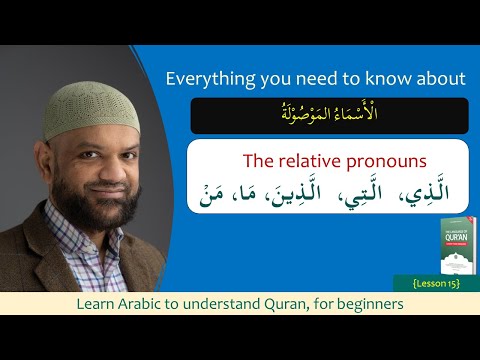 Click to play
Introduction
Lesson 15 is the final lesson of Book One. Throughout this course we have built a systematic understanding of Arabic: the three types of words, the four properties of the noun, the various phrase types, the nominal sentence, and the particles (inna and her sisters, negation, questions). In this last lesson we complete the map of definite noun categories begun in lesson 2 by studying the final major category: the relative noun (اِسْمٌ مَوْصُولٌ).
Relative nouns appear approximately 3,500 times in the Quran. They are the mechanism by which Arabic links a noun to additional descriptive information — the Arabic equivalent of the English words "who," "which," and "that" as used in relative clauses. Mastering even the three most common relative nouns (الَّذِي، الَّتِي، الَّذِينَ) accounts for over 1,400 individual word occurrences in the Quran. This lesson introduces the concept, presents the full set, and gives detailed Quranic illustrations.
Lesson Notes
What Is a Relative Noun?
A relative noun (اِسْمٌ مَوْصُولٌ — literally "the connected noun") is a word that links a previously mentioned definite noun to a following clause that provides more information about it. In English: "the man who came," "the book which is on the table," "those who believe."
The key structural requirement is that the relative noun must always be followed by its connecting clause (صِلَةُ الْمَوْصُولِ), which is essential to complete the meaning. The relative noun alone gives no complete information — الَّذِي by itself just means "the one who..." and leaves us waiting.
الاِسْمُ الْمَوْصُولُ always: 1. Follows a definite noun (the noun it connects back to) 2. Is itself always definite (it is one of the seven categories of definite nouns) 3. Is mabni — its ending does NOT change for case (raf`a, nasab, jarr) 4. Is followed immediately by صِلَةُ الْمَوْصُولِ (the connecting clause) صِلَةُ الْمَوْصُولِ may be: — A nominal sentence (جُمْلَةٌ اِسْمِيَّةٌ) — A verbal sentence (جُمْلَةٌ فِعْلِيَّةٌ) — A shibhu jumlah: jar-majruur OR dharf + mudaf ilayhi
The Specific Relative Nouns
These words are used exclusively as relative nouns — they have no other grammatical function. Of the full set, three dominate Quranic usage completely:
| Form | Use | Quranic occurrences |
|---|---|---|
| الَّذِي | Masculine singular (rational or non-rational) | 304 |
| الَّتِي | Feminine singular (rational or non-rational; also broken plurals of non-rational) | 68 |
| الَّذِينَ | Masculine plural (primarily rational beings) | 1,059 |
The dual forms (اللَّذَانِ / اللَّتَانِ) each appear only twice in the entire Quran. The feminine plural (اللَّاتِي) appears 9 times, and اللَّائِي 4 times. For practical Quranic reading, three words suffice.
Three words cover the vast majority of relative noun usage in the Quran: الَّذِي — singular masculine (or any non-rational noun) الَّتِي — singular feminine (and non-rational broken plurals, treated as sing. fem.) الَّذِينَ — plural masculine (the most common: 1,059 occurrences) All three are mabni — they do NOT change their ending regardless of grammatical case.
Using الَّذِي with Non-Rational Nouns
الَّذِي may refer back to non-rational nouns (غَيْرُ عَاقِلٍ) as well as to rational beings. When a non-rational broken plural is the antecedent, Arabic treats it as singular feminine — therefore الَّتِي is used, just as with the demonstratives (lesson 12).
Example: اَلْكُتُبُ الَّتِي عَلَى الْمَكْتَبِ جَدِيدَةٌ — "The books which are on the table are new." Though كُتُبٌ is a broken plural, it is treated as singular feminine, so الَّتِي is used.
The Non-Specific Relative Nouns (مَا and مَنْ)
Unlike the specific set above, مَا and مَنْ serve multiple grammatical roles in Arabic (question, negation, and relative). As relative nouns they are highly flexible — they do not distinguish gender, number, or rational/non-rational.
مَنْ (man) as a relative noun: — Primarily used with rational beings (humans, etc.) — Can be singular, plural, masculine, or feminine — Means "who" / "whoever" / "the one who" — Has been used approximately 650 times as a relative noun in the Quran مَا (maa) as a relative noun: — Generally used with non-rational referents (though not exclusively) — Can mean "what," "that which," "whatever" — Has been used approximately 1,476 times as a relative noun in the Quran — Distinguish from: مَا as negator (lesson 13), مَا as question word (مَا هَذَا?)
Summary
- A relative noun (اِسْمٌ مَوْصُولٌ) connects a definite noun to a following clause (صِلَةُ الْمَوْصُولِ) that completes and clarifies it. It is always definite and always mabni (does not change for case).
- The three essential specific relative nouns are الَّذِي (masculine singular — 304 times), الَّتِي (feminine singular — 68 times), and الَّذِينَ (masculine plural — 1,059 times). Learning these three words gives access to over 1,400 Quranic occurrences.
- الَّتِي is used for feminine singular nouns and also for non-rational broken plurals, which are treated as singular feminine throughout Arabic grammar (consistent with the demonstrative rule from lesson 12).
- The non-specific relative nouns مَا (what / that which — ~1,476 relative uses) and مَنْ (who / whoever — ~650 relative uses) are flexible: they do not change for gender, number, or rationality. مَا has several other functions (negation, questions) and must be distinguished by context.
- صِلَةُ الْمَوْصُولِ may be a full sentence (nominal or verbal) or a shibhu jumlah (prepositional phrase or adverbial idafah). Verbal sentences as the connecting clause will be studied in depth in Book Two.
Terminology Reference
| Arabic | Transliteration | Meaning | Type |
|---|---|---|---|
| اِسْمٌ مَوْصُولٌ | ismun mawsuul | relative noun — a noun that connects two clauses | ISM |
| صِلَةُ الْمَوْصُولِ | silatu l-mawsuul | the connecting clause — the clause that follows the relative noun and completes its meaning | ISM |
| الَّذِي | alladhii | who / which / that (masculine singular) | ISM |
| الَّتِي | allatii | who / which / that (feminine singular) | ISM |
| الَّذِينَ | alladhiina | those who / who (masculine plural — rational beings) | ISM |
| مَا | maa | what / that / which (non-specific relative — also used for questions and negation) | HARF |
| مَنْ | man | who / whoever (non-specific relative — used primarily with rational beings) | ISM |
| عَاقِلٌ | `aaqil | rational — a living being capable of reason (human, jinn, angel) | ISM |
| غَيْرُ عَاقِلٍ | ghayru `aaqil | non-rational — inanimate objects, animals, and plants | ISM |
| صِرَاطَ الَّذِينَ أَنْعَمْتَ عَلَيْهِمْ | siraata lladhiina an`amta `alayhim | the path of those upon whom You have bestowed favour | ISM |
Linked Arabic terms open their full entry in the Arabic Grammar Guide.
📖 Grammar guide. Grammar terms are explained in the Arabic Grammar Guide — fully vocalised, searchable in Arabic, any transliteration, or the English meaning.
Lesson Transcript
Read the full transcript (6,051 words)
Auto-generated from the lesson video. Timestamps jump to that point in the video. May contain transcription errors.
0:00 The language of Qur'an, easier than English, lesson 15. Alhamdulillah, by the grace of Allah, we are on the last lesson of our first book. Inshallah, after this, we're going to go to book 2, where we will begin to look at verbs and also further develop our knowledge of verbal sentences.
0:17 As a quick reminder for you and myself, Alhamdulillah, where we began and how far we have gone. Right at the beginning, when we did the mapping of Arabic series, we talked about in Arabic, there are only 3 types of words. And we started with the ismun and we said that it had 4 properties.
0:35 In lesson number 2, we reminded ourselves of the 7 categories of ism that were definite. And today's lesson is about one category of that, which is the relative noun. Or in English, it is called the relative pronoun.
0:51 Now, just going through what we have learned so far, as if you call remember, that in lesson number 5, we studied the pronouns. Lesson number 12, we looked at the demonstrative nouns. And in lesson number 2, we started making sentences just with the definite article or the definite nouns that we learned.
1:09 Vocative, we will learn later, inshallah ta'ala. But also related to a definite, which we already done in lesson 10 and 11, where we looked at an indefinite word becoming definite because it's linked to mudaf mudaf ilayhi structure. For example, his pen, qalamuhu, his pen is definite, even though the word qalam is indefinite on its own.
1:28 But when it belongs to a specific person, it becomes definite. So you can see here how well this course has been structured in order to give you the maximum yield in your learning of Arabic. Also in the mapping session, I reminded you of not to worry about vocabulary.
1:44 Look, by the grace of Allah subhanahu wa ta'ala, these are the sets of words in the Arabic language and particularly Quran that we have learned, but a huge amount of yield in vocabulary that we've received. First of all, again, we learned the Muslim table. If you remember, we did that early back in lesson number 4. So by the end of lesson number 4, we got to the point where we could recognise the four properties of most of the noun plus that we came across.
2:12 Then in lesson 5, we did the pronouns, which is 1400 times almost in the Quran. Then we did the attached pronouns in lesson 8, lesson 9, lesson 10, and so on. Even in lesson number 13, we went through them. And we're going to see them again when we go through the verbs also. Then in lesson 12, we did the pointing words. Then now in this lesson, we're going to do the demonstrative relative nouns.
2:40 And they're about 3500 times in the Quran. Lesson number 8 and lesson number 9 gave us the muraqab jari, which is almost 13,000 times in the Quran. And of course, inna and our sisters, we did in lesson number 13. And for book 2, we've left the derived nouns and verbs, which will give us lots of patterns, inshallah ta'ala, going up to 20,000 plus. So vocabulary learning has never been your challenge. When it comes to understanding Quran, Allah has made it easy.
3:12 All we have to do is spend a little bit of time learning the common grammatical structures. And again, if you've forgotten that, please go back and look at the mapping of Arabic video that I did right at the beginning on this playlist, inshallah. So this is the map. And alhamdulillah, by the grace of Allah, we know what a descriptive phrase is. And I hope and pray by now you are somehow an expert at this. We've done the demonstrative phrase, pointing phrase.
3:37 In lesson 12, we've done the muraqab jari, lesson 8 and lesson 9. We've done the idhaafa, 10 and 11. And of course, conjunctural phrase is very simple. One copies the other. We've done that quite a few times already. We've already done significant amount of work on jumla ismiya. And of course, jumla fi'aliya, we only used as examples.
3:56 And I've left that for detailed study in book 2. You're already familiar with the ismun, alhamdulillah, and its four properties. And you've already done quite a few huruf. And of course, verbs have been left for book 2. So this map that we showed right at the beginning of your journey, you can now see how much progress we have made by the grace of Allah subhanahu wa ta'ala.
4:16 Again, whatever good that has come is from Allah subhanahu wa ta'ala in His infinite mercy. We thank and praise Allah for all the blessings He has bestowed upon us. And of all the blessings He has bestowed upon us, the greatest of the blessings is the blessing of Islam.
4:31 May Allah subhanahu wa ta'ala keep us firm in our faith. And may Allah subhanahu wa ta'ala grant us the highest of the rewards and forgiveness and mercy for all the efforts that we make in order to understand the Quran. What is a relative noun? In English, there's a category called relative pronouns.
4:52 Very similar to the one when we saw, for example, demonstrative pronouns in English. We call them demonstrative or pointing nouns or words of pointing. Simplicity, in Arabic, because they're actually a category of an ism, we will translate them as relative nouns. What they are is that they link two clauses together. One to the preceding one. That's all.
5:15 As an example, all that glitters is not gold. Now, of course, the word THAT, for example, I can ask a question, what is that? So, it can be used in many ways in the English language, but one of the ways is as a relative noun. Other words that can be used, who, whom, whose, which, that, etc. So, these are relative nouns. They're available in English as well as in Arabic. In Arabic, particularly for Quranic studies, they're very important as they're very frequently used in the Quran.
5:45 So, let me give you some example of how they work. Now, the relative noun is used to connect previously mentioned definite ism with that which follows. Now, what follows can be anything, but in Arabic, this is called silatul mawsool. Now, silatul mawsool can be a sentence, nominal or verbal, or it can be shibhujumla. Now, if you remember, what was it? Mudaf, mudaf ilayhi, if the mudaf is an adverb, or jar majroor. So, this is the bit that it can connect to.
6:19 Silatul mawsool is essential to clarify the meaning. So, what I mean by that, if I say to you, arrajulu allathee, the man who. We're not clarifying anything here, just saying the man who. In the same way, I can say, al kitaabu allathee, the book which. What about that book which? So, I'm not clarifying. So, something comes after it, which is called silatul mawsool, which you can see on the screen.
6:47 So, something will come after it, which will clarify what I mean. So, for example, here in the first example I have, the man whose father is an imam came. Long sentence, but you can see the idea. So, jaa arrajulu allathee, aboohu imamun. So, I'm giving a bit more information about the one who. That's basically how it works. Aboohu imamun, on its own, is actually a sentence. His father is an imam. His aboohu imamun, his father is an imam.
7:20 A very easy sentence, inshallah, you can see. Qara'atul kitaba. I read the book. I read the book allathee, which is, or the one which. Alal maktabi, which is on the table or on the desk. So, I've read the book which is on the desk.
7:38 So, you can see here, alal maktabi is of course our jaar and majroor. So, you can use many different ways, and it's used in the Quran in many complex different ways. And just to make it very clear, in this lesson, I'm not going to go through all the details, because a significant number of times that it's used, primarily is used with verbs or verbal sentences, which we are covering later on.
7:59 And then, inshallah ta'ala, we'll do an advanced lesson on this, as it is very, very significant importance when it comes to Quranic text, and of course, by extension, hadith. So, let's look at the example we saw earlier. Ja'a, you already know, means somebody came, he came. Ja'a allathee, who came. So, allathee now is your ismun mawsool. It's an ism mawsool. And the verb, ja'a fa'alun, is your verb. I hope you can see that, inshallah. Abuhu mudaf mudaf ilayhi.
8:34 Abuhu mudaf mudaf ilayhi. Imamun is your khabar. So, abuhu becomes the mubtada, imamun becomes the khabar, and we have a jumla ismiya. All of that is connecting back to allathee, that together is the doer of the verb. Who came? The father, sorry, whose father is an imam, okay, came. That's the person we're talking about.
8:58 So, quickly review with the example, allatheena, allatheena means those who, it's a plural one, used for masculine plural, and they literally are nouns of the connected. This is the literal translation of the al-ismun mawsool, the reconnected noun, or the noun of the connected. And they connect two parts together, as we have already seen.
9:20 More importantly, they're a category of ism, they will have the four properties. As far as the property of arab is concerned, they are considered to be mabni, they do not change their ending. Please refer to lesson number seven for more detail, and of course lesson number two, we mentioned that they are always definite, they're one of the seven categories of the asma or ism that are definite.
9:45 And this is so far what we know about them, and inshallah ta'ala this is the definition of what they are. And what comes after their usage is called silatul mawsool, and it can be a complete sentence, or it can be shibu jumlah. So it can be jumlah ismiya, jumlah fa'aliyya, and of course, it can be jar majroor, or it can be zarf mudaf, mudaf ilayhi.
10:05 That's all you need to know inshallah ta'ala, the right hand side bits, you should already be very familiar with, jumlah ismiya you should be familiar with, but jumlah fa'aliyya, we are still learning inshallah ta'ala, we are at a very early stage. So this map shows you, even though they look complex, but if you break them down, that it really isn't that much of a complexity inshallah, which you will see in forthcoming lessons after we studied the verb. So again, example here, you can see, siratul lazeena an'amta alayhim.
10:35 I hope you don't need me to remind you that this is from surah al-fatiha, and of course you can see the relative noun there, pointed out very very clearly, and an'amta is actually a verb, and it's called the doer. An'amta, you bestowed favours, alayhim, which is your jar and majroor. So you can see very clearly from surah al-fatiha, al-lazeena, here is the relative noun, relative noun, and it is connecting an'amta alayhim to something before, and of course here we can see, sirata, the path of those you have bestowed favours upon them.
11:12 The path of those upon whom you have bestowed your favours. So now you can see the verb, and the doer, connects to the alayhim to complete my jumlah fa'aliyah. And this is the most common way they use with jumlah fa'aliyah. Again, we will reserve that for later lessons, inshallah ta'ala. And the ism mawsool and the silatul mawsool have joined together to complete a structure. So you can see here another one from the Qur'an.
11:39 Qad aflahal mu'minoon Certainly, will the believers have succeeded. Al-lazeena then comes up and gives more detail about the believers. We can see here now, whom fee, whom, they, fee in, salatihim, please note, salah is prayer, salatihim, their prayer, khashiroon, who are humbly submissive.
12:04 So you can see here now, exactly what we explained later, the whom is now acting as my mubtada, and jar majroor, you can see here, fee salatihim, is coming together, and that is your, and salatihim is mudaf mudaf ilayhi, and you should remember this, every time an ism has an attached pronoun, it will be mudaf mudaf ilayhi. So you can see here the structures, alhamdulillah, very very clear, you've got your mubtada, and you've got your khabar, and with the jar majroor structure, in the, in the, before it, and the khabar coming afterwards. So mubtada, plus the khabar, is your silah, coming together.
12:43 So you can see very very, clear structure here, how they are being used. And this is what I tried to explain, right from the beginning. If you go to Arabic, and go straight to the more complex structures, you'll never make progress.
12:55 Learn the easy bits first, and inshallah ta'ala, we will be able to put them together, and then find the connection, and of course understand the text correctly, and more importantly, for us English speakers, understand it in the context of the English language. Now there are two types of relative nouns, in Arabic. Now I explained earlier, in English, that those, those who, whom, these can be used for other purposes also, and there are words in the Arabic language, that can be used for multiple purposes.
13:22 But there are certain words in Arabic, which are specifically, only used as relative nouns, and they are, allathee, allatheena, we'll see the full set shortly, but allathee, allatheena, are called specific, meaning they're not used as anything else. Whereas other sets, which is like ma and man, which we will see in this lesson inshallah, are, can be used for other things. And ma we've already seen quite a few times, for negation is one, and we will see it right throughout, it's used a number of ways.
13:52 One of them is a relative noun. One of the usage is a relative noun. Just like the word what in English, if I say, what are you doing? That's a question. But if I say, I'm doing what you told me to do, so that is no longer a question, the word what here. I'm responding. So you can see here, different uses of words, and inshallah, through examples and practise, you will get them.
14:14 But at the moment note, there are specific words, which are only used as relative nouns, and allathee, allatheena, is the most common, and then we have other words, like ma and man. So let's look at the two examples, on the screen. The one who prays, is a believer.
14:31 allathee yusalli mu'minoon allathee yusalli mu'minoon yusalli is the verb here, so the one who prays, yusalli, or is praying, and depends on the context you translate, is a believer, or a believer prays. This is another way, of translating that. He knows, what is in the heavens and the earth, and this is a Quranic example, ya'lamu, he knows.
14:54 This is a verb. ma, whatever, and this is now your relative noun, ma, whatever, is your relative noun, which you can see here, inshallah ta'ala, on the screen. So what, here is the word ma. So ma, what. ya'lamu ma, bissamawati, bee, harf of jar, and you can see this samawat, which is the plural, heavens, samawati, wal ardi. So he knows, whatever, is in the heavens, and the earth.
15:23 So ma is now here, being used, as a relative noun. The relative nouns, specific. Let me quickly go through, the table of relative nouns, there really isn't a lot to worry about. You don't have to memorise them all, and I'll explain to you why. The singular masculine one, is allathee, and it is exactly the same, in rafa, nasab, and jar. So, they are mabni, they do not change their ending.
15:50 Very similar to what we saw in lesson 12, with the relative nouns. The duals on the other hand, always change in Arabic. So allatheani, is the rafa version, allatheini, allatheini, exactly the same ending of all duals, that we've come across.
16:06 The plural, pointing to masculine, or referring to masculine, I should say, is allatheena, and this is the one we saw in surah al-fatiha, allatheena, and again, it's exactly the same, in rafa, nasab, and jar. So the dual version, like all other dual versions, nasab and jar, is the same, but in rafa, we have a different version, and for the, singular and the plural, it's the same one, whether it is rafa, nasab, or jar. Now, these are all for masculine, let us look at feminine.
16:37 Feminine is allatee, and it's exactly the same, in rafa, nasab, and jar. And of course, the dual version, is also changing, and you can see here, allatheani, allatheini, allatheini, and, the plural is, allatee, allae, and it's, mabne, both of them do not change. Now, why I told you not to worry, about too many of them, all you need to know, is the singular.
17:03 The singular is used, 304 times, in the Quran. The duals have been used, only twice, the masculine duals, only twice. The plural has been used, 1059 times, the feminine singular, has been used 68 times, and, the plural has been used, 9 times, and 4 times.
17:24 So, if you were to learn, only the masculine singular, and plural, allathee, allatheena, that will nearly get you to, nearly, 1350 odd, words of our Quran. You can add, the feminine singular, allatee, on top, and that will get you, 1400 words, plus, of the Quran. You really don't need to spend, a lot of time, memorising this list, because, the feminine duals, are not used, in the Quran, at all, and the masculine dual, is only used, twice.
17:55 So, this shows you, only three words you need, allathee, allatheena, and allatee. That's it, for the bulk of them, the rest, Insha'Allah, when you see them, you'll recognise them, as long as you learn the rules, related to the others, you will be 100%, flying through this lesson. Allathee, the one who.
18:11 We're going to look at, allathee first, very briefly, just a few examples, Insha'Allah. Allathee, has been used in the Quran, 304 times. Its use, is predominantly with, singular masculine, aqil, it can also be used with, ghayru aqil. Again, I'm sure you remember, aqil is humans, includes jinns, and angels, ghayru aqil, is everything else. So, let's look at two examples, of its use. Arrajulu, the man, of course that is, a masculine singular, allathee, jalisun, huwa alimun.
18:43 Now, the man who is sitting, is a scholar, the man who is sitting, over there, is a scholar. So, this is its use, allathee, referring, joining the word, arrajulu, with jalisun, coming after huwa alimun. The man who is sitting, is a scholar, huwa alimun, of course, in its own right, is a sentence, on its own. And ghayru aqil, alkitabu allathee, alal maktabi, mufeedun. alkitabu allathee, alal maktabi, mufeedun. The book, which is on the table, is useful.
19:18 Don't throw the book away, it's useful. So, the book, is useful. I'm saying, which book? The book, which is on the table. Okay, which is on the table. And you can see how I've connected the two parts together. And just as a reminder, aqil, we translate as rational, ghayru aqil, non-rational.
19:36 Few quick examples, for you to note, alwaladu allathee, yaqraoo, alquraana, saalihun. So, allathee is singular, alwaladu is the one that's referring back to the boy, which, or the boy who, yaqraoo, reads, this is a verb, the Quran. So, this is nasab, why? Because it is the object of the verb. Okay, object of the verb, saalihun. The boy who reads the Quran is pious. A general statement being made.
20:06 And, alkitabu allathee, alal maktabi, lil mudarrisi. Again, I've added a bit more there. You can see, allathee, because it's referring back to the book, alal maktabi, jar majroor, so this is jar, lil, and then this is a harf of jar as well, and this is, therefore this is jar, this is the harf of jar, li, and then you join the word al afterwards.
20:27 Hamzatul wasal is not written. I've been through this quite a few times, inshallah. The book which is on the table, belongs to the teacher, or is of the teachers, or teacher's book.
20:37 haathal kitabu allathee, okay, haathal kitabu allathee, this book, this book, so this is your muraqab ishaari, okay, muraqab ishaari, after it is al, and please refer to lesson number 12 for this, if you've forgotten, allathee, the one who or that which, okay, taraatuhu, I have read. This is the book which I have read. This is the book which I have read.
21:02 So again, in English, who, which and who, depending on what you're referring to, otherwise in Arabic, it's the same word being used, because we can refer to both, rational and non-rational. Few quick examples from the Quran, and I'll give you the quick translations, inshallah, so you can see it's been used. Have you seen the one who denies the day of recompense? Okay, so denies the recompense.
21:29 arayatallathee yukadhibu biddeen, and this is my favourite example, allathee allama bilqalam, who taught by the pen, who taught by the pen. Again, of course, this is a verb. Who taught by the pen. And then you have, allathee yuwaswisu fee soodoorinnaas, who whispers in the hearts of mankind, who whispers in the hearts of mankind. Again, another beautiful example. huwallathee khalaqakum, wa minkum kafirun, so he is the one who created you, yet some of you are disbelievers.
22:10 wa minkum mu'minun, and some of you are believers. Some are believers. And, wallahu bima ta'maloona baseer, and Allah is all-seeing of what you do.
22:23 May Allah subhanahu wa ta'ala guide us to be believers. allathee, we'll look at now allathee, which has been used in the Quran 68 times. It can be used, primarily of course, it's used with singular feminine, but we can use it with, we can use it with also broken plurals, which are treated as singular feminine, as well as plurals that are, that follow the sound feminine plural as well. Anyway, let's look at three examples. Hopefully, this will now suffice. Firstly, aqil, and then we'll look at non-aqil.
22:57 Aqil, we have, attaalibatu, meaning the female student. allathee jaalisatun, the one who is sitting, huna, here. Salihatun, is pious. The student, female, who is sitting here is pious. As far as ghayru aqil, we can refer, let's use the word car. assayaratul latee, amamal baytee, jadeedatun. Again, you can see here, the singular feminine form has been used for the car. And it is exactly as it is. So, the car which is in front of the house is new.
23:34 So, you can see the use of allathee here. Now, what if we had a plural? A plural word, we still use allathee, even though it is singular feminine. Why? Because the rule. The rule is that it can be used non-rational plural. So, we have here, al-kutubu, books. Book is masculine. Al-kutubu is a broken plural. Therefore, it is treated as singular feminine. Therefore, al-kutubu allathee, alal maktabi jadeedatun.
24:05 I'm treating it as singular feminine. And therefore, I need to use allathee. Okay, I've been through this rule so many times. But inshallah, every time you see it, it will reinforce this non-rational, I would say, way of thinking. But that's how it is in Arabic, right throughout. So, the book which, so this word here, which is referring to this one as a translation, are on the table.
24:29 So, this is your jar majroor, alal maktabi jadeedatun, are new. So, the books are new. Not the book, one book. It's books, plural. So, again, you can see, alhamdulillah, these three, I think, is enough for you to see how different way it is used. So, allathee is used with singular masculine. Rational, non-rational, doesn't really matter. Allathee is used with singular feminine. That's what it's meant for.
24:56 But we can use it with broken plurals of non-rational beings, which are treated as singular feminine. So, quick examples on the screen. We have here, alhamdulillah, albintu, which you can, I'm sure, recognise as the girl. Okay, the girl. Allathee takra'ul qur'ana dhakiyatun. And again, I used another example here. The girl who reads the Qur'an is intelligent. The girl who reads the Qur'an is intelligent. assayyaratul lathee amama albayti jameelatun.
25:27 The car which is in front of the house is beautiful. It's a beautiful car. Again, I'm describing as it is. Allathee has been used as it is. Al-aqlamu, again, broken plural. Pen is masculine. Please note that. Allathee alal maktabi jadeedatun. Singular feminine. The pens that are on the table are new. The pens, plural. Allatheena has been used more than a thousand times in the Qur'an. It is the most commonly used relative noun. It is predominantly used with the rational masculine plural. The human, etc.
26:02 And, of course, here's one example. Ra'aytu. We've done many, many times as a verb. I saw. Allatheena. Those who. Zahabu ilal masjidi. I saw those who went towards the mosque. I saw those who went towards the mosque. So if somebody asks you, did you see those who went to the mosque? You can say, I saw allatheena zahabu ilal masjidi. So you can see how it's used. I've also given you already in the introduction some examples from the Qur'an.
26:32 Three more examples to look at. We have hum. Humul mudarrisuna. They were teachers. Allatheena hum ra'aytu fil masjidi. Whom I saw in the mosque. I'm just giving you simple examples with vocabulary that you can recognise. You can see how it's used. Allatheena. Those who. Ra'aytu allatheena. I saw those who. Zahabu ilal masjidi. You've seen this one already. I have seen or I saw those who went towards the mosque. A Qur'anic example for you lastly. Wallatheena aamanu. And this is very frequently repeated in the Qur'an.
27:08 And those who. Those who aamanu. Have believed. Wa'amilu. And did. As salihati. The good deeds. Ulaika. Those are the ones. And ulaika I've done in lesson number 12. Ashabul jannah. They are the companions of the paradise. So again you can see the use of both. Demonstrative nouns here. Ulaika. And of course allatheena. Which is a relative noun. Just a few examples. But as I said you'll see it. Almost 1000. More than 1000 times. So one on almost every page of Al-Qur'an. Two Qur'anic examples. Very famous.
27:45 Inshallah I hope you can recognise them. Inna allatheena kafaru. Those who have disbelieved. So inna indeed. You can see now inna. This will be your ismu inna. Allatheena does not change. So therefore it will not change due to inna. But it is mansub. Because it is ismu inna. Kafaru. Have disbelieved. Min ahlil kitabi. From the people of the book. Wal mushrikeena. And the idol worshippers. Wil be fee nari jahannama. In the fire of jahannam. Khalideena feeha. Wherein they will dwell forever. Ulaika.
28:22 They are the ones. Hum. They. Sharrul bariyah. And those are the worst of creations. So you can see here. Very beautiful use of allatheena. As with inna. Again one of the things that we learned in lesson 12. One of the particles. Inna and our sisters. Then we have another example here. Illa allatheena. Except for those. Amanu. Have believed. Wa amilu. And did. As salihat. The good deeds. Watawasaw bil haqqi. And advised each other to the truth. Watawasaw bil sabr. And advised each other to the patience.
28:59 So two examples where you will see the use of allatheena. Again note them down please. And also have a look at the examples. In the actual surahs of the Quran. And you will be able to get more detail. Non specific relative nouns. Now we mentioned earlier. There are two types of relative nouns in Arabic. One is specific. We looked at them. Allatheena is the two most important. That you need to know.
29:25 And the feminine allatheen. Again apart from that the others don't worry about it. But there are also words that are used for both purposes. I have shown you this already. Allathee yusalli mu'minoon. And you can see here allatheen is used. Ya'lamu maa fissamawati wal ard. He knows. Maa here is your relative noun. Now once we have done advanced Arabic. We will go through the different types of maa in Arabic. For now we have already seen it negate jumla ismiya.
29:54 And we also ask questions with it. Maa hatha. What is this? And this is another use of it. Non specific man. Just like maa. Man can also be used for question. Maa hatha. What is this? Is a question. Maa can also be used for negating jumla ismiya. Maa can also be used as a relative noun. Which we have seen previously. But maa also can be used for many purposes. One of them is to ask questions. Manil muallimu. Who is the teacher? Manil muallimu.
30:26 And it is usually used with aqil. Whereas maa can be used with objects and non aqil things in general. But maan specifically questioning about aqil. Aqil meaning rational beings. So maan. Manil muallimu is a question. Maan can also be a relative noun. And it can be used for singular, plural, masculine, feminine, etc. It has been used in the Quran as a relative noun for 650 times.
30:54 So one use is, as I said, who are you? But then the way it is used in a relative noun is I am the one who taught you. So who are you? I am the one who taught you. So you can see here the use of who. One is a question. The other is a relative use. Now here we see an example from the Quran. Qaloo. Qaloo. They said. Ataj'aloo. Feeha. Are you going to make in it? Or will you place in it? Man.
31:22 Again now this is your relative noun. Yufsidoo feeha. Wayasfikooddimaa. The translation is they said. Will you place upon it one who. The one who. Causes corruption therein and sheds blood. This is from Surah Al-Baqarah. So you can see here now the use of man as a relative noun. Insha'Allah within the context how it's used, all of that detail will be in advanced Arabic. But for now we'll simply note that man can be used also as a relative noun. Non-specific relative noun.
31:55 Maa. So again the use of maa is quite comprehensive in Arabic. So we have a question like. Maa deenuka. What is your deen? Maa nasartuka. Insha'Allah I did not help you. This is negating a verb. You can also negate Jumla Ismiya with it. As we have seen in lesson number 12. Lesson number 13 in detail Insha'Allah. 13 and 14 I believe. Lesson 14. However maa can also be used as a relative noun. And has been used 1476 times. So very very commonly used word.
32:30 So what are you doing? I'm doing what you told me to do. So maa is used with singular, plural, masculine, feminine, etc. And it can mean what, that, which. These are non-specific ones so they're quite flexible. You can use masculine, feminine, it doesn't really matter. Maa is generally used as I said with rational. Non-rational but it can be used also with rational. Anyway. To Allah belongs. Lillahi maa. Whatever fissamawati. Whatever is in the heavens.
33:04 Wa maa and whatever fil arudi. So the maa here is a relative noun not for negation. Wa ila Allahi turja'ul umoor. And all matters are returned to Allah subhana wa ta'ala. So again a very beautiful example of the use of maa as a relative noun. Alhamdulillah that is the conclusion of the lesson. Today really we're not going to go into too much depth as I said. The relative nouns are primarily used with verbal sentences. And therefore we need that.
33:31 And that leads us on to learning insha'Allah ta'ala. What we have in Book 2 to go through further with verbs and so on. Alhamdulillah by the grace of Allah I wanted to finish the whole thing. Before the start of Ramadan in 2024. And insha'Allah ta'ala get that out there. And then bi-idhnillah after Ramadan I will continue to deliver the lessons. Where we will look into verbs in more detail. A series of lessons will come. Please remember me in your duas.
33:56 Allah subhana wa ta'ala forgive my mistakes. And give me the ability to complete the task that is ahead of me. I hope and pray you found the lessons of benefit. Insha'Allah ta'ala I will see you in the next. Where we will start learning verbs from Book 2. Assalamualaikum warahmatullahi wabarakatuh.
Test Yourself
After every lesson it is essential to test what you have learnt. We are working hard to produce the full set of resources for every lesson — thank you for your patience.
If you would like to support the production of content and the running of this site, you can do so on our support page.
Updated