
Negate Jumlah Ismiyyah
Laysa · Ma · La · Double Negation
- Negate a jumlah ismiyyah (nominal sentence) using لَيْسَ (laysa)
- Recognise that laysa is a verb with masculine (laysa) and feminine (laysат) forms
- Apply مَا (ma) and لَا (la) as particles of negation that behave like laysa
- Identify ismu laysa (rafa') and khabaru laysa (nasab) in a negated sentence
- Use double and triple negation patterns with مَا...وَلَا and لَا...وَلَا...لَا
- Recognise common Quranic examples of negated nominal sentences
Video Lesson
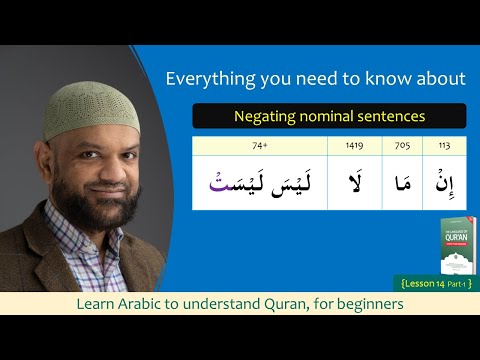 Click to play
Introduction
In previous lessons we learned to form and emphasise the nominal sentence (الجُمْلَةُ الاسْمِيَّةُ). In this lesson we learn how to negate it using three tools: لَيْسَ (a verb), and مَا and لَا (particles). Each tool converts the sentence to a negative meaning while the predicate (الخَبَر) shifts to nasab (accusative) case.
Lesson Notes
Review: Jumlah Ismiyyah Structure
A nominal sentence has two parts, both in rafa' by default:
| Part | Arabic | Function | I'rab |
|---|---|---|---|
| Subject | زَيْدٌ | مُبْتَدَأ (mubtada') | رَفْع |
| Predicate | عَالِمٌ | خَبَر (khabar) | رَفْع |
زَيْدٌ عَالِمٌ — Zayd is a scholar.
Key reminder: when the subject is indefinite, a jar-majroor or adverbial (zarf) predicate comes first. Jar-majroor and zarf phrases can never serve as mubtada'.
Negation with لَيْسَ (Laysa)
لَيْسَ is a verb that negates the nominal sentence. It:
- Adds the meaning "not" to the sentence
- Converts the khabar into nasab
The subject is now called اِسْمُ لَيْسَ (ismu laysa) — remains rafa'. The predicate is now called خَبَرُ لَيْسَ (khabaru laysa) — becomes nasab.
| Positive | Negative |
|---|---|
| زَيْدٌ عَالِمٌ — Zayd is a scholar | لَيْسَ زَيْدٌ عَالِمًا — Zayd is not a scholar |
| زَيْنَبُ ذَكِيَّةٌ — Zaynab is clever | لَيْسَتْ زَيْنَبُ ذَكِيَّةً — Zaynab is not clever |
Because لَيْسَ is a verb it requires gender agreement:
- لَيْسَ — used when the subject is masculine
- لَيْسَتْ — used when the subject is feminine
لَيْسَ appears 74 times in the Quran; لَيْسَتْ 3 times.
Negation with مَا (Ma)
مَا is a particle that behaves exactly like لَيْسَ grammatically — it converts the khabar to nasab. Because it is a particle (not a verb), there is no masculine/feminine distinction.
مَا زَيْدٌ عَالِمًا — Zayd is not a scholar.
Other uses of مَا in Arabic:
- Negation of past-tense verbs
- Relative pronoun ("that which")
- Question word (مَا هَذَا — what is this?)
مَا is used 705 times as a particle of negation in the Quran.
Negation with لَا (La)
لَا is a particle that also negates like laysa, but is primarily used when the subject is indefinite.
لَا خَوْفٌ عَلَيْهِمْ — There is no fear upon them. (خَوْفٌ is indefinite)
لَا is used 1419 times as a particle of negation in the Quran.
Double and Triple Negation
Arabic negates two or three things in one structure by combining مَا and لَا or repeating لَا:
| Pattern | Example | Meaning |
|---|---|---|
| مَا...وَلَا | مَا عِنْدِي قَلَمٌ وَلَا كِتَابٌ | I have neither a pen nor a book |
| لَا...وَلَا | لَا خَوْفٌ عَلَيْهِمْ وَلَا هُمْ يَحْزَنُونَ | No fear upon them, nor will they grieve |
| لَا...لَا...لَا | لَا بَيْعٌ... وَلَا خُلَّةٌ... وَلَا شَفَاعَةٌ | No exchange, no friendship, no intercession |
Summary
- لَيْسَ (verb): negates nominal sentences; gender agreement required (laysa / laysат); khabar becomes nasab (خَبَرُ لَيْسَ); subject stays rafa' (اِسْمُ لَيْسَ)
- مَا (particle): same grammatical effect as laysa; no gender distinction; 705x in Quran as negation; also used as relative pronoun and question word
- لَا (particle): primarily with indefinite subjects; 1419x in Quran; main particle for negating the imperfect verb (al-mudari')
- Double negation: مَا...وَلَا or لَا...وَلَا; triple negation: لَا...لَا...لَا
- When jar-majroor or zarf is the predicate, the indefinite subject follows — no visible nasab change on the subject itself
Terminology Reference
| Arabic | Transliteration | Meaning | Type |
|---|---|---|---|
| لَيْسَ | laysa | is not (masculine) — negating verb | FIL |
| لَيْسَتْ | laysat | is not (feminine) — negating verb | FIL |
| مَا | ma | not — particle of negation (no gender distinction) | HARF |
| لَا | la | no / not — particle of negation, mainly with indefinite subjects | HARF |
| اِسْمُ لَيْسَ | ismu laysa | subject of laysa, remains in rafa' | ISM |
| خَبَرُ لَيْسَ | khabaru laysa | predicate of laysa, converted to nasab | ISM |
| دَافِعٌ | dafi` | preventer / repeller | ISM |
| خَوْفٌ | khawf | fear | ISM |
Linked Arabic terms open their full entry in the Arabic Grammar Guide.
📖 Grammar guide. Grammar terms are explained in the Arabic Grammar Guide — fully vocalised, searchable in Arabic, any transliteration, or the English meaning.
Lesson Transcript
Read the full transcript (4,296 words)
Auto-generated from the lesson video. Timestamps jump to that point in the video. May contain transcription errors.
0:00 The language of Quran, easier than English. Asalaamu Alaikum and welcome to lesson number 14, part 1. In this lesson, our main focus is how to negate the nominal sentence. We've been learning how to use the nominal sentence in the previous lesson.
0:15 We've learned how to emphasise the meaning of the nominal sentence. In this lesson, inshaAllah ta'ala, we're going to learn how to negate the nominal sentence, how to use laisa, how to use the particles as in ma and la to negate sentences, how to do the categorical negation and the emphatic negation in Arabic, and also how to use illa as exception. So, a lot to cover. Let us begin with the blessed name of Allah. Bismillahirrahmanirrahim. Rabbi zidni ilma, O my Lord, increase me in knowledge.
0:49 Negating nominal sentences with laisa. Before we look at how to negate the nominal sentences, inshaAllah, I'm going to quickly review jumla ismiya. And again, you should be very familiar with this. Zaidun alimun. Now, translation will be very easy for you. Zaid is a scholar. I've got two parts. We have both parts marfu. The subject and the predicate.
1:13 The subject comes first, muqtada, and the khabar comes after. So again, very, very easy. And as you know, the subject and the khabar, they will match in number and gender, and the subject will be definite in most cases, and the khabar will be indefinite. However, when the subject is indefinite, the subject is indefinite. For example, here, fil bayti rajulun. The translation of it is, a man is in the house.
1:41 In English, of course, we can say, there is a man in the house. Here, fil bayti is, of course, jar, because al bayti is preceded by a harf of jar, and rajulun is rafa. We have here, harf of jar, ism majroor. And please note, if they come in the beginning of the sentence, they cannot be muqtada. Harf of jar, ism majroor, cannot be muqtada. It can be khabar, but not muqtada.
2:06 So what is happening here, because the subject is indefinite, the khabar is coming first. So this is called khabar muqaddam. It literally means khabar coming first, and muqtada coming later, or after. So this is the change in the structure of the sentence, when the subject is indefinite, and we have a muraqab jari. Also, if you look at the example three, we have baytu zaydin. Now this is an edafa structure, I'm sure you should know by now.
2:42 And the translation is, Zayd's house is big. House of Zayd is big. Baytu zaydin will be now our subject. Mudaf mudaf ilayhi, of course, is more than one word. Mudaf mudaf ilayhi, which is our muqtada, and the predicate is kabeerun. So Zayd's house is big. So describing Zayd's house, or giving information regarding house of Zayd, or Zayd's house. Now if you look at the next example, Amam al bayti shajaratun. Amam al bayti, again, is, of course, mudaf mudaf ilayhi.
3:17 And the shajaratun is rafa, we can see. Now when the mudaf is an adverb, it is called an adverbial phrase, and it behaves exactly like number two, which is jar majroor. Exactly the same. Therefore, when the mudaf mudaf ilayhi, is a special type of mudaf, which is zarf, even if it comes at the beginning of the sentence, it cannot be muqtada. And we have an indefinite khabar. So what we have here is exactly the same as number two.
3:46 We have the khabar coming first, and the muqtada coming after. So these are the nuanced changes that we've learned to the muraqab, to the jumla ismiya in different forms. Of course, the other issues are also there.
4:01 The matching of the gender and the number and the other rules related to the jumla ismiya that we've covered many, many times. This is one that people tend to forget. So please pay attention to this, inshallah ta'ala, because even in the previous lesson, when we did the emphasis with inna and her sisters, you'd have to recognise the subject and the predicate to label it correctly.
4:22 And of course, to translate it correctly. So these are the basic rules, a review for nominal sentences. Now let us look, how do we negate nominal sentences? Two example of sentences, first in the positive and the second in the negative. So I'm saying zaydun alimun. Of course, we've just done that. Zayd is a scholar, muqtada and your khabar.
4:48 Now we're going to use a word called laisa. Now laisa is actually a verb in Arabic, and it can be conjugated to 14 different forms. Laisa, so it will negate a jumla ismiya. Please now pay attention to that. Now when it does that, it converts the khabar to nasab. Pay attention. So we have laisa zaydun alimun. Zayd is not a scholar. Zayd is not a scholar.
5:17 So the word laisa gives it the meaning of not, but it converts the khabar into mansub. So the labelling, very similar to what we said, seen in the previous lesson, now needs to change. So we have one rafa, the other nasab, and this will be called ismu laisa. Ismu laisa and khabaru laisa. Ismu laisa, khabaru laisa. So the muqtada is now changed, very similar to what we seen in the previous lesson with inna.
5:46 Inna, ismu inna. This is now ismu laisa. The ism of laisa will be rafa, and the khabar of laisa will always be mansub. Always be mansub. Another reason now you've learned where the ism is mansub. So we have two sentences here. Let's quickly review them one more time. Zaydun alimun. Zayd is a scholar. Laisa zaydun aliman. Zayd is not a scholar. Zayd is not a scholar.
6:18 So what I have done in terms of meaning, I have used laisa to negate, and also converted the khabar into mansub. These are the two points that you need to know when the word or the verb laisa is used. So again to reiterate the point, another slide on the same topic as we had in the previous screen. The first we have, Zaynab is clever. Very simple sentence. Zaynabu dhakiyatun. Dhakiyatun, which it is. Of course, both are rafa. I put laisat in front because Zaynab is feminine.
6:53 I have Zaynabu dhakiyatan. So laisat Zaynabu dhakiyatan. And of course by now you are expert in this. So this is now nasab and this is rafa. So you have your ismu laisa and khabaru laisa. Now in the same example here, alwaladu, which is masculine. Hakimun, the boy is wise. But I want to say the boy is not wise. I simply put laisa in front. Alwaladu, which is rafa. And this is nasab. Hakiman.
7:22 So laisa alwaladu hakiman. The boy is not clever. So the use of laisa in the Quran has been 74 times, as far as I could find. And three times for laisat. Laisa and laisat. So you can see here, alhamdulillah, how they're used. Now, as I mentioned earlier, laisa will have 14 different forms. One for each pronoun. But we don't need to learn them at this stage in book two when we do verbs.
7:48 Inshallah, we'll cover them. But it is a verb. And therefore we have a masculine version and the feminine version. And I'm sure by now you can remember we did, for example, ja'a. And we did ja'at. Already, okay. Ja'a and ja'at. He came and she came. So this is a different way of understanding negation using laisa.
8:10 Please note that, inshallah ta'ala. And the only thing you need to worry about is if the subject is masculine, you will use laisa. If the subject is feminine, you will use laisat. Two examples from the Quran of its use. To the disbelievers of it, there is no preventer. To the disbelievers, there is of it no preventer. I've given the ayah reference, inshallah. Please do check the full source. I will just go through the basic meaning here.
8:38 So lil kafireena, I'm sure you should be able to work out now. This is jar, the li part, which is this part here. And kafireena is, of course, in majroor or jar status. So you have jar plus majroor, both together. So that should be very easy. And li, there's a al there, which is hamzatul wasal and the laam.
9:05 And because li's been added, that's been removed. If you're unsure, please check lesson number eight and nine, where I went through this in detail. So to the disbelievers, lil kafireena laisa. So this is your negation of what's coming after. lahu daafi'un. Remember I said jar majroor cannot be muqtada. So this is khabar coming first. Okay, daafi'un, no preventer. So again, you can see here, alhamdulillah, everything we've learned, we are repracticing. Something new, laisa. We have another example here. laisa kamithlihi shai'un.
9:45 Please look at how beautiful example this is. laisa negating. Ka is your harf of jar. This part is your ism majroor. Okay, this is your ism majroor. The hi is your mudaafi layhi because it's an attached pronoun to a noun, an ism. So mithl or example is the noun and ka. So like him, like him, kamithlihi, like him. So not like him, shai'un, anything. So there is nothing like unto him. This is the translation. And you see this structure quite often in the Quran.
10:32 So pay attention to that, inshallah. Wa huwa. And the rest should be very easy for you. Huwa is your pronoun. So this is your naa mubtada, second sentence. So this wa is splitting the two parts together. And he is assamiu al basiru. He is all hearing, the hearing, the seeing. Again, the reference is given for you from the Quran here.
10:55 So alhamdulillah, you can see that every time we're learning something new, we can open up at least another part of an ayah or parts of an ayah now as we're going through the examples. So again, the second example, laisa kamithlihi shai'un. There is nothing like unto him, i.e., of course, referring to Allah azza wa jal.
11:12 And he is all hearing, all seeing, or he is the hearing and he is the seeing. So again, please note these two examples and you should be able to understand all parts of it, even if you're not familiar with one or two of the words. Negating with the particles ma, in, la. Ma, in, and la, they actually work very similar to laisa. Except for one thing, they're not verbs, they're particles. However, since they are particles, there's no need to worry about masculine and feminine.
11:43 So in will be whether the same, ma will be the same, la will be the same, whether it is masculine or feminine. Ma, of course, has many uses in Arabic. One of which is negation. One of which is negation. We will look at others like, it is used as a relative pronoun. It is used also to negate past tense verbs.
12:02 It is also used for asking question. For example, ma hatha, what is this, et cetera, et cetera. Another one of its use is a negation in jumla ismiha, behaving like laisa, behaving like laisa. In has a lot of complex issues. One of them is that it can be used with negation. It is mainly used with illa.
12:22 We will look at that later, inshallah. And la is primarily only used for negation, but in many different ways. In this case, we're going to look at it, how it is used like laisa, but mainly la is used with indefinite, when the subject is indefinite.
12:37 Slight variations of them all, but learning them, you can see inshallah ta'ala, ma is used 705 times in 113, and la is 1419 as particles of negation. So you can see the frequency in the Quran is quite high. We just need to become familiar with how they're used. And when we go to advanced, inshallah, we'll pick up its variations. So three sentence examples now, just to illustrate ma and its use. It's exactly the same, inshallah.
13:06 Nothing here new. We have, of course, Zaid is not a scholar. And of course, I put ismu laisa and khabaru laisa. Now, ma Zaidun aliman. I hope you can see it's exactly the same. Ma is behaving like laisa. So Zaid is not a scholar. The translation is exactly the same. When we use ma, we don't have to worry about the feminine version. Ma is used both masculine and feminine. So again, ismu ma and khabaru ma. This is the easiest way to do it.
13:42 We're not going to go into the complex details at this stage. So ma is used exactly the same as laisa, and it will convert the nasab into nasab, the predicate, the khabar. So please pay attention to that. Nothing new as compared to laisa. Four examples on the screen. Quickly illustrate ma for our benefit. This is a student. I'm pointing to somebody. Now I point to somebody and say, this is not a student.
14:15 This is not a student. Again, I hope you can see that this is now mansub or in nasab. They are believers. Female plural. Okay, they are female plural believers. This is nasab. Of course, it could be nasab or jar. Sound feminine plural. Please refer to lesson number four. If you've forgotten. They are not believers. Next. The house is new. The house is not new. Okay, the house is not new.
14:59 Then we have I have a car. I have a car. Now here you don't see anything mansub. Why? Because remember earlier I told you indi is actually a mudaf mudaf ilayhi structure. Yes. So we have inda. That's the original. But then I add the ya mutakallim. The ya mutakallim will always, always force the word before it to take a kasra.
15:35 So we have indi, indi. So we don't know the arab of it in simple form. But of course, when we look in the detail, we'll work out the arab. But most important thing here, this is mudaf, mudaf ilayhi. And inda is actually a dharf. So let me write that down. So inshallah ta'ala you can note it down. Dharf, which is an adverb. So therefore indi, I have, is going to become the qabr, coming early, first.
16:04 Sayyaratun, car, is my subject. So I'm saying here, I do not have a car. I do not have a car. Ma indi sayyaratun. And that is why you cannot see that this is in nasab at the moment, because it is another structure on its own and plus the ya mutakallim. So I will say now here, this is my ismu ma and this is my qabr.
16:30 Qabr, mutallik or shibu jumla, whichever way we want to do it, inshallah ta'ala. So this is the difference between the first three and the last one, four. To illustrate that, let's look at a bigger example inshallah. I want to say he has a brother in Arabic. He has a brother. Lahu, I hope you can remember lahu is what? Jaar majroor.
16:51 So he has a brother and he does not have a brother. Ma lahu akhun, he does not have a brother. So what is happening here? Lahu is jaar majroor. Akhun is now of course rafa. But what is it? Lahu jaar majroor is your qabr coming early and akhun is your mubtada coming late. And therefore the labelling of it will be early predicate and subject delayed or late or coming after.
17:23 And this is your jumlatul ismiya where the mubtada and qabr has been turned around. Why? Because akhun is indefinite. It is not the brother. It is a brother. Ma lahu akhun is exactly the same except for that of course, I have the jaar majroor which is my qabr and I have my mubtada coming later, qabr coming early. But we have the ma which is for negation coming earlier.
17:46 That's the change meaning but the structure is exactly the same. So again, I repeat, if you see jaar majroor or adverb followed by mudafi ilayhi, they cannot be the subject of or the mubtada and therefore they cannot fit into that slot. And therefore when the subject is indefinite, they're moved around to facilitate that in Arabic.
18:08 Please pay attention to these forms inshallah ta'ala because otherwise you'll be confused when you cannot see the nasab. It is because the structure itself has taken that position. So again, a few examples from the Quran. This is not a man. So I'm has been changed to because of So you can see that inshallah in that structure. He shall not have no power nor helper. So he shall have no power or no helper. Again, exactly the same. I hope you can see jaar majroor, another one here.
18:53 And then la is repeated here for the second negation. We'll look at la shortly inshallah. Not they, female plural. They are not their mothers. The him is your attached pronoun. And ummahat is the sound feminine plural. And therefore this is now acting as we've seen the previous examples earlier. This is ma, hunna is your subject. Ummahati, him, their mother, which is your predicate. And the predicate here is nasab. Remember the feminine plural is atun, atin. Here is ati for nasab or jaar.
19:42 But it is now going to be nasab, why? Because of ma in the front. And of course, lost is tanween because it is mudaf. Anytime a pronoun is attached to a noun, it will be mudaf, mudaf ilayhi. Now la is also used for negation. I've got two examples here, both from the Quran inshallah. Exactly the same principle as we've seen with laisa in terms of grammar. But la is used mainly where the subject is indefinite. Subject is indefinite. So la rajulun khayran minka.
20:14 There is no man better than you. There is no man better than you. So again, this is a construct here, of course, jaar majroor. La rajulun khayran minka. And again, we have la khawfun alayhim. There is no fear upon them. Khawfun is indefinite. Rajulun is indefinite. Therefore, I'm using la. La khawfun alayhim, of course, is from the Quran. It's a commonly used structure in the Quran. I've many, many examples.
20:45 I've given you one here. So that inshallah, when you come across it, you'll recognise it. So there is no fear upon them. So as a general rule, when you have multiple negation, ma and la can be used. La can be used also repeatedly for double or second negation, triple negation. Negating three things at the same time in one structure. You repeat the la again and again. So we'll see a few examples here. I've got seven examples on the screen.
21:11 I'm going to enlarge them inshallah and go through them so that these points can be understood and you can see how they're used in the Quran. So the first three examples, the first one is ma indi qalamun. I don't have a pen. But by putting wa here, I'm joining something else to it. Wala kitabun. So I'm using la again for negations. Ma for the first one, la for the second negation. Another example of it here, ma huwa imaman. He is not an imam.
21:42 Wala shaykhan. Nor is he a sheikh. So again, double, two negations here. Ma first, la in the second. And then this is a Quranic example. So this is your first negation. I hope you can see it. Other than Allah. Again, another jar majroor. So you've got one here. One there. One there. And these two are the idafa structure. Okay, this is why this is majroor. So, and you have no guardian or helper besides Allah.
22:28 You have no guardian or helper besides Allah. So you can see here, ma negating the first part, la negating the second part. In the next four example, again, they're all from Quran. You'll see now la being repeated. So the first, fourth example, we have. There shall be no fear upon them, neither shall they grieve. There'll be no fear among them, upon them, nor shall they grieve. In the fifth example. So again, quite a few negations there.
23:08 But how is it happening? Three different ones. And there is to be no intimate relations, foul language, and arguments during hajj. And arguments during hajj. Three specific negation using la la la. So we've seen ma la combination. We've seen la la combination. We've seen now la la la. Why are the differences? We don't need to go into this detail. We need to recognise them at this stage. And then we have another very powerful example. We have ma kana. So here we have ma first.
23:43 The sixth example, we have ma first negation. So Ibrahim was not a Jew. Nor a Christian. So again, two negations here. Very powerful statement. Ibrahim could not have been a Jew, nor could he have been a Christian. He predated both. So what was his deen? So ma kana Ibrahimu yahudiyan wala nasraniyan. Again, you can see that inshallah ta'ala very clearly. Reference is given there for you. In the seventh and last example on the screen, we have three uses of la. We have here the first la.
24:25 The second la and the third la. So yawmun, a day. La bay'un fihi, there is no buying or exchange on that day. Wala khullatun, nor is any no friendship. Wala shafa'atun, or intercession. Of course, it is talking about the day of judgement. Whatever we are going to earn, we're going to earn in this dunya. And may Allah's mercy upon us. Because on the day there is no ransom.
24:55 There is no friendship. There is no intercession except by the permission of Allah azza wa jalla. So these are the beautiful examples for us. Just to see the simple negations that we are adding to the knowledge that we've already got. Inshallah ta'ala. Inshallah, we'll conclude the first part of the video here. Alhamdulillah, we have covered the negation of the jumla ismiya. The simple how to do that. We've covered how to use laisa.
25:21 We've also done how to use inma la. Exactly the same as laisa, really. But these are particles. The other laisa was, of course, a verb. So you had laisa and laisat. Alhamdulillah, very simple. If you've done the previous lesson with inna, well, this should not really cause you any major problems, inshallah ta'ala. In the second video, we will continue the topic. And jazakumullahu khayran for your feedback and watching the video.
25:45 May Allah subhanahu wa ta'ala bless you. I hope and pray you are benefiting from these lessons. Kindly share, like and subscribe. Encourage others to learn and share widely. So others from the ummah can benefit from learning Arabic to understand Quran. Until the next video, remember us in your du'as. Assalamualaikum warahmatullahi wabarakatuh.
Test Yourself
After every lesson it is essential to test what you have learnt. We are working hard to produce the full set of resources for every lesson — thank you for your patience.
If you would like to support the production of content and the running of this site, you can do so on our support page.
Updated