
إنَّ and Her Sisters — إنَّ وَأَخَوَاتُهَا
أنَّ · كَأنَّ · لَيْتَ · لَكِنَّ · لَعَلَّ · noon of protection · Quranic examples
- Name all six sisters of إنَّ with their meanings and Quranic frequency
- Distinguish أنَّ from إنَّ by their position in the sentence
- Understand كَأنَّ as a particle of comparison and apply it to Quranic examples
- Recognise لَيْتَ as a particle of wishing and لَكِنَّ as a particle of contrast
- Understand the three meanings of لَعَلَّ (hope, apprehension, purpose) and identify them in context
Video Lesson
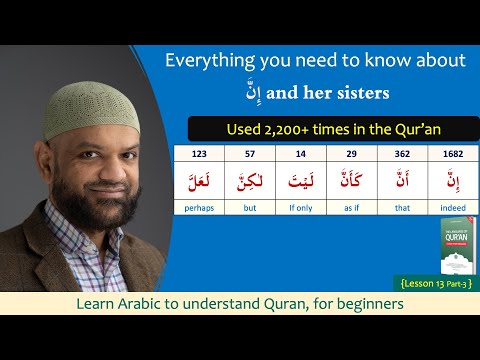 Click to play
Introduction
In Parts 1 and 2 we explored إنَّ in depth — how it works, how to attach pronouns to it, and how to combine it with the lam of emphasis and إنَّمَا. Part 3 completes the picture by introducing the remaining five sisters: أَنَّ، كَأَنَّ، لَيْتَ، لَكِنَّ، لَعَلَّ.
Together, these six particles appear over 2,200 times in the Quran — on average three or four times every page of the standard Mus-haf. They are known collectively as إنَّ وَأَخَوَاتُهَا (Inna and her sisters), or in the classical grammar books as الْحُرُوفُ الْمُشَبَّهَةُ بِالْفِعْلِ (particles resembling the verb) — because like a verb, they take their ism into nasab. All six share the same grammatical rule. What distinguishes them is meaning and position.
Lesson Notes
The Rule Common to All Six Sisters
All six particles — إنَّ، أنَّ، كَأنَّ، لَيْتَ، لَكِنَّ، لَعَلَّ — share the same grammatical effect: [Ism of the particle: nasab] + [Khabar of the particle: rafa] Learn the rule once for إنَّ and you have learned it for all six.
أَنَّ — That / Verily (Mid-Sentence)
أَنَّ is grammatically identical to إنَّ — same impact, same meaning of assertion. The crucial difference is position in the sentence:
- إنَّ always comes at the beginning of its clause.
- أَنَّ always comes in the middle — it can never open a sentence.
أَنَّ typically follows a verb such as عَلِمَ (to know), شَهِدَ (to bear witness), or أَشْهَدُ (I bear witness):
> أَشْهَدُ أَنَّ مُحَمَّدًا رَسُولُ اللهِ — I bear witness that Muhammad is the messenger of Allah.
Here, أَشْهَدُ (a verb) has come first, so we use أَنَّ not إنَّ. مُحَمَّدًا is the ism of أَنَّ (nasab) and رَسُولُ اللهِ is the khabar (rafa — mudaf-mudaf ilayhi structure).
One important exception: after the verb قَالَ (he said) and its derivatives, إنَّ may appear in the middle — this is not أَنَّ but إنَّ in a rare permitted position.
إنَّ = beginning of clause أَنَّ = middle of clause (after a verb like عَلِمَ، شَهِدَ، قَالَ etc.)
أَنَّ is used 362 times in the Quran.
كَأَنَّ — As If / As Though (Comparison)
كَأَنَّ expresses comparison — like saying "he is like a lion" or "it is as if they were eggs." It is formed from كَ (the particle of comparison, meaning like) + أَنَّ. It makes its ism nasab and leaves its khabar in rafa, exactly like إنَّ.
> كَأَنَّ زَيْدًا أَسَدٌ — It is as if Zayd is a lion (he is very brave).
كَأَنَّ is used 29 times in the Quran.
لَيْتَ — If Only / I Wish (Expressing a Wish)
لَيْتَ is the particle of wish or longing. It is used to express something the speaker desires — whether that wish is attainable or not. It carries the same grammatical rule: its ism takes nasab and its khabar stays in rafa.
> لَيْتَ الإِسْلَامَ غَالِبٌ — If only Islam were victorious.
لَيْتَ is used 14 times in the Quran but appears frequently across all classical Arabic texts.
Note on the noon of protection with لَيْتَ: When attaching the ya mutakallim (I) to لَيْتَ, the noon of protection is required — لَيْتَنِي is the only option (لَيْتِي is not used). This is the opposite of لَعَلَّ where the noon of protection is not permitted.
لَكِنَّ — But / However (Contrast)
لَكِنَّ is the particle of contrast and correction. It introduces a statement that is contrary to or qualifies what came before. In English it conveys: but, however, or on the contrary.
> الرَّجُلُ غَنِيٌّ لَكِنَّهُ بَخِيلٌ — The man is rich; however, he is a miser.
Here لَكِنَّهُ = لَكِنَّ + هُ (attached pronoun as its ism in nasab), and بَخِيلٌ is the khabar (rafa).
لَكِنَّ is used 65 times in the Quran.
لَعَلَّ — Perhaps / Hopefully / Maybe (Hope, Apprehension, Purpose)
لَعَلَّ has three possible shades of meaning depending on context:
- Hope — perhaps something good will happen: hopefully Zayd is well.
- Apprehension / fear — perhaps something unwanted may happen: perhaps he is ill.
- Purpose — so that / in order that.
The meaning is determined by context. The grammatical rule is unchanged.
> لَعَلَّ السَّاعَةَ قَرِيبٌ — Perhaps the Hour is near.
لَعَلَّ is used 129 times in the Quran.
Note on the noon of protection with لَعَلَّ: The noon of protection is not permitted with لَعَلَّ. Only لَعَلِّي is possible (not لَعَلَّنِي).
The Noon of Protection — Summary for All Six
| Particle | Noon of Protection |
|---|---|
| إنَّ | Optional — both إِنِّي and إِنَّنِي are used |
| أَنَّ | Optional — both أَنِّي and أَنَّنِي are used |
| كَأَنَّ | Optional — both كَأَنِّي and كَأَنَّنِي are used |
| لَكِنَّ | Optional — both لَكِنِّي and لَكِنَّنِي are used |
| لَيْتَ | Required — only لَيْتَنِي is used |
| لَعَلَّ | Not permitted — only لَعَلِّي is used |
Summary
- All six sisters of إنَّ — إنَّ، أنَّ، كَأنَّ، لَيْتَ، لَكِنَّ، لَعَلَّ — share the same grammatical rule: ism in nasab, khabar in rafa.
- أنَّ is identical to إنَّ in grammar but always appears mid-sentence (after verbs like عَلِمَ and أَشْهَدُ). إنَّ always opens its clause.
- كَأنَّ is used for comparison ("as if / as though") and appears 29 times in the Quran.
- لَيْتَ expresses a wish or longing and requires the noon of protection when the ya mutakallim is attached (لَيْتَنِي — no other option).
- لَكِنَّ introduces contrast or correction ("but / however") and is used 65 times in the Quran.
- لَعَلَّ expresses hope, apprehension, or purpose ("perhaps / hopefully / maybe"), used 129 times in the Quran. The noon of protection is not permitted — only لَعَلِّي.
- Together all six appear 2,200+ times in the Quran. Mastering إنَّ from Parts 1 and 2 means you have mastered the grammatical core of all six.
Terminology Reference
| Arabic | Transliteration | Meaning | Type |
|---|---|---|---|
| إِنَّ وَأَخَوَاتُهَا | inna wa akhawaatuha | Inna and her sisters — the six particles that share the same grammatical rule | grammatical category |
| الْحُرُوفُ الْمُشَبَّهَةُ بِالْفِعْلِ | alhurooful-mushabbaha bil-fi'l | particles resembling the verb — the formal Arabic name for إنَّ and her sisters | grammatical term |
| أَنَّ | anna | that / verily (always mid-sentence) | harf of nasab |
| كَأَنَّ | ka-anna | as if / as though (comparison) | harf of nasab |
| لَيْتَ | layta | if only / I wish (expressing a wish or longing) | harf of nasab |
| لَكِنَّ | lakinna | but / however / on the contrary (contrast and rectification) | harf of nasab |
| لَعَلَّ | la-alla | perhaps / hopefully / maybe (hope, apprehension, or purpose) | harf of nasab |
| نُونُ الوِقَايَة | noonul-wiqaya | noon of protection — inserted before ya mutakallim | grammatical term |
| يَا لَيْتَنِي | ya laytanii | woe to me / if only I had | expression of regret (Quranic phrase) |
Linked Arabic terms open their full entry in the Arabic Grammar Guide.
📖 Grammar guide. Grammar terms are explained in the Arabic Grammar Guide — fully vocalised, searchable in Arabic, any transliteration, or the English meaning.
Lesson Transcript
Read the full transcript (5,227 words)
Auto-generated from the lesson video. Timestamps jump to that point in the video. May contain transcription errors.
0:00 The language of Quran, easier than English. Asalaamu Alaikum and welcome to part three. In part one and two, we looked at in detail inna and how it works in the Jumla Ismiya nominal sentence. Now there are six words in Arabic which behave exactly the same way as inna. They are inna, anna, ka'anna, layta, lakinna, la'alla. So these are the six words that behave grammatically exactly the same way as inna.
0:28 They are called collectively inna and her sisters. inna wa akhawatuha, inna and her sisters. Very important lesson, why? Because these words collectively are used in the Quran 2,200 times.
0:43 That means on every page you will find three or four of them on the average because there are 600 pages in the standard Mus'haf and these come in the Quran more than 2,200 times. So let us begin this important lesson or this part of this lesson by reciting a'udhu billahi minash shaitanir rajeem bismillahir rahmanir raheem and making the dua rabbi yassir wa la tuassir wa thammim bil khair You're already familiar with this inshallah. Very quick review.
1:14 When it comes to a Jumla Ismiya which was originally allahu ghafoorun in this example converts it to inna allaha ghafoorun. The subject now is called ismu inna the khabar is now called khabaru inna and of course inna is called a particle of nasab and emphasis. We've done this and of course it can also be without a noun it could be a pronoun for example inna hu indeed he ghafoorun exactly the same principle we have the hu is mansub remember the attached pronoun can be nasab or
jar in this case because it's attached to inna it will be mansub and of course ghafoorun is marfo so this will be your ismu inna now the pronoun and the khabar of inna is ghafoorun both of the cases is Jumla Ismiya all inna has done is created emphasis hasn't really changed the meaning as such but all it's done is created emphasis and as a result many times in English you will not see this being translated whereas in the Arabic there is a deeper meaning which inshallah
ta'ala as you learn more and more Arabic grammar you will appreciate so allahu ghafoorun Allah is forgiving to create emphasis we say inna allaha ghafoorun indeed without doubt certainly Allah is forgiving creating emphasis in the meaning and this is what inna does and all the other six grammatically will behave all of the six I should say exactly the same way inna also we've learned is being used with the pronoun please note this chart is very important because inna alone is used in the Quran 1682 times
and of course significant number of times it is used with pronouns as opposed to a express noun so we need to memorise this chart I've asked you to do that before if you've done it already this lesson will be relatively easy for you and the pronoun the 14 pronouns are inni inna and of course there are two versions innani innana and I've explained why there are two versions in the previous videos please see on this lesson inshallah and you'll find it in the playlist just in
case you've just landed on this video please try to watch the videos in order you'll have less questions inshallah so this is the chart with the pronouns of inna and this chart must be memorised by you you should be able to recall it in recitation as well as in writing inshallah and this will help you progress through Arabic significantly these attached pronouns are very very important when it comes to understanding the Quran or any Arabic text as you've seen in the previous chart with inni there
were two versions and of course with inna there were also two versions let me explain this ya mutakallim now the ya mutakallim is called the ya of the first person usually translated as my or me depends on the context it's used or in some cases it can be translated as I it depends on how it's used this ya which is the personal pronoun first person I it requires always or prefers always a kasra before and this causes the issues and we mentioned it before when it
comes particularly see inshallah in book 2 when we go to verbs that sometimes you need to bring an extra noon in in order in order to facilitate the reading of it and of course to make sure that the previous word does not take a kasra so here you see inni so inna has been changed to a kasra whereas here by adding the noon then inna has remained the same and the noon has taken the kasra so this noon is called the noon of protection it's called
the noon of protection and this noon of protection with this six that we're learning now with inna with these four you have the option of using or not using you have the option you can use it or not use it both are used in the language so you have both are available okay and of course both are used however with laita please note you must use this noon on the other hand you cannot use this noon okay so it's so this is the six inshallah with
four of them option with two of them with one of them you must use it with the other you cannot use it so with laalla the noon of protection is not used so it becomes and with laita the noon must be used that's all you need to remember inshallah and you can do the rest of the chart relatively easily so please make a note of this inshallah it's not you wisely taught in books but i found it very useful so i always include it here for
your benefit the six particles that behave like inna are please repeat three four times inshallah you'll probably memorise it forever and of course it will become a great use to you once you've memorised it memorisation does help it's only six words if you repeat it a couple of times inshallah in this order so it's easy to remember i've given you the basic meaning of them also and the number of times they occur in the quran giving us a collection of 2200 words where these are used
please note significant number of times they'll be used with pronouns so you need to learn them with pronouns also inshallah now these six are collectively called in arabic grammar books and what does that mean it means particles that behave or resemble verbs is singular huroof is plural meaning resembling with the verb so something resembling verb they act like verb why because they make it mansub the other common name for them are which is more easier and her sisters or if you prefer i personally just would
simply at the beginning just call it harf of nasab or huroof of nasab that's the easiest way to remember them later on inshallah we can focus on learning the terminology at the moment we should focus on how they're used and what meanings they yield we're going to look at each one inshallah with examples from the quran in this last lesson and they're all important and you'll see them in hadith of course as well as in the quran anna is actually exactly the same as inna in
terms of what it does to the sentence as well as meaning it creates some emphasis in the meaning sometimes it is translated in english sometimes it is not that verily surely that kind of meaning now what inna and anna the difference between it inna almost always comes at the beginning of the sentence that's the most important thing anna can never come in the beginning it must always come in the middle there are some occasions when inna can come in the middle we will look at them
shortly but that's the difference so inna always at the beginning anna can never be at the beginning but always in the middle of a sentence structure so two examples which you should be able to translate inshallah very easily inna muhammadan rasoolullah indeed muhammad sallallahu alayhi wasallam is the messenger of allah so you have inna which is the harf of nasab and muhammadan which will be your ismu inna and of course rasoolullah is your khabar inna now khabar inna is not one word here it is mudaf,
mudaf ilayhi again if you're not familiar with this please check lesson number 10 and 11 very very important lesson as they are the most frequently used structure then we have ashhadu so we've already begun our statement ashhadu or sentence i bear witness now i cannot use inna anymore it has to be anna so i use anna muhammadan so this is your harf of nasab muhammadan is your ismu anna please note it is not called ismu inna but ismu anna okay anna here ismu anna and of
course khabar anna is rasoolullah or technically rasoolu and then this is your idafa structure so inna and anna almost identical that is the only thing you need to remember how they are placed in the sentence so inna you will see always at the beginning for example in this one inna rabbaka why rabbaka not rabbuka because of inna is changed to nasab cannot be rabbuka here rabbaka, rabbaka so these become nasab and that is your ismu inna inna rabbaka indeed your lord is hakeemun alimun all-wise all-knowing
so indeed your lord is all-wise and all-knowing however after the verb qala and any of its derivatives inna comes in the middle so there's a verb called qala which is one of the most commonly used verbs in quran and of course in hadith also you will see inna coming in the middle okay example qala he said innahu and this is related to musa alaihissalam please check the reference in the quran musa alaihissalam said innahu indeed it yaqulu he says i.e. allah azzawajal says innaha indeed it
okay innaha indeed it is baqaratun a cow safra'u meaning yellow so indeed it is a yellow cow yellow cow so again that is the basic translation you can see now that inna is being used in the middle this is a rare occasion but with qala it has to be used then we have other occasions where inna may be used we have inna sometimes is used after the verb alima and shahida again take example from the quran and allah which means knows k-n-o-w-s knows so this part
i think you should be able to fully translate inshallah and this laam is the laam of emphasis which we covered in the previous videos so indeed you certainly is his messenger indeed you are certainly certainly his messenger so a lot of emphasis given to the meaning that muhammad sallallahu alaihi wasallam is the messenger of allah of course allah knows it because he appointed him then allah says and allah bears witness testifies indeed the hypocrites again why because of inna has to be nasab and of course
you've done the muslim table you should know that this can be either nasab or jar and it is nasab here because of inna certainly are liars certainly are liars so again example of inna being used in the middle so you can see alhamdulillah with our progress now we are on lesson number 13 we are now beginning to appreciate significant parts of ayat that we are reading and these are just example and alhamdulillah with inna and our ancestors being done and previously we did the huruf of
jar we've done the mudaf mudaf ilayhi i'm confident you're not going to be open a single page of quran or single line of quran for that matter where you will not find one of these thing structures that we've already learned of course verbs we need to cover and we will do that in book two anna is also used with the pronouns so let's quickly review them inshallah please make a note of rewriting and memorising these and of course the second version again please take a note
and memorise them rewrite them and make sure you're able to read them out by looking and then later on without looking and rewrite them and that's when you know you've learned them inshallah ta'ala and of course not only will they help you with these but these attached pronouns you see them with verbs and when we go to verbs we don't have to worry about the attached pronouns that you will be able to master them by then inshallah so please to take some effort to make some
extra effort now to learn these so they will come in use in the future quick examples from the quran we'll take two inshallah with anna here translation basically is do you not know that to allah belongs the dominion the ownership the dominion the kingdom of the heavens and the earth so allah rules over the heavens and the earth so again this is a verb we'll learn that later ta'alam anna allaha you can see that here not allahu here allaha why? because of anna lahu we've done
this already lahu is the harf of jar with hu for him or belongs to him mulk means dominion rulership kingship of the heavens wal ardi of course the earth is one heavens is in plural so the dominion of the heavens and the earth so again alhamdulillah from here to here you've already learned so far with structures already inshallah ta'ala and again the reference is there should use to check it in the quran for your additional benefit and do an exercise see how much of the ayah
before it and after that you can already understand based upon you've been only in lesson number 13 the second example we're going to look at wa anna sa'ata and this is very important message wa anna that sa'ata means the hour in arabic or it can also be referred to watch but sa'ata here meaning the hour when the world will come to an end the universe everything will be brought to an end by Allah's command so and that the hour okay aatiyatun la rayba feeha is going
to come it's coming the final hour is coming la rayba feeha there's absolutely no doubt in it la rayba feeha no doubt in it wa anna allaha please pay attention here mansub and again you can see here it's mansub why? because of anna okay then what would Allah do? and that Allah yaba'athu man fil quboor will raise up those who are or whoever's in the grave the translations is here for you inshallah and please do read the context of the ayah so you can see how
beautifully these are used and how powerfully the message is given but certainly the hour is going to come there's no doubt in it meaning the universe will come to an end and that Allah subhanahu wa ta'ala is going to raise up everyone from their graves to hold account for what they did on earth may Allah subhanahu wa ta'ala make our living of this world with iman may Allah subhanahu wa ta'ala raises up on the day amongst the believers now let's quickly look at two with the
pronouns here we have shahidallahu Allah testifies okay bears witness annahu indeed he la ilaha illa huwa there is nothing but there is no nothing worthy of worship except he now here of course deity means some an object of worship so there's no ilah except he so again you can see here the attached pronoun with anna being used references are given on the screen for you wa annahu khalaqa and indeed he or certainly he khalaqa created zawjaini meaning in pairs meaning in pairs okay adhakara waluntha meaning
male and the female so Allah created the male and the female in pairs so you can see here annahu another example of the use of anna totally used 362 times in the Qur'an ka'anna ka'anna is again exactly the same as inna grammatically speaking it gives the meaning of comparison like not like we use in English like I like mangoes but it means he is like this so for example if I say he is like a lion or he is like a computer meaning his brain is
very fast that kind of meaning comparative so it can be translated as as if as though it is as if that kind of meaning or like the variations in translation in context so here we have an example ka'anna zaydan asadun it is as if zayd is a lion meaning he is not afraid of anyone very brave person so you have harf of nasab ka'anna and of course zaydan is ismu ka'anna and asadun is khabaru ka'anna very simple I don't think there's anything new here and of
course I can use the pronoun ka'annahu asadun it is as if he is a lion so again exactly the same harf of nasab ismu ka'anna and khabaru ka'anna you can see that alhamdulillah ka'anna is used in the Quran 29 times exactly the same as what we've learned and so if we put the effort into inna these will become relatively easy though there is a slight difference in meaning ka'anna is a comparative whereas inna was only used for emphasis ka'anna is also used with pronouns let's quickly
go through the 14 ka'annahu ka'annahuma ka'annahum ka'annaha ka'annahuma ka'annahunna ka'annaka ka'annakuma ka'annakum ka'annaki ka'annakuma ka'annakunna ka'anni ka'anna and the second version ka'annani ka'annana again take time to review them inshallah ta'ala as with the others this is used 29 times in the Quran significant number of times also with pronouns let's take two examples from the Quran with ka'anna this one is used with pronouns and I hope inshallah ta'ala you can easily see that this is the attached pronoun and this is your ka'annahunna of course referring to
feminine plural the home version hunna okay so this is the feminine plural baydun maknoonun now baydun maknoonun you should be able to recognise that is muraqab tawsifi rafa rafa and the four properties matching they're both indefinite so we have our standard sentence here of course influenced by ka'annah and normally adding ka'annah hunna so this is now ismu ka'annah this part and this is your khabaru ka'annah I hope that's easy for you and of course the translation is as if they were delicate eggs well protected as
if they were delicate eggs well protected another example from the Quran and we can see here inna allaha so we have inna already inna allaha not allahu allaha yuhibbu allatheena yuqatiluna fee sabeelihi saffa so indeed certainly Allah loves those who fight in His cause fee sabeelihi saffan in one solid structure in rows ka'annahum ka'annahum as if they were bunyanun marsusun so you can see the translation here indeed Allah loves those who fight in His cause in a row as though they are a single structure joined
firmly so again you can see here how ka'annah has been used again and of course another example of inna being used very very frequently used in the Quran and of course this is your isbu ka'annah just in case you are again wondering and this is your khabar of ka'annah and of course ismu inna is here and that the rest of the sentence comes in to fill in the gap of the additional meaning so these are things we'll pick up inshallah when we've done verbs but these
two examples will illustrate the use of ka'annah which is used in the Quran 29 times and it is used for comparison laita laita is one of the sisters of inna and it is used to express a wish a hope if only this would happen so you can say I wish that or if only this is the sense that is used and of course it has exactly the same impact so here I'm saying I wish that Islam was victorious so laita al-islama ghalibun laita al-islama so this
is la ismul laita and ghalibun is khabaru laita ghalibun is khabaru laita exactly the same as we've done before so you can see laita is only used 14 times in the Quran but of course you'll find it across many many other texts of Arabic that you read exactly the same as far as its grammatical impact is concerned laita is used with pronouns so let's quickly go through them so laita hu laita huma laita hum laita ha laita huma laita hunna laita ka laita kuma laita kum
laita ki laita kuma laita kunna and of course we have laita ni no other option and laita na again please note these please note the first person one that is only one option and the laita ni is used quite frequently in the Quran so you need to make note of that one inshallah another example of laita we'll come across in the book it's a very beautiful structure so I'll share it with you laita shababa laita shababa shabab means youth yaoodu yauman again that's a verb but
the structure meaning is if if only or I wish youth would return one day so when you get a little bit older my age and so on you start wishing that your youth would be back as it were and it would be in your youth again so this is the statement inshallah exactly the same principle ismu laita and khabaru laita laita shababa yaoodu yauman if only I wish youth would return one day quick examples from the Quran we have qeela dukhulil jannah and he was told
thou shalt enter paradise so he's been old two examples from the Quran we have here qeela dukhulil jannah and he was told qeela means he was told thou shalt enter paradise so you should enter paradise he immediately said ya laita whoa he explained okay would qawmi ya'lamoon if only people knew my nation only they knew what this is what a great honour it is or what a beautiful place jannah is so he's wishing that other people would have known what jannah is so again a very
beautiful example of laita and here please note there's the ya of the calling vocative which we haven't covered yet but we will be inshallah that is before it and laita is joined okay laita is joined to it so that is why in the Quranic script this alif here which is called the dagar alif representing ya so in many cases in the Quranic script you'll see this alif or in the Indian subcontinent they call it kharazabar it's really replacing exactly the same as having an alif there
so again different style of writing but this is in the Quran and very frequently used next example is wa yaqoolu ya laytani woe to me lam ushrik birabbi ahada woe okay woe to me ya laytani same ya is used okay wa yaqoolu i wish i had not associated partners with my lord meaning i had not associated anyone with my lord so again this is the regret of the and you find it in surah kahf please do read it inshallah ta'ala of the person ya laytani woe
to me woe to me so what after he's seen everything destroyed he regretted his shirk and again please do check the reference for further detail lakinna lakinna also exactly the same what it does it gives the meaning of but actually on the contrary however this is how we use them normally it is it is called a rectifying particle in Arabic grammar we don't need to learn the terms at this stage it gives emphasis to the context but to the contrary to the contrary you say no
but to the contrary that kind of use so we have an example here inshallah ta'ala which will help us understand how it's used the man is rich he's rich however he is a miser so contrary to his richness he's very tight you know in terms of spending his wealth in anything good always trying to save money so this is called a miser in English and so this is the example is given arrajulu ghaniyun the man is rich lakinna hu but he rather or however he bakhilun
is a miser so we have our lakinna here which is harf of nasab hu is your ismu lakinna and khabar here is bakhilun khabaru lakinna you can see exactly the same principle how it is used it's been used in the Quran 65 times so it gives a meaning of but actually on the contrary however there could be other contextual meanings also this is the meaning of lakinna exactly the same as inna lakinna is also used with pronouns so quickly let's go through them we have lakinna
hu lakinna huma lakinna hum lakinna ha lakinna huma lakinna hunna lakinna ka lakinna kuma lakinna kum lakinna ki lakinna kuma lakinna kunna lakinni lakinna na lakinna ni and lakinna all of the two versions are used remember i gave you the list before so in this one both versions are used let's look at two examples from the Quran maa khalaqna huma illa bil haq we did not create them but with true purpose true purpose walakinna walakinna however but aktharahum laa ya'lamoon but most of them do not
know the creation of the heavens and the earth whatever Allah has created is with a purpose but most people they do not know then we have another example this is from surah al-baqarah we have umaa kafara sulaymanu walakinna ash-shayateena kafaru note that Suleiman himself was a disbeliever i.e. Suleiman a.s. did not commit kufr Allah is clarifying here it is the devils the shayateen who did it who in fact were disbelievers so again the details are found in surah al-baqarah there walakinna walakinna is here and of
course shayateen okay shayateena not shayateenu shayateena this is nasab okay kafaru this is your verb the whole sentence is here the verb so verb is coming as the khabar we'll look at that inshallah ta'ala in future lessons so you can see another use of lakinna lakinna here from the quran and please note it has been used 65 times in total la'alla la'alla gives the meaning of maybe perhaps hopefully is there really to create three different ways depends on the context is used one is hope the
other is fear or apprehension and the third is purpose now when i say hopefully zaid is truthful i cannot say hopefully zaid is unwell that's pretty bad i don't want somebody to be unwell so here the meaning really is perhaps it possibly maybe that kind of meaning i haven't seen zaid for a few days maybe he is unwell same la'alla is used both cases but the meaning will be different depending on the context is used so the first example we have so we have here is
truthful which is our khabar of la'alla exactly the same principle you can see here the second example and so you can see here two different examples giving the slight nuanced meaning depending on the context that it is used please note la'alla is used 129 times in the Quran la'alla is also used with pronouns so let's quickly go through the 14 we have la'allakumaa la'allakum la'allaki la'allakumaa la'allakunna and please note there are only one version la'allee no noon option is allowed and la'allana again one option so
you can see the 14 pronouns used 129 times in the Quran significant number of them is used with pronouns so please note this chart also two examples from the Quran the first one la'alla then we have assa'ata i hope you can see that this is nasab and this is rafa so this is your ismu la'alla and this is your khabar of la'alla translation perhaps the hour is near perhaps the hour is near okay so la'alla assa'ata qareebun near let's look at the second example we have
wama yudreeka okay the translation of that is but what would make you perceive or realise what would make you perceive or realise la'allahu so this is your ismu of la'alla yazzakka that perhaps perhaps he might be purified again references is there for you to check so you can see the use with pronoun use with a noun this is how you need to recognise them and inshallah ta'ala the more time you come across it the more practise you do the easier it will become inna and her
sisters conclusion alhamdulillah by the grace of Allah subhanahu wa ta'ala we are now concluding the video part three of lesson 13 i did split the video up i could have done it in a shorter time but there's a lot of feedback from you guys that he preferred to go slower and of course breaking the parts videos into parts is not that of a great inconvenience so i hope inshallah ta'ala that you have got a flavour of what's going on there are some other additional stuff to
learn with for example inna anna and ka'anna dik lakinna also they can be used with the the ending being sukoon but we will look at that in advanced lessons inshallah ta'ala but apart from that all that which you need to know the most common most frequent have been covered in detail in the three videos and i hope and pray inshallah ta'ala and that is the ultimate test that you are benefiting from these otherwise it's just an exercise of producing videos the purpose and the intention is
that you're learning you're benefiting and i hope and pray that i'm able to explain the grammatical rules in a simplified way so you don't have to worry too much about terminology but more about practical understanding of what is going on when you begin to look at the quranic text for watching the videos all your feedback and your support and your duas may allah subhanahu wa ta'ala grant all of us taufeeq to begin to understand the quran begin to live by the quran and learn more and
more of the quran every day of our lives may allah subhanahu wa ta'ala make us all of those who are attached to the book of allah attached to the practises of our religion and attached our heart to the love of allah and his prophet thank you again for watching giving your feedback and your support kindly like subscribe and share so others can also benefit inshallah ta'ala i will see you at the next video assalamu alaikum
Test Yourself
After every lesson it is essential to test what you have learnt. We are working hard to produce the full set of resources for every lesson — thank you for your patience.
If you would like to support the production of content and the running of this site, you can do so on our support page.
Updated