
إنَّ — Particle of Emphasis and Nasab
إنَّ and the Jumlah Ismiyyah · Ism of إنَّ · Khabar of إنَّ · Nasab endings
- Recognise إنَّ as a harf of nasab and emphasis (حَرْفُ النَّصْبِ وَالتَّوْكِيدِ)
- Identify the ism of إنَّ (اسْمُ إنَّ) and understand why it takes nasab
- Identify the khabar of إنَّ (خَبَرُ إنَّ) and understand why it stays marfu
- Apply إنَّ to a variety of nominal sentences including duals, plurals, and special word types
- Name the six sisters of إنَّ and state their shared grammatical behaviour
Video Lesson
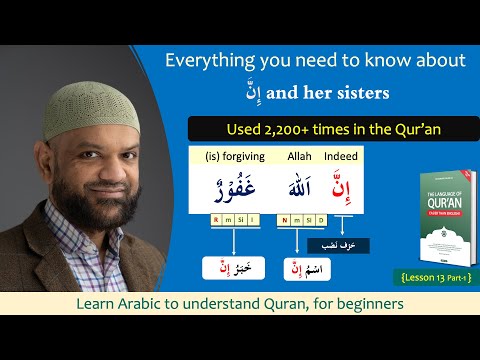 Click to play
Introduction
إنَّ is one of the most frequently used words in the Quran, appearing 1,682 times alone. Open any page of the standard Mus-haf and you will find it several times. Understanding how إنَّ works is therefore not an optional extra — it is foundational.
This lesson introduces إنَّ as the lead member of a family of six particles collectively known as إنَّ وَأَخَوَاتُهَا (Inna and her sisters): إنَّ، أنَّ، كَأنَّ، لَيْتَ، لَكِنَّ، لَعَلَّ. All six share the same grammatical impact on the nominal sentence (الجُمْلَةُ الاسْمِيَّة), and together they appear over 2,200 times in the Quran. If you have followed the previous lessons on the Jumlah Ismiyyah, the Huruf of Jar, and the Mudaf-Mudaf Ilayhi, this lesson will feel like a natural and rewarding next step.
Lesson Notes
What إنَّ Does to the Nominal Sentence
A standard Jumlah Ismiyyah has a مُبْتَدَأ (subject) in rafa and a خَبَر (predicate) also in rafa:
> اللهُ غَفُورٌ — Allah is forgiving.
When إنَّ is placed at the front of this sentence, two things happen simultaneously:
- Emphasis is added to the meaning — the sentence now conveys: Indeed / Certainly Allah is forgiving.
- The مُبْتَدَأ changes from rafa to nasab — it is no longer called mubtada but اسْمُ إنَّ (ism of inna).
- The خَبَر stays in rafa — it is now called خَبَرُ إنَّ (khabar of inna).
> إِنَّ اللهَ غَفُورٌ — Indeed, Allah is forgiving.
إنَّ + [اسْمُ إنَّ: nasab] + [خَبَرُ إنَّ: rafa] The subject (ism of inna) always takes nasab. The predicate (khabar of inna) always stays marfu.
How Nasab Shows on Different Word Types
The nasab change is expressed differently depending on the word type — this is where all the earlier lessons come together:
- Regular nouns (e.g. حَامِد): rafa = حَامِدٌ → nasab = حَامِدًا → result: إِنَّ حَامِدًا صَالِحٌ
- Diptotes (e.g. إِبْرَاهِيم): no tanween in any case — rafa = إِبْرَاهِيمُ → nasab = إِبْرَاهِيمَ → result: إِنَّ إِبْرَاهِيمَ عَالِمٌ
- Indeclinables (e.g. مُوسَى، هَذَا): the ending does not visibly change, but the word is grammatically in nasab because of إنَّ
- Sound masculine plural (e.g. مُؤْمِنُونَ): rafa = مُؤْمِنُونَ → nasab/jar = مُؤْمِنِينَ → result: إِنَّ الْمُؤْمِنِينَ شَاكِرُونَ
- Dual (e.g. مُسْلِمَانِ): rafa = مُسْلِمَانِ → nasab/jar = مُسْلِمَيْنِ → result: إِنَّ الْمُسْلِمَيْنِ صَادِقَانِ
- The Five Nouns (أَب، أَخ etc.): rafa uses waw (أَبُو), nasab uses alif (أَبَا), jar uses ya (أَبِي) → result: إِنَّ أَبَا حَامِدٍ عَالِمٌ
إنَّ always puts its ism (the original mubtada) into nasab. The khabar of إنَّ always remains marfu — this never changes.
The Khabar of إنَّ Coming Before the Ism
When the khabar of إنَّ is a shibh ul-jumlah (a jar-majroor phrase or an adverbial mudaf structure), and the ism of إنَّ is indefinite, the khabar may — and often does — come first. This is a recognised and beautiful pattern in Quranic style. The khabar in such cases is called a muta-alliq (مُتَعَلِّق), connected to a hidden verb.
If the ism of إنَّ is indefinite and the khabar is a shibh ul-jumlah, the khabar comes first and the ism of إنَّ comes at the end.
The Six Sisters of إنَّ
All six particles share the same grammatical rule — they take their ism into nasab and leave the khabar in rafa. They differ in meaning:
| Particle | Meaning |
|---|---|
| إِنَّ | indeed / certainly |
| أَنَّ | that / verily (mid-sentence) |
| كَأَنَّ | as if / as though |
| لَيْتَ | if only / I wish |
| لَكِنَّ | but / however |
| لَعَلَّ | perhaps / hopefully |
Summary
- إنَّ is a harf of nasab and emphasis (حَرْفُ النَّصْبِ وَالتَّوْكِيدِ), appearing 1,682 times in the Quran.
- It converts the مُبْتَدَأ into اسْمُ إنَّ in nasab, while the خَبَرُ إنَّ stays in rafa.
- The nasab ending is expressed differently by different word types — some show a visible ending change, others (like مُوسَى or هَذَا) are grammatically nasab even though their form does not change.
- إنَّ is the lead member of a family of six particles — إنَّ، أنَّ، كَأنَّ، لَيْتَ، لَكِنَّ، لَعَلَّ — all sharing the same grammatical rule but each with its own distinct meaning.
- When the khabar is a shibh ul-jumlah and the ism is indefinite, the khabar precedes the ism — a common and meaningful Quranic word-order pattern.
Terminology Reference
| Arabic | Transliteration | Meaning | Type |
|---|---|---|---|
| إِنَّ | inna | indeed / certainly / verily | harf (particle of nasab and emphasis) |
| حَرْفُ النَّصْبِ وَالتَّوْكِيدِ | harful-nasbi wat-tawkeed | particle of nasab and emphasis | grammatical term |
| اسْمُ إنَّ | ismu inna | the subject of إنَّ — takes nasab | grammatical term |
| خَبَرُ إنَّ | khabaru inna | the predicate of إنَّ — stays marfu | grammatical term |
| مَنْصُوب | mansoob | in the nasab (accusative) case | grammatical term |
| مَرْفُوع | marfoo | in the rafa (nominative) case | grammatical term |
| أَنَّ | anna | that / verily (mid-sentence form of إنَّ) | harf |
| كَأَنَّ | ka-anna | as if / as though | harf |
| لَيْتَ | layta | if only / I wish | harf |
| لَكِنَّ | lakinna | but / however / on the contrary | harf |
| لَعَلَّ | la-alla | perhaps / hopefully / maybe | harf |
Linked Arabic terms open their full entry in the Arabic Grammar Guide.
📖 Grammar guide. Grammar terms are explained in the Arabic Grammar Guide — fully vocalised, searchable in Arabic, any transliteration, or the English meaning.
Lesson Transcript
Read the full transcript (3,459 words)
Auto-generated from the lesson video. Timestamps jump to that point in the video. May contain transcription errors.
0:00 The language of Quran, easier than English. Assalamu Alaikum and welcome to lesson number 13. In this lesson, we're going to learn Inna, along with other set of words which behave exactly like Inna, which are called Inna and her sisters. More importantly, how they work within the sentence structure and what they do. Inna is one of the most commonly used words in the Quran. And this series, Inna Anna Ka Anna, Laita Lakinna La'alla is used about 2200 times in the Quran.
0:29 So it's a very, very important set of new words. But more importantly, how they work within the grammatical structures of the Arabic sentences that we have been learning so far. So we have a lot to cover. Again, we're going to split the video into parts so that the video does not become too long. But please do take your time and make sure you're able to follow the context. Inshallah, if you've done the previous lessons, this lesson will be relatively easy.
0:54 So let us begin with the blessed name of Allah. Bismillahirrahmanirrahim. Making the dua. Inna, the particle of emphasis and nasab. Alhamdulillah, I hope you can remember back in the mapping of the Arabic session, I introduced you to groups of sets of words in the Arabic language, which are very commonly used in the Quran. And as I mentioned already, that they're very useful if we learn them and how to use them, that you can get significant understanding of the Arabic text.
1:27 Again, these words you're already familiar with. We've done the pronouns here, which you can see. We did that in lesson number five. And then we got the attached pronouns, which poked up in lesson number nine, 10, 11, and 12, how they're used. And in the previous lesson, we've done the pointing words. And of course, we're going to be looking at those in the final lesson of this book.
1:50 And of course, the huroof of jar, which are used almost 12,000 times in the Quran. And now one of the major ones that's left is inna and her sisters, almost used 2,200 times. You can see here, not only alhamdulillah, so far, you've learned many sets of words, but you've actually learned how to use them.
2:08 So again, most important thing in Arabic is not really learning and memorising vocabulary, but more importantly, how to focus and how to understand how they're used in sentence structure. You will also recall the map of the Arabic language that I shared with you. Now we're going to learn inna and her sisters, how they're used, but they do not actually form a structure of their own, like a muraqab naqis.
2:31 What they do, they actually, they work as part of the jumla ismia, which you can see here, the nominal sentences. They go into the nominal sentence and make some changes. And then we're going to look at that in detail in this lesson, insha'Allah. So let's begin with inna. Now inna is used in the Quran 1,682 times, 1,682 times. That means you will find it nearly three or four of them per page, 600 pages.
2:59 So six divided into 1,600. So we'll find very, very commonly used inna. So we're going to look at how it's used. Now inna is a harf of nasab. Remember the harf of jar that we did in lesson number eight and nine. They changed the ism to jar, majroor. But these sets, what they do, they change it to mansub, nasab. So it's called the harf of nasab and also emphasis. The Arabic name for it is harf al-tawqid wa nasb.
3:29 So again, it does two things, gives emphasis and makes it into nasab. So we have a standard jumla ismia here on the screen. Allahu ghafoorun. Again, you don't have to, by now inshallah, you should be able to recognise that this is rafa and this is rafa. And we've got our mubtada and the khabar. And therefore we have the sentence, Allah is forgiving.
3:52 Now if I want to put inna in front, inna. So what happens when I put inna in the front to the sentence? I change the meaning of the sentence. So this is where the emphasis comes in. The meaning isn't just now Allah is forgiving. It's certainly indeed Allah is forgiving. So I'm actually emphasising the sentence, its meaning, by putting emphasis by using inna. So inna creates emphasis. Please note that, very, very important. But it also converts the mubtada, converts the mubtada from rafa to nasab.
4:25 So again, instead of allahu, it becomes allaha, inna allaha, inna allaha. And then this becomes mansub, nasab. Now when it becomes nasab, it cannot be mubtada anymore. So the scholars call this ismu inna. Ismu inna is mansub, nasab. So again, please clearly see that, inna allaha. And then of course, ghafoorun is rafa. And now it is called khabaru inna, khabaru inna. So it's still khabar, but it's khabaru inna.
4:58 So inna, the ism of inna here is the first, is the mubtada. Ism of inna and the khabar of inna is the khabar. So this is how it grammatically impacts. So please note, mubtada, which is rafa, marfoor, it is converted to nasab. And this is why it's called the harf of nasab here and tawqeed, because that's what the meaning is. Again, I mentioned to you before at the beginning that there are six of these words that convert the subject to nasab.
5:26 Inna, anna, ka'anna, layta, lakinna, la'alla. All of them have different meanings. Just like the huruf of jar that we did, remember? Those ones that we studied, they convert to jar. These convert to nasab. But they have their own meaning. So each one will have its own meaning, but the impact will be the same.
5:49 So the same thing, inshaAllah ta'ala. So if you learn one of them, you've learned them all. And we will, of course, learn inna in detail because it is the most commonly used in the Qur'an. 1682 times. On the screen now, you have five. Five different Arabic sentences. They're all, of course, nominal sentences. Jumla ismiya. And you have haamidun sualihun, Ibrahimu alimun. Ibrahim is a scholar. And Musa is truthful. This is a reminder.
6:22 And then we have the believers are grateful. So what I'd like you to do is add inna. To them. And change the meaning to indeed. Which you can see the translation on the left-hand side. Using the same principle as I showed you earlier with the example. Inna allaha ghafoorun. So using that example, inshaAllah ta'ala, as a template. See if you can do this. Pause the video. Take your time, inshaAllah. And come back when you've done the task.
7:00 So you can see on the large screen there, I have put the examples there. We are going to see what happens when we add inna to haamidun sualihun. So if you remember what happens. This is al-muqtada, so it becomes haamidun sualihun. So indeed, haamid is pious. Will be inna haamidun sualihun. And then Ibrahimu alimun. Exactly the same principle. Inna Ibrahimu.
7:28 Please note, it needs to become nasab when I add inna. So Ibrahimu becomes Ibrahima. And please note, these are the set of words that don't take tanween. And in the rafa, there are Ibrahimu, Ibrahima in nasab and Ibrahima in jar. So it becomes inna Ibrahima alimun. Indeed, Ibrahim is a scholar. The third one is Musa. Musa is a set of words that don't change their ending in the normal sense that we've seen. So it becomes inna Musa sadiqun.
8:02 No change, but it will be nasab. Why? Because of inna. Inna will impact on it and make the muqtada into ismu. Inna will be mansub. So even though you can't see the actual change, it is nasab because of inna. Hatha dhikrun. Again, hatha does not change. See the previous lesson. But it is nasab. Why? Because of inna. Inna impacting on hatha will make it or put it into the nasab state. And because this category do not change, there is no change at the end.
8:40 But it is nasab. And this is, of course, rafa as it is in the case with all the others that we have seen. So let me label them all for you. And the last one, al mu'minuna shakiruna. I put inna in front. I get al mu'minina. And please note, mu'minuna is rafa. Mu'minina is nasab or jar. But here, because of inna, we can be 100% sure that this is nasab.
9:06 And of course, this is rafa. And then the right-hand side, you have your ismu inna. On the left-hand side, you have your khabaru inna. So that's exactly the examples that I showed you earlier. In some more detail, please make a note of these. The rest of the lessons are easy. All I need you to do exactly the same exercise, inshallah ta'ala. So you have now three examples. I use the word Muslim just to make life easy for you.
9:37 Should be very easy for you. Pause the video and let's go through the answers. So let's go through the answers now, inshallah ta'ala. We want to say, indeed, the Muslim is truthful. Very easy, inshallah. I hope you can see the change. Inna al-muslima sadiqun. And then we have inna al-muslimani sadiqani. What changes happens when we add inna? We can see here, inshallah ta'ala, inna al-muslimayni.
10:15 Remember, ani, ayni, ayni. You can see the example of this now here on the screen, inshallah. Now let's look at the next example. Inna, then al-muslimuna will become inna al-muslimina. Sadiquna, again, I hope this is not difficult for you now to recognise that the ismu inna is nasab in all three examples. And of course, the khabaru inna is marfoor.
10:46 Again, if you've forgotten the endings here, please revise lesson number four when we did the singular, dual, and plural in some more detail. Another set for you to practise in this set, inshallah, you have now the feminine version. Exactly the same principle, inshallah. See what happens when you add inna to those jumla, the sentences which are jumla ismiya. So add inna to it and see what changes occurs with the sentence. Remember, the structure is the same.
11:17 It's still a sentence, but we are emphasising the meaning. Let's quickly go through the answers. In the first example we have, inna al-muslimata sadiqatun. Okay, very easy, I hope, inshallah ta'ala. In the second version with the dual, again, inna al-muslimatayni sadiqatani. Again, you can see that very clearly on the screen. And the last example, inna al-muslimati. Please note, the atun is the rougher version. Atin is nasab, atin is also the jar version.
11:59 But here al is added, so the tanween disappears. So we have inna al-muslimati and it is nasab sadiqatun, which is our rafa. So please note, and because there is no al, the tanween here can be seen. So this is rafa and this is nasab. So the first part is your ismu inna. The second part is your qabaru inna. Okay, two examples now on the screen. First, we have Abu Hamedin Alimun. I hope you can easily recognise this is mudaf, mudaf ilayhi.
12:34 If you are struggling, go back to lesson number 10 and 11, where I did this in detail. And of course, I'm adding inna. So what happens to Abu Hamedin Alimun, Akhu Zaydin Salehun. So I want to say indeed. What happens to these two special types of words? There are five of these, if you recall. So what happens when we add inna, i.e. we need to make it mansub.
13:00 Pause the video, take your time and come back when the task is complete. So again, very easy here insha'Allah. Inna Aba Hamedin. Please note these words are Abu, when rafa. Aba with an alif, when nasab. And abi with a yaa, when jarb. So they express their i'arab with waw for marfu. And alif for mansub. And yaa for jarb. These are five words. Most important two that we need to know is Abu and Akhu. That's why I put them there.
13:42 So Inna Aba Hamedin Alimun. And then we have Inna Akhu Zaydin Salehun. Again, I hope you can recognise that this is now our ismu inna, which is nasab. And of course, this is your mudaf. And your mudaf ilayhi is here. Okay, and then of course, this is now my abaru inna.
14:08 So again, exactly the same principle follow. Except that you got to know which type of categories of words and how they express their i'arab, which is exactly the thing that I've been mentioning all the way from the beginning. You can see now, inshallah, all of that coming together. So in summary, brothers and sisters, what happens? You add inna, the muqtada and the khabar. Inna will change the muqtada to ismu inna, which will be mansub. Or in the nasab status, and you'll have ismu inna.
14:37 And then we have khabar inna, which is rafa. I hope you can see that very easily, inshallah ta'ala. So inna allaha ghafoorun. Indeed, Allah is forgiving. And this is your jumla ismia, which we've been learning. And slight variation, huge difference in the meaning. And of course, grammatical changes that you can see on the screen. So please remember this sentence. This will help you remember which part to change to mansub.
15:01 And it's a very important structure for you to learn. So let's look at some examples from the Qur'an. The first one we have here at the beginning is, of course, with the word inna. Inna is your harf, harf of nasab. This will now be your ismu inna. This will be your khabar of inna. And this will now be your khabar number two. And I've covered when you can have more than one khabar in, I think, in lesson number five. So inna allaha ghafoorun raheemun.
16:00 Indeed, Allah is Oft-Forgiving, Most Merciful. Again, we're emphasising the meaning here of the forgiveness and the mercy of Allah. So we can say, Indeed, Allah is Oft-Forgiving, Most Merciful. So again, very beautiful example for you to practise what we have learned. Another very common example from the Qur'an. Inna allaha alaa kulli shay'in qadeer. Little bit more involved, but inshallah, you can recognise straight away. So of course, this is your harf of nasab. And this is your ismu inna.
16:37 So we have two things. Ismu inna becoming mansub, which you can see here. Then we have alaa. Alaa, of course, you can recognise that as harf of jar. Kullun is the original word. So you have kullun, meaning every. But because of the alaa, it becomes kullin, right? But you can see it's kulli. So it must be mudaf also. Okay, it's majroor. And it's also mudaf. And shay'in is your mudaf ilayhi. And that's why it is in jar status or majroor.
17:27 And qadeerun, inna allaha alaa kulli shay'in qadeer. So indeed, Allah has power over all things. So the qadeerun is power. So you can see here what's happened here. That this structure, alaa kulli shay'in, has come before the qadeerun. So inna allaha alaa kulli shay'in qadeer. Allah indeed has power over all things. Very beautiful and very commonly used in the Quran. So please pay attention to all the parts.
17:56 And inshallah, there is nothing new here that you cannot recognise. And qadeerun is rafa. And this one, inna allaha, you can see here is mansub. So these are called muta'allik. So it's coming between the, technically speaking, ismu inna and the khabar of inna. Last beautiful example from the Quran, I'm going to look at in this video, inshallah, is this example here. Now you see inna, you're looking for ismu inna and khabar inna. Now ismu inna is mansub. The only nasab that we can see is here.
18:34 So what is going on here? This is your harf of nasab. Harf of nasab, inshallah, by now you got this bit. But ma'a is your mudaf. Remember ma'a is an adverb. So mudaf plus mudaf ilayhi. So these two combined together, mudaf plus mudaf ilayhi, is now coming before the ismu inna.
19:09 Ismu inna, of course, is the same as having a mubtada, but because of inna changes. So why is the mubtada or ismu inna going at the end? Why? Because it is indefinite. Can you see it's indefinite? And in that case, if it's used with a special, what we call shibu jumla, if you remember, we said that harf of jar, followed by insan majroor, or an adverb, mudaf, followed by mudaf ilayhi.
19:33 Not all mudaf ilayhi, but mudaf mudaf ilayhi structure, when it is an adverb, when the mudaf is an adverb, they will come first. So this is now khabar. Khabaru inna, we can say technically speaking, mutaalik is actually connected to something hidden. So inna allaha ma al usri yusran. So what is the beautiful message here? Indeed, indeed, with hardship, there is ease. The emphasis is given on the ease here.
20:05 Inna, upon the ease itself. So whatever hardship we have, difficulty in our lives, ease will follow inshaAllah ta'ala. So again, be patient, be sabr. And this is a very beautiful message here. You can see where the ismu inna is coming at the end, and khabaru inna is coming first. But the khabaru inna is mutaalik.
20:24 It is, you can say here is shibu jumla because of ma al usri, which is a special type of structure. Please pay attention to these. All the things that we've learned previously now, they're going to get in practise, practise more with additions inshaAllah ta'ala.
20:38 Alhamdulillah, we have completed the introduction to inna, the particle of emphasis and of nasab. InshaAllah ta'ala, we will continue to develop our knowledge in the next video where we will look at its use with attached pronouns. We will also be looking at a number of other ways how sentences in Arabic are emphasised using particles like lam and also innama and how to make the sentence restrictive.
21:03 So it's a lot to cover inshaAllah ta'ala and we will cover that or we'll continue to covering the topic in the next video. Again, may Allah subhanAllah bless you with the very best in this world and in the hereafter for a good intention to learn Arabic, to understand Quran. May Allah subhanAllah make things easy for us, remove all difficulties and may Allah subhanAllah bless and reward you for your continued support and your duas and your feedback.
21:28 Kindly like, share and subscribe with others so that others can also benefit from learning Arabic to understand Quran.
Test Yourself
After every lesson it is essential to test what you have learnt. We are working hard to produce the full set of resources for every lesson — thank you for your patience.
If you would like to support the production of content and the running of this site, you can do so on our support page.
Updated