
The Six Separable Huruf of Jarr
Min, Fi, An, Ala, Hatta, Ila — with Attached Pronouns
- Identify and name the six separable huruf of jarr used in the Quran
- Distinguish between inseparable single-letter huruf of jarr and the separable six
- Recognise each harf of jarr in Quranic text by written form and pronunciation
- Attach all 14 pronouns to min and fi and reproduce the conjugation tables from memory
- Explain why attached pronouns must be used — not detached pronouns — after a harf of jarr
- Memorise one Quranic or Islamic phrase as a mnemonic anchor for each of the six huruf of jarr
Video Lesson
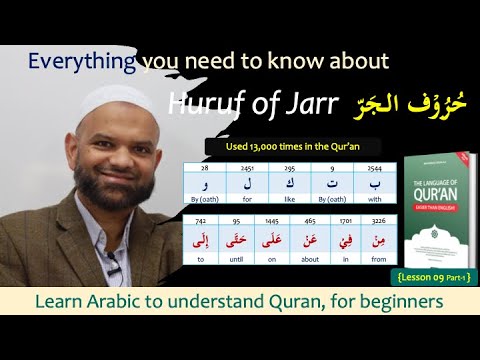 Click to play
Introduction
In Lesson 8 we studied the five single-letter huruf of jarr — بِ، تَ، كَ، لِ، وَ — which are always written attached (joined) to the word that follows them. In this lesson we turn to the remaining six huruf of jarr found in the Quran. Unlike the single-letter group, these six are written as independent words and are therefore called separable (مُنْفَصِل).
Together, the eleven huruf of jarr used in the Quran appear approximately 13,000 times — on average, at least one in every line of the standard mus-haf. By the end of this lesson a student who opens any page of the Quran should be able to find and recognise something in every single line.
The six separable huruf of jarr, with their core meanings and approximate Quranic frequencies:
| Harf | Transliteration | Core meaning | Frequency |
|---|---|---|---|
| مِنْ | min | from, of, among | ~3,226 |
| فِي | fii | in, at | ~1,700 |
| عَنْ | `an | about, from, away from | ~465 |
| عَلَى | `alaa | on, upon | ~1,445 |
| حَتَّى | hattaa | until, even | ~95 |
| إِلَى | ilaa | to, towards | ~742 |
A learning strategy taught throughout this lesson: never learn a word in isolation. Link each harf of jarr to a Quranic phrase or Islamic expression you already know and use daily. A word anchored to something familiar enters long-term memory far more reliably than a bare definition repeated in isolation.
Lesson Notes
Separable vs. Inseparable Huruf of Jarr
Single-letter huruf of jarr (بِ، تَ، كَ، لِ، وَ) are always written joined to the word that follows them. The six separable huruf of jarr (مِنْ، فِي، عَنْ، عَلَى، حَتَّى، إِلَى) are written as independent words. A single-letter prefix such as فَ may attach to their front — but they themselves do not attach to the noun or pronoun that follows.
When reading the Quran, what appears at first glance to be one long word is often two, three or even four distinct units. For example, فَمِنْهُمْ contains three words: فَ (so / thus) + مِنْ (from) + هُمْ (them). Learning to see these internal boundaries is the foundation of Quranic reading comprehension.
The Effect of a Harf of Jarr on the Following Noun
Every harf of jarr forces the noun immediately after it into the jarr (genitive) case. That noun will take a kasrah ending — or, for nouns that do not take tanween (ghayru munsarif), a fathah serves as the jarr marker. The harf and the noun it governs together form a مُرَكَّبٌ جَارِّيٌّ (murakkab jarii), a prepositional phrase.
Attaching Pronouns to Huruf of Jarr
The detached pronouns (هُوَ، هِيَ، أَنَا, etc.) are fixed in the rafa' case and cannot serve as the object of a harf of jarr. For that function Arabic uses the attached pronouns (الضَّمَائِرُ الْمُتَّصِلَة), which suffix directly onto the harf of jarr and are always majruur in this position.
After a harf of jarr, a pronoun must be expressed as an attached (suffixed) pronoun — never as a detached pronoun. The attached pronoun is then the ism majruur of the prepositional phrase.
مِنْ with attached pronouns:
| Person | Form | Meaning |
|---|---|---|
| 3rd m. sg. | مِنْهُ | from him |
| 3rd m. du. | مِنْهُمَا | from them two |
| 3rd m. pl. | مِنْهُمْ | from them |
| 3rd f. sg. | مِنْهَا | from her |
| 3rd f. du. | مِنْهُمَا | from them two (f.) |
| 3rd f. pl. | مِنْهُنَّ | from them (f.) |
| 2nd m. sg. | مِنْكَ | from you |
| 2nd m. du. | مِنْكُمَا | from you two |
| 2nd m. pl. | مِنْكُمْ | from you all |
| 2nd f. sg. | مِنْكِ | from you (f.) |
| 2nd f. du. | مِنْكُمَا | from you two (f.) |
| 2nd f. pl. | مِنْكُنَّ | from you all (f.) |
| 1st sg. | مِنِّي | from me |
| 1st pl. | مِنَّا | from us |
The نُونُ الْوِقَايَة (Protective Noon): When مِنْ attaches to the first-person pronoun يَاء, an extra noon is inserted, producing مِنِّي. This noon is called the protective noon (nuun al-wiqaayah). It stands between the word and the يَاء that always demands a kasrah before it, protecting مِنْ from being altered. The two noons produce a shadda: مِنِّي. Similarly, مِنَّا (from us) shows two noons — the noon of مِنْ and the noon of نَا — merging with a shadda.
Key phonological changes when attaching pronouns to فِي:
The ya' at the end of فِي affects what follows it. When the attached pronoun هُ comes after ya'-sukuun, it shifts from هُ to هِ — hence فِيهِ (not فِيهُ). When the first-person يَاء attaches, the two ya's merge with a shadda: فِيَّ. All other pronouns follow the same pattern as مِنْ.
Mnemonic Anchors for the Six Huruf of Jarr
| Harf | Mnemonic phrase | Meaning |
|---|---|---|
| مِنْ | أَعُوذُ بِاللهِ مِنَ الشَّيْطَانِ الرَّجِيمِ | I seek refuge with Allah from Shaytan the outcast |
| فِي | فِي سَبِيلِ اللهِ | in the path of Allah |
| عَنْ | رَضِيَ اللهُ عَنْهُ | may Allah be pleased with him |
| عَلَى | اَلسَّلَامُ عَلَيْكُمْ | peace be upon you |
| حَتَّى | سَلَامٌ هِيَ حَتَّى مَطْلَعِ الْفَجْرِ | it is peace until the break of dawn |
| إِلَى | فَفِرُّوا إِلَى اللهِ | so flee to Allah |
Summary
This lesson covered the six separable huruf of jarr that account for the vast majority of the ~13,000 prepositional constructs in the Quran:
- مِنْ (from) — the single most frequent word in the Quran, ~3,226 occurrences
- فِي (in, at) — ~1,700 occurrences
- عَنْ (from, about) — ~465 occurrences
- عَلَى (on, upon) — ~1,445 occurrences
- حَتَّى (until) — ~95 occurrences; its use before verbs is an advanced topic
- إِلَى (to, towards) — ~742 occurrences
Every harf of jarr places the noun or pronoun that follows it in the jarr (genitive) case. When a pronoun is needed after a harf of jarr, only an attached pronoun may be used — a detached pronoun is grammatically impossible. The first-person singular attached pronoun triggers the insertion of نُونُ الْوِقَايَة, producing forms like مِنِّي and عَنِّي.
Learners who master the full مِنْ conjugation table will find that the tables for فِي، عَنْ، عَلَى، and إِلَى follow the same pattern with only minor phonological adjustments.
Terminology Reference
| Arabic | Transliteration | Meaning | Type |
|---|---|---|---|
| حَرْفُ جَرٍّ | harf jarr | preposition — a particle that places the following noun or pronoun in the genitive (jarr) case | HARF |
| مِنْ | min | from, of, among | HARF |
| فِي | fii | in, at, on | HARF |
| عَنْ | `an | about, from, away from, on behalf of | HARF |
| عَلَى | `alaa | on, upon, over | HARF |
| حَتَّى | hattaa | until, even, so that | HARF |
| إِلَى | ilaa | to, towards, until | HARF |
| مَجْرُورٌ | majruur | a noun in the genitive (jarr) case | ISM |
| مُنْفَصِلٌ | munfasil | separable — written as an independent word, not joined to the following word | ISM |
| نُونُ الْوِقَايَةِ | nuun al-wiqaayah | the protective noon — an extra noon inserted before the first-person yaa' to ease pronunciation | ISM |
Linked Arabic terms open their full entry in the Arabic Grammar Guide.
📖 Grammar guide. Grammar terms are explained in the Arabic Grammar Guide — fully vocalised, searchable in Arabic, any transliteration, or the English meaning.
Lesson Transcript
Read the full transcript (7,317 words)
Auto-generated from the lesson video. Timestamps jump to that point in the video. May contain transcription errors.
0:00 The language of Quran, easier than English, lesson 9. As-salamu 'alaykum and welcome to lesson number 9. In 8, we've introduced the huruf of Jar and I mentioned to you that there are 17 of them in the language. 11 of them are used in the Qur'an almost 13,000 times. That means we will see one of them in every or one or two of them in every line of Qur'an on the average.
0:24 And therefore, they're absolutely essential for us to begin to appreciate the Qur'an in Arabic. So by the time we finish this lesson, insha'Allah, if you follow the steps of the lesson, you would have learned enough Arabic to recognise something in every line of Qur'an. So a huge achievement. Let us praise Allah subhanahu wa ta'ala for getting us this far and we will continue to strive until we understand more and more of the book of Allah. Now, in the last lesson, we covered the first five. In this lesson, we're going to cover six.
0:59 So the learning outcomes is to look at these, how they're used in the Qur'an, and in particular, those that are attached to the pronouns, how they attach, insha'Allah ta'ala. And as I said to you, this is one of the most important construct. Insha'Allah ta'ala in lesson 10 and 11, we will see other constructs coming through.
1:17 So let's begin with the blessed name of Allah. Oh my Rabb, make it easy and not difficult and help complete this task with goodness. In this lesson, we're going to focus on the six. So these are the six remaining. The five with others were of course picked up in the other lesson. One of the biggest challenges happens when you learn a new language is to remember vocabulary and their meaning.
1:52 And let me share with you a very important learning tip that will help you learn any vocabulary, insha'Allah ta'ala, very quickly. And not only that, retain it for permanent memory. What you need to do is whenever you learn a new word, try to learn it in context. In context. So if you've seen a new word, you want to learn it, memorise the ayah or the line where you've actually seen that word. So I'm giving you some hints here, insha'Allah, which I hope will help you.
2:18 Now, one of the good news is when it comes to learning Arabic to understand Quran, every Muslim, alhamdulillah, whoever prays, uses three to four hundred sentences in their daily salah, along with at least six to ten surahs we try to memorise. So using those as our base, if we see a word that belongs to any of those areas, which we already know, we should try to memorise and link the meaning with what we know in those areas. So let me give you an example with the five that we learned earlier.
2:46 If you want to remember bi or ba as a harf of jar, you need to remember, I seek refuge with Allah. If you want to remember ta, simple. And if you want to remember ka, what's meaning and its use, Again, you can see here, now this is a surah that we know, so we can link the meaning and next time we see it, This is the ka, which is the harf of jar.
3:16 Of course, we know this one, all of us use it in our salah. Again, you can see here a surah that we all know. We can use now these five words which are new to us. We will now remember them along with this. So what I'd like you to do is write out this table. For each one, write the meaning, the Arabic and the English.
3:38 If you do this exercise a couple of times, you will not get confused with these five that we learned in the previous lesson. Also, you need to repeat these five like in this order. And make sure you're able to repeat them from memory as well as write them down.
4:02 And again, this is another way of reinforcing the knowledge in our memory. So in the last lesson, we've learned the inseparable. Again, just as a reminder for you, what is inseparable? These are single letter words and the rule in the Arabic language is single letter words are always written attached to the following word.
4:21 Unlike in English, of course, there are only two single letter words, which is I and a, as in a book. This is a book or I am a Muslim. So I and a, these are the only two single letter words and they're written separately. Whereas in Arabic, and there are many others like fa and so on, which are always written attached to the following word. So remember this rule, Inshallah. Now we are learning the remaining six, which are used in the Quran.
4:51 And these are separable, i.e. they will be written separately. They will not be written joined to the following word. Yes, if there's a single letter word before them, they will be joined to that, but not to the following word. So just remember this learning tip, Inshallah, and it will help you avoid confusion, especially when we are new. We don't even know the words. We look at a word in the Quran, it looks like a single word, but in reality, it could be three or four words.
5:13 So just pay attention to this very important learning tip, Inshallah. So let's remember these six. Very easy. Just repeat a few times after me. Please memorise them, because you're going to see them again and again in the Quran. Rewrite them out with the basic meaning, and I've given you the frequency of number of times they occur in the Quran, which you can see at the top here.
5:44 And that will help you again, motivate you, that I'm going to see this min 3,000 times in the Quran. I'm going to see fee 1,700 times in the Quran and 465 times. So these are words I really need to master.
5:56 So again, please note this very important tip, and write them down, make a note of them, along with the ones I gave you earlier, and this will help us move forward. Alhamdulillah, min, we practised in detail in lesson number eight. Of course, I used it as your template for learning this topic.
6:26 And Inshallah, I hope by now you're familiar with it. I'm just including it here because this is the ideal place to study it, because of the fact that it is a two-letter one, and therefore it is part of the separable, meaning they're written separately. So min, you should be very familiar with.
6:43 Here I have min, and then I'm adding it to azabun alimun. Now, please note, of course, this is a Quranic reference. Azabun alimun should be now for you very easily to recognise that this is a muraqab tawsifi, meaning a descriptive phrase. We have both in rafa, and of course, both of them, I hope you can recognise, are singular, masculine, masculine, and both are indefinite. I hope, Inshallah ta'ala, that is easy for you to recognise the four properties. So they match, they are a descriptive phrase.
7:16 I put min in front, and immediately the change would be that min azabun alimun. So you can see here that this has now become jar. Why? Because of the impact of min. And this one is copying. This is copying from that one, all the four properties. And this is again reinforcing what we have already learned. Please note again, as I remind you, min is the most commonly used word in the Quran. It is used 3,226 times. So again, four or five times in every page.
8:09 We also learn to use min with the attached pronoun. This diagram I've already shared with you. And you can see here how when we attach the pronouns, what is the combination? What is the ending? And so on and so forth, which we have done in detail. So I don't need to go through it again. Please refer back to lesson number eight. We will just revise it once, Inshallah ta'ala.
8:29 So you can see the attached pronoun, min. Min comes first, the attached pronouns afra, after. And of course, when I said they're inseparable, if the attached pronoun comes, attached pronouns always attach. So min and plus hu, min hu, min huma, min hum. So Inshallah ta'ala, I hope that bit is clear for you. The attached pronouns and min.
8:48 Again, please memorise this table back to front so you can actually recall it from memory. One reminder, when we see min with the yaa mutakallim, yaa mutakallim, the yaa of the first person, we end up with min ni, min ni. Why does that happen? Well, because of the fact that now we've got, min has got a noon, an additional noon has been added to help with the pronunciation.
9:16 And this is called a noon of protection. And it is used in a number of places, particularly when we see the verb. And that is why we will see it as min ni, the shadda on the min, because an additional noon has been added. The yaa mutakallim always demands a kasra. And therefore, to take the kasra, the additional noon has been added. And we will see this quite often, Inshallah.
9:37 So it is min ni, just for you to be aware. When it comes to min naa, we already know that there are two noons now. One is the end of min. And then the other one is the naa, which is us or we. So we end up with min naa. And again, written together, it is written like so.
9:55 Just in case you're wondering what's going on, it's min naa. Why the shadda? Because there is two noons actually present. One at the end of min, and the other is the additional naa. Min naa. So let's quickly practise the min table. Again, because of the importance, I'm including it again here, just to remind you to learn it. Inshallah, if you've done lesson 8 properly, this is second nature to you. So let's do this together. Min hu, min huma, min hum.
10:25 Min hu, min huma, min hum. And then we have min haa, min huma, min hunna. Min hu, min huma, min hum. Min haa, min huma, min hunna. And then this way, min ka, min kuma, min kum. And then we can, min ki, min kuma, min kunna. Min ni, min naa. Min ni, min naa. So you can see our 14 pronouns using the hand signs. I've explained this to you before. This is third person, masculine. This is third person, feminine.
10:55 Singular, dual, plural. This is second person, okay? One of the person I'm talking to. And of course, this is first person. I, we. So if I'm talking to feminine person, this way. Masculine, this way. So again, this will help you in your brain, sort out these 14. And they're very, very important, these pronouns, because they occur in the Quran almost 9,000 times. That means one in every line.
11:20 And this is the secret of learning Arabic. If you can understand attached pronouns and the Arab of nouns, you're almost halfway there. So inshallah, we're going to go through it in some detail. And inshallah, slowly, slowly. But with min, you must memorise it. There is no way forward without you memorising this table. And your template example to remember min. I take refuge with Allah or in Allah from Shaytan, the outcast. Please write the Arabic and the English.
11:55 And inshallah, you'll get two advantages. You'll learn bi, billahi, and you'll also learn min. And of course, the rest of the words, you'll also get ash-shaytan, the shaytan, ar-rajim, the outcast. Very easy way to develop vocabulary by learning what you already know. Let me give you a few very common occurrences of min in the Quran. And you'll see, inshallah, what we've done just as a revision. This will help. Min plus al-ardu becomes min al-ardi, min al-ardi. Again, I've given you Quranic reference there for you.
12:27 Min al-sama'i, min al-sama'i. Again, you can see the Quranic reference there. And again, you can see what's going on here. And I think you know this surah, the last surah of Quran. Min al-jinnati wal-nasi. And you can see here, min has converted the jannah word into jar. And the wa is joining what is before. So it will copy its arab. I've been through this a couple of times just for you to know this basic rule.
12:56 So you can see they're very, very commonly occurring. The other occasion of min comes, it's very important. We might not recognise it. For example, here we see the normal standard min with the noon sakin. Here we see with the fatha, which I've explained to you before. And here we have an additional fa-mina. Fa-mina doesn't look like min to us. Fa-min-hum. This is actually min.
13:19 So what's going on here? Let me quickly explain what is happening. And these are very commonly occurring in the Quran. Min, of course, you have an example, min qablika. Min qablika. So you can see here an example with min, sukoon. You can recognise it as min. And qablika is actually made up of two words. And this is the jar part. And this is the attached pronouns at the end.
13:41 We're going to learn this construct inshallah in the next lesson. So min is what makes the word qablu or qabla begin to qabli. It becomes qabli. Then qa is the attached pronoun. We'll learn that next inshallah. Of course, the fatha comes here in the second example because of the hamzatul wasl and the meeting of two sukoons. Fa-mina is actually fa, so or thus. Fa-mina Allah. So from Allah. So again, please note fa is a single letter word. So it is attached to min. Fa-min-hum.
14:14 Now we've got three words here. We've got fa and of course min-hum. We've done quite a few times. Min-hu, min-huma, min-hum. Fa-min-hum is still the word min is there. And inshallah, I'm hoping through this method, you're now beginning to recognise that fa-min-hum is actually three words. And this is the beauty of Arabic. At the beginning, you're looking for min only. But be aware if fa comes before it, it will be joined to it.
14:40 If attached comes after it, attached pronoun will always be joined to it as a suffix. So please note these points. They will help you inshallah. And I've given you Quranic references there. Inshallah, do check them in your own time. Harf of jar-fi. Fi is used in the Quran 1,700 times. Subhanallah. So one word fi used 1,700 times. Now I put fi and I got khusrun. So what's going to happen to khusrun? It becomes fi khusrin. And if you practise min, there is nothing new to learn.
15:29 If you practise min very well, there's absolutely nothing new you're going to come across. Fil ardu becomes fil ardi. Fi then al ardu then becomes fil ardi. I hope you can see that inshallah ta'ala. Fi and the word dunya. Again, this is very commonly occurring in the Quran. You see fid dunya. And please note dunya, the word does not change. And I've covered that in lesson number seven in detail.
15:56 So please go back and if you review that, that the word dunya doesn't change. And again, as a reminder for me and you, dunya will never change. Dunya has been deceiving people from the beginning of the first time they've been here. And dunya will continue to deceive people. It is dunya. So dunya does not change. The word dunya remains the same. When we attach fi to any of the pronouns, same thing as min. So there is nothing new here again.
16:34 Let's quickly practise. You can see the attached pronouns. And we're going to attach them to How do you memorise this very quickly? Through practise. Exactly the same as I did. The more you practise, it'll become second nature. And of course, you'll see them being attached to an ism, fail and harf with the moment we're learning them attached to huruf of jar.
16:58 So what happens when we attach it to fi? Please note there's going to be some slight changes in the reading. So it's not going to be hu. It's going to become fihi. Please note here, no elongation on the hi. I've covered the rule earlier. Go back to lesson eight. Again, these are for phonetic reasons. When you have ya with a sukoon before huma, it becomes hima. Okay, ya sukoon before ha becomes hi.
17:30 Okay, I went through this already. And of course, now it's going to be quite interesting what's going on here. We have iya at the end of fi. I hope you can see that inshallah. That is relatively easy for you to recognise. And then we have this iya, which is the iya of the first person. So the two join together. And hence we have a shadda here, which you again, I hope you can easily see that there is a shadda here. So it becomes fiya, fiya.
17:55 Again, please note that that's the slight change from what we've learned before. Otherwise, same principle. Let's go through them inshallah. Ready? So we start with the third person, masculine. And we go, fihi, fihima, fihim. Fihi, fihima, fihim. Fiha, fihima, fihinna. Fika, fikuma, fikum. Fika, fikuma, fikum. Then we have fiki, fikuma, fikunna. Fiki, fikuma, fikunna. And then fiya, I explained the change already. And of course, fina, fina. 1700 times. These attached pronouns occur many, many times with it.
18:42 Of course, it comes on its own as well. You cannot afford not to memorise this table. Please do it in the order I mentioned, by reading it three times loudly while looking at it, writing it down once. Okay, and then next day practise again, the next day practise again. If you do this three, four times, it will become permanent memory, inshallah. And you will get it.
19:03 1700 words of Al-Qur'an will come to you instantly, whenever you open any of the pages of Qur'an. I think you know what to do now. I've got here words on the first column, in marfu or rafa form. And all you got to do is add fi to them. And these are all Qur'anic examples. I hope I have been able to convince you that this course is designed for you to learn, to understand Qur'an.
19:27 It's not for you to learn spoken Arabic or anything else. So it's focused entirely on that. So please use that. You've got the English translation here as a guide, which you can see. But use that, inshallah, the words on the right-hand side, and complete it. Please get a pen and paper, write it all down. If you don't write it, you're not going to learn it. So please take the time, pause the video, and come back when you've completed the task. The first one, As-Samaa'u.
20:00 I hope you can recognise, As-Samaa'u. And then we have Fi Jahannama. And now you know why Jahannama, not Jahannami. Again, go back to lesson number seven. And Fi Jannatin Aaliyatin. Why Jannatin? Because of Fi. Why Aaliyatin? Because it is copying the Arabic, because it is a descriptive phrase. Those two words on their own. And then Fi Ha. Fi plus here, Fi Ha. I hope that again is clear for you, inshallah. And then we have Fi Kum. Fi Kum. Antum, Fi Kum. And then Fi Hinna.
20:44 Fi Hinna. Again, Hunna becomes Hinna because of the Ya before. Please go back and check the previous lesson eight, where I went through this in some detail, and gave you the rules. But just memorise them as they are. And inshallah, you'll see them many, many times in the Qur'an. Let me show you one ayah from the Qur'an, which I think we've all memorised.
21:04 We make this du'a all the time. Allah accepted from all of us, inshallah ta'ala. Just a few words, just to show you how our eyes are opening up to the Arabic of Qur'an. As you can see here, I have Wa Minhum. I hope you can see Min, then Hum, which is the previous part we did. Min, Hum. So it's for them, okay? But among them, Wa Minhum. So you can see that bit, inshallah ta'ala. Inshallah, we'll learn slowly.
21:30 But we're going there. Rabbana, our Lord. Our Lord. Atina, grant us. Can you see Fid Duniya? Grant us in the world. Hassanatan. Wafil Aakhirati. Again, I can see Fi again here. Wafil Aakhirati. Again, it's in Jarwai because of Fi. I hope this is all easy for you, inshallah. Hassanatan. And you can see that very clearly. Waqina Azaaban Naar. We're going to learn this construct, inshallah, in the next lesson.
21:58 So you can see, Alhamdulillah. Look, just to convince you, everything that you're learning has a direct relevance to the Qur'an. So again, final tip for you to remember Fi in other meaning also, at, etc. Fi Sabeelillah, in the path of Allah. So that's again, it will help you remember Fi. Fi Sabeelillah. Please write the sentence down in your notebook with the Fi. And this is the way you'll remember it forever, inshallah. And you'll also get the bonus of two additional words.
22:26 One, you already know, Allah. And Sabeel means path. Sabeel means path. So Fi Sabeelillah, in the path of Allah. Harf of Jar, An. An is exactly the same as Min as far as the language part of it is concerned. Of course, the meaning is different. An can have many different meanings. And as I said to you, I think in lesson number eight, I repeated, prepositions will change their meaning in English.
23:01 In Arabic, there's Arabic. But when it changed from one language to another, different prepositions are used in different context. So please note, there will be a contextual translation, which we will pick up later on, inshallah. But that is more relevant to the language that you're translating into. So how in English is this understood? So An has many, many different translations, depending on the context. I've given you three on top there, inshallah.
23:26 There will be others as we go through. Now, An plus Arrukh, what happens? An Arrukh, again, exactly the same as Min. I hope this is easy for you. So we have An Arruhi. Again, it's in Jar, as you can see. And why is it taken Kasra? Min is the only one, when the meeting of two sukun happens, which takes a Fatha that we've come across.
23:49 But everything else, as a general rule, will take a Kasra. So this is only with Min. So again, just be aware what we did there, inshallah. So it should be Ani, okay? An Arruhi, about the soul. An Arruhi. Then we have An Uthmanu. Uthmanu, again, is Ghayru Munsarif. So we'll end up with An Uthmana. Again, you can see that very easily, inshallah. And again, I've given you that reference from Hadith. So you can see how An is working exactly the same as Min. Fi, Ala, etc.
24:22 If you learn Min well, the rest is relatively easy. An, exactly like Min, will attach to pronouns. Let's quickly practise them, inshallah. So you have An Hu, An Huma, An Hum. An Hu, An Huma, An Hum. And then we have An Ha, An Huma, An Hunna. Exactly the same as Min. I hope you can see it. An Ha, An Huma, An Hunna. And then we go this way. An Ka, An Kuma, An Kum. And then we have An Ki, An Kuma, An Kunna.
25:06 And then An Ni, An Na, An Ni, An Na, Min Ni, Min Na. No difference. So these are your 14 attached pronouns with An. Please note the slight differences. An Ni, which I've explained with Min. And An Na, because of the two noons coming together. Just note those differences, inshallah. But they're easy to memorise once you've gone through this chart a couple of times. So do practise and learn it 465 times.
25:33 And of course, it's very commonly used in Hadith. So when I add Hua, An plus Hua, what do I get? I get An Hu, An Hu, An Hu. Now let me remind you what do I mean by the most common use. Whenever we mention the name of one of the beloved companions of our beloved Prophet Sallallahu Alaihi Wasallam, we say Radiyallahu An Hu. So one male person will say An Hu. If it's two, we will say An Huma, An Huma.
26:04 So for example, if I say Abu Bakr Siddiq, Radiyallahu An Hu, Abu Bakr and Umar, An Huma. If I mention Abu Bakr, Uthman, Ali, I would say Radiyallahu An Hum. So three or more, I would say An Hum. So inshallah, from now on, you'll never make a mistake. One companion, An Hu, male companion. An Huma for two. Three or more, An Hum. So do it one more time with me, please, inshallah. Radiyallahu An Hu, Radiyallahu An Huma, Radiyallahu An Hum.
26:35 So this is very easy, inshallah. And of course, if we mention one of the female companions of our beloved Prophet Sallallahu Alaihi Wasallam, we'll say, here, it'll become, I hope you can do it already, An Ha. And then we will say, Radiyallahu An Ha, Aisha Siddiqa, Radiyallahu An Ha. And then if it's two of them, we will say, An Huma, Radiyallahu, An Huma, two fingers this way, inshallah. And of course, we will say, An Huna, if it's three or more. Radiyallahu An Huna.
27:05 So from now on, inshallah, every time we mention a male or female companion, we will not get them wrong. When we first learn Arabic or we don't know, sometimes we don't know what ending to use, what's going on, who, whom, ahum, etc. Or Ha, Huma, Huna. Now we know, inshallah, when to correctly use them. You're going to ask me the question, what happens if it's a group of male and female companions, you mentioned them together. In that case, you lose a masculine form.
27:30 So again, very important practise. Do write them down and they will stick, inshallah, in your heart and mind forever. So again, you know exactly what to do. I've got An, plus I got four examples here. Please complete the task and give me the full construct with the examples given. You shouldn't have any worry with vocabulary or with spelling. Everything's there. You've got to just make sure that it is connected correctly. And of course, the reflection of the I'rab as it needs to be.
28:01 Pause the video. Do not come back until you've done the task. I hope and pray you've done the exercise. Let's look at the first example. We have Anis Sa'ati, Anis Sa'ati. And we have An Nafsin, An Nafsin. Again, we don't change to An here because there's no meeting of two sukoons. An Kum, An Kum. And then, of course, we have here Anil Fahsha'i Wal Munkari.
28:32 Okay, again, you can see here Fahsha'u and Wal Munkaru have been changed to both majroor. Okay, one is following the I'rab of the one before because of the Wa in the middle. But the first one has been converted to Jar because of An. All the Quranic references are there for you. Please do check in your own time. Quick reminder how to remember An. Very easy. Radiyallahu Anhu. This will help you remember.
28:59 Write the Arabic and the English. And Inshallah, I picked up a new word here, Radiya. Okay, Radiya. Then, of course, the word Allah, you already know. Anhu, with Him, with Him. Harf of Jar, Alaa. Here we have the word Alaa, exactly the same principle again. There's really nothing new to teach you. And I say with the word Muhammad, it will be Alaa Muhammadin. I hope you can see that, Inshallah. And of course, Alaa with Ibrahimu will be Alaa Ibrahima. Not Ibrahimun, Manmin.
29:43 Because this is a word that is Ghayru Munsarif. Lesson number seven, please go back and revise. And it does not take Tanween. And in Jar, it will be a Fatha. Jar, it will be a Fatha. So this is definitely Jar. Why? Because of Alaa before. It could be Nasab or Jar. But here we say definitely Jar. Why? Because of Alaa. Alaa will force the Ism afterwards to be Majroor. Again, where did I get this from? I think you all know this, Alhamdulillah.
30:10 You all use it in your daily Salah. Allahumma Salli Alaa Muhammadin. This is Jar. Alaa Muhammadin. Wa Alaa Ali. This is also Jar. But we will learn this construct later. Again, you can see this is Jar because of Alaa before. Alaa Ibrahima. This is Jar. Okay, Wa Alaa Ali. Again, you can see that this is Jar. Ibrahima. Again, you can see it is Jar. Okay, and of course the rest, that's a repeat here as well, Inshallah.
30:40 So now parts of what you already use every day, you're beginning to see and you're beginning to learn, Inshallah Ta'ala. So Alaa Muhammadin. Alaa Muhammadin. And Alaa Ibrahima. Now Alaa, of course, is used also with attached pronouns. Let's quickly practise those. We have here Alayhi, Alayhima, Alayhim. Again, I explained to you why it's Hima already in the previous session. So please do look at it. If the Ya is Sakin before, it will be Hima. Okay, and then Him and He. So again, we went through that.
31:30 Alayhi, Alayhima, Alayhim. Alayha, Alayhima, Alayhinna. Okay, I hope this is okay. Alayha, Alayhima, Alayhinna. And for you, this way. Alayka, Alaykuma, Alaykum. Now, Assalamu Alaikum. Now you know Alhamdulillah, Alaykum. Okay, all your life you've been saying Assalamu Alaikum. Now you know where it's coming from. And then you have Alayki, Alaykuma, Alaykunna. Alayki, Alaykuma, Alaykunna. And of course, the change in note. Alayya, Alayna, Alayya, Alayna. Because of the two Ya.
32:08 One at the end of Alaa, which becomes, which is an Alif Maqsoor. I've explained this before. And then of course, the second Ya is for me. And that is why we have Shadda on the Ya. Alayya and Alayna. I hope this is all, Inshallah Ta'ala, just revision. Please memorise it. Do exactly what I mentioned before. Join them with Alaa. And then Inshallah Ta'ala, come back after you've completed the task. Pause the video, do the task, and then come back. Don't look at the answers.
32:38 That is not the way to learn. Occurrence of Alaa is 1445 times in the Quran. So now you can see why it's so important for you to learn this word. Of course, it can be attached to pronouns. It can be attached, it can come before just in standard Ism. So therefore, you need to recognise it and translate. So first one is Alaa, then Hum. I hope you're going to quickly tell me it is Alayhim. Okay, this one, Malakani.
33:11 Two angels. Two angels. What is the Dar version of Kani? I hope you got this one right. If you have, you do reward yourself. Okay, Alhamdulillah. Alalmalakaini. Ani, Aini. Muslimani. Muslimaini. Muslimaini. If you've learned lesson number four, and if you've done the Muslim table, you're going to fly through Arabic. So go back and take the tip I've given you in lesson number four. Alaa, Shay'un. Shay'un means thing, something. So it'll be Alaa, Shay'in. Shay'in. And Hudan. Hudan.
33:44 Alaa, Hudan. Why doesn't it change? Because this is one of those words. Rafana sabarjar. It is exactly the same. And this is a special case. Again, go back and revise lesson number seven.
33:55 So anything and everything we're learning is going to come again and again. All you need to do is be brave enough to open up the book of Allah and start checking yourself. Just to give you the confidence and motivation that you're learning things that are relevant, important and repeatedly used in the book of Allah. How to remember Alaa? Very easy. Assalamualaikum. Write it down. Inshallah ta'ala. If you have to make the Alaa part in different colour, it will help you remember. Peace be upon you all.
34:25 May Allah subhanahu wa ta'ala bless you. Make sure that you're following my learning tips. Harf of jar Hatta. Hatta is quite complex in Arabic. Comes in many different forms. Simple forms is rare. But this one, Hatta heen. This is used six times in the Quran from what I could find. So you can six times. Hatta heenin. Why heenin? Because of it is the harf of jar. There are other use of Hatta you will see with verbs.
35:01 So we'll pick that up in advanced lessons. But for now, note that it's use is 95 times. Simple ones are rare. But just note few examples of them inshallah ta'ala. And let me show you one more example of it. Salamun hiya hatta matla'il fajr. Again, matla'il fajr is a new construct for us this bit. Which we'll pick up in the next lesson called mudaf mudaf ilayhi. But this definitely is jar. And I hope inshallah that is easy for you. Because of Hatta. Again, simple lesson.
35:33 But remember Hatta, very very important for Quranic Arabic. Used 95 times in the Quran. Harf of jar, Ilaa. Ilaa is again one of the most common words used in the Quran 742 times. Now again, very simple example. An-nuru will become ilan-nuri. Should be very easy for you now inshallah ta'ala. Of course, towards Allah or to Allah. Ilaa, then the word Allah. For Allah, lafza jalala. We have ilallahi, ilallahi. Again, you can see very simple inshallah ta'ala.
36:17 Very very simple. Once you've learned one, you get the rest for free. So if you paid attention to min, the rest is inshallah ta'ala very very easy. Ilaa also attaches to pronouns. Exactly the same principle. Let's quickly revise them. And then inshallah in your own time, you need to master this. So ilayhi, ilayhima, ilayhim. Ilayhi, ilayhima, ilayhim. Wahima, him, covered already. Ilayhi, okay. And for her, ilayha, ilayhima, ilayhinna. Ilayha, ilayhima, ilayhinna. Then ilayka, ilayka, ilaykuma, ilaykum. Ilayka, ilaykuma, ilaykum.
37:11 Ilayki, ilaykuma, ilaykunna. Ilayya and ilayna, ilayna. How can it be any more easier than this? So please, please practise, revise, master. Make it your pet inshallah ta'ala hobby to learn Arabic inshallah ta'ala. And spend 10-15 minutes a day. Allah subhanahu wa ta'ala will open doors for you. Alhamdulillah by now, you know exactly what to do. We have ila and then of course, we have 1, 2, 3, 4 tests for you to carry out inshallah ta'ala. Do not continue, pause the video until you've completed the task.
37:51 So the first example is ila and then we have siratin mustaqimin. I hope this is very easy inshallah for you now. Ila Ibrahima. Again, reminding you of exactly the same example we've seen many times. Antum, antum is this way. Ilaykum, ilaykum. And I've given you all the Quranic references. You can see them here inshallah. Please do check and you can actually see it in the ayah itself. This will motivate you. Fir'aunu, go towards fir'aun for example. Ila fir'auna, again Ibrahimu fir'auna.
38:31 These two words are ghayru munsarif. I hope this is not difficult for you now that we've done this exercise so many times. In order to help you remember the word ila in context, here is a very beautiful example from the Quran. Allah subhanahu wa ta'ala tells us to flee to Allah. Flee to Allah. Flee to Allah.
38:53 Whatever our condition in life, my dear brothers and sisters, we need to be in the shade of the mercy, the forgiveness and the pleasure of Allah. All of us, myself first, need to flee to Allah away from a life that is in disobedience to Allah azza wa jal, away from a life that is in contradiction to what the Prophet sallallahu alayhi wa sallam has brought. May Allah grant all of us tawfiq to flee to Allah, to the shade of his mercy, his forgiveness and his pleasure.
39:23 Alhamdulillah, that is actually the end of lesson number nine. In which, alhamdulillah, lesson number eight, we covered ba'ta kaaf laam wa, and here we've done min fee'an ala hatta ila. With the array of examples I've given you, I hope inshallah ta'ala, you have covered the most important aspect of these.
39:41 And I've been promising you before, by the time you get to lesson number 10, you'll recognise something in every line of Qur'an. I hope I haven't convinced you. Inshallah, open up the Qur'an and see if you can actually recognise something in every line. If you have alhamdulillah, praise Allah, thank Allah, the more you praise him, the more you thank him, Allah subhanahu wa ta'ala make it easier and easier for you. It is the rule of Allah. The more grateful you are, the more Allah gives us.
40:07 So please keep on continuing praising Allah subhanahu wa ta'ala for making Arabic easy for us to learn, to understand his book. And of course, more importantly, give us the tawfiq to follow his book. I'm going to pause the video here.
40:20 There are a few things which I'm going to do in the second part of the video, just as a revision aid and to help you remember, because I think we've reached a very important milestone here. And inshallah ta'ala, I hope I've given you enough to motivate you, to show you that within the 10 lessons, 9 lessons so far that we've done, how much you've actually learned. In lesson 10 and 11, we're going to learn the most common structure in the Quran and Arabic, which is called mudaf, mudaf ilayhi or al-idafa.
40:48 Very, very complex it is taught, but inshallah, we're going to make it very easy for all of us by simply going through a very simple methodology, a practical way of learning. May Allah subhanahu wa ta'ala grant me tawfiq to continue to produce the videos. May Allah grant you tawfiq to continue to learn.
41:05 I want to thank you again for all your support and your du'as and your encouragement. I put all the details in the description of the video rather than having to repeat. Inshallah, you also have the details of our website here, as well as inshallah ta'ala for getting in touch.
41:18 So if you want to support our cause, you want to support us in helping to produce more videos and lessons, please go and see the description and details are there. As far as the lessons are concerned, inshallah, I'm going to continue until I finish the 15 lessons. And then we will go into book two, inshallah ta'ala, very soon.
41:36 Please remember us in your du'as. May Allah subhanahu wa ta'ala bless you once again for all your kind support and everything that you have been doing for us. May Allah subhanahu wa ta'ala give us the tawfiq, forgive our mistakes, and also shower all of us with His mercy and reward us abundantly for the desire to learn Arabic, to understand Quran. Until the next video, As-salamu alaykum wa rahmatullahi wa barakatuhu.
Test Yourself
After every lesson it is essential to test what you have learnt. Take the quiz, then check your understanding against the model answers provided.
Updated