
Demonstratives — I'rab, Idafa, and the Jumla Ismiyya
i'rab of murakkab ishaari · pointing to mudaf or mudaf ilayhi · demonstratives in sentences
- Identify the i'rab (grammatical case) of a demonstrative phrase by looking at the musharun ilayhi, since the ismul isharah itself is mabni and does not change
- Correctly form demonstrative phrases in rafa, nasab, and jarr for both singular and plural nouns
- Point to the mudaf or the mudaf ilayhi within an idafa construct using the correct placement of the ismul isharah
- Use demonstrative words as the mubtada of a jumla ismiyya and supply an appropriate khabar
- Understand when the khabar in a jumla ismiyya can be definite, and recognise the role of the pronoun of separation (to be developed further in Part 3)
Video Lesson
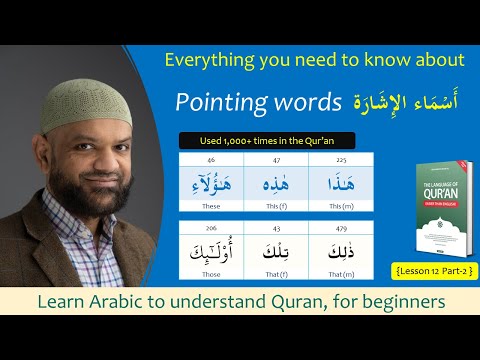 Click to play
Introduction
Lesson 12 Part 1 introduced the six essential demonstrative pronouns (أَسْمَاء الإِشَارَة) and the basic demonstrative phrase (مُرَكَّب إِشَارِي). In Part 2, we go deeper: we work out the i'rab of demonstrative phrases, explore the tricky problem of pointing to an idafa construct, and use demonstratives as the subject of a nominal sentence (جُمْلَة اِسْمِيَّة). These are precisely the structures that appear in every page of the Quran, so mastering them here pays direct dividends when reading the Quranic text.
A key principle runs throughout this lesson: the pointing word itself (هَذَا، هَذِهِ، هَؤُلَاء etc.) is mabni — its ending never changes. We can therefore only read the i'rab from the noun being pointed to (مُشَارٌ إِلَيْهِ).
Lesson Notes
Reading the i'rab of a demonstrative phrase
Because the ismul isharah is mabni and cannot show i'rab through its own ending, the grammatical case of the whole phrase is revealed by the musharun ilayhi — the noun with الـ that follows the pointing word.
The musharun ilayhi copies the i'rab of the ismul isharah. Since the ismul isharah is mabni, we determine the case from the role the phrase plays in the sentence and then confirm it by reading the ending of the musharun ilayhi.
Three examples with the same noun هَذَا المَسْجِدُ:
| Structure | Arabic | Case | Role |
|---|---|---|---|
| Rafa | هَذَا الْمَسْجِدُ | marfu | mubtada or fa'il |
| Nasab | هَذَا الْمَسْجِدَ | mansub | maf'ul bih (object) |
| Jarr | فِي هَذَا الْمَسْجِدِ | majruur | after harf of jarr |
> رَأَيْتُ هَذَا الْمَسْجِدَ — "I saw this mosque" (nasab, because it is the object) > صَلَّيْتُ فِي هَذَا الْمَسْجِدِ — "I prayed in this mosque" (jarr, because it follows فِي)
Pointing to an idafa construct
The idafa (مُرَكَّب إِضَافِي) has two parts: mudaf and mudaf ilayhi. When we want to point to one of them, the placement of the ismul isharah changes:
Pointing to the mudaf (e.g., "this house of the teacher"):
The mudaf cannot take الـ (a rule of idafa), so we cannot put هَذَا in front with الـ on the mudaf — that would break the idafa. Instead, the pointing word must come after the entire idafa construct:
When pointing to the mudaf, place the ismul isharah at the END of the idafa construct: بَيْتُ الْمُعَلِّمِ هَذَا — "this house of the teacher"
> بَيْتُ الْمُعَلِّمِ هَذَا — this house of the teacher (هَذَا points back to بَيْتُ) > سَيَّارَةُ زَيْدٍ هَذِهِ — this car of Zaid (هَذِهِ points to سَيَّارَةُ, which is feminine)
Note: if هَذَا is placed in front of an idafa construct, the result is a complete sentence (jumla ismiyya), not a phrase: هَذَا بَيْتُ الْمُعَلِّمِ = "This is the teacher's house."
Pointing to the mudaf ilayhi (e.g., "the house of this teacher"):
This is straightforward. The ismul isharah and musharun ilayhi form a murakkab ishaari that itself becomes the mudaf ilayhi:
> بَيْتُ هَذَا الْمُعَلِّمِ — "the house of this teacher" (هَذَا الْمُعَلِّمِ is the murakkab ishaari serving as mudaf ilayhi) > كِتَابُ هَذِهِ الْمُعَلِّمَةِ — "the book of this (female) teacher"
Demonstratives in the jumla ismiyya (nominal sentence)
Demonstratives are very commonly used as the mubtada (subject) of a jumla ismiyya. The rules are exactly as before: mubtada is rafa and definite, khabar is rafa and (usually) indefinite.
> هَذَا مُسْلِمٌ — "This is a Muslim" (hatha = mubtada, muslimun = khabar, indefinite) > هَؤُلَاءِ مُسْلِمُونَ — "These are Muslims" > تِلْكَ مَدَارِسُ — "Those are schools" (broken plural treated as feminine singular → tilka)
When the khabar can be definite
Normally the khabar is indefinite, but there are two situations where a definite khabar is permitted:
- When the mubtada is a detached rafa pronoun (هُوَ، هِيَ etc.) and the khabar is a proper noun or begins with الـ:
> هُوَ حَامِدٌ — "He is Hamid" / هِيَ الطَّالِبَةُ — "She is the student"
- When the mubtada is a pointing word and the khabar is a proper noun:
> هَذَا حَامِدٌ — "This is Hamid" > ذَلِكَ عِيسَى — "That is Isa" (from the Quran, Al-Imran, 3:59)
A murakkab ishaari (pointing word + noun with الـ) is a PHRASE, not a sentence. A jumla ismiyya with a pointing word as mubtada requires the khabar to be indefinite — unless the khabar is a proper noun (in which case it can be definite).
Distinguishing a murakkab ishaari from a jumla ismiyya
| Structure | Example | Analysis |
|---|---|---|
| Demonstrative phrase (murakkab ishaari) | هَذَا الْوَلَدُ | phrase — "this boy" |
| Complete sentence (jumla ismiyya) | هَذَا وَلَدٌ | sentence — "this is a boy" |
| Demonstrative phrase as mubtada | هَذَا الْكِتَابُ جَدِيدٌ | mubtada (phrase) + khabar — "this book is new" |
The signal is simple: after the pointing word, if there is a word with الـ and no further predicate, it is a phrase. If there is no الـ, or if there is additional information after the phrase, it is (or contains) a sentence.
Broken plurals and demonstratives
Broken plurals of non-rational nouns (غَيْرُ عَاقِل) are treated as singular feminine throughout Arabic grammar. This rule applies equally to demonstratives:
> هَذِهِ أَبْوَابٌ — "These are doors" (أَبْوَاب is a broken plural of a non-rational noun → هَذِهِ, not هَؤُلَاء) > تِلْكَ مَسَاجِدُ — "Those are mosques" (broken plural, feminine → تِلْكَ) > تِلْكَ مَدَارِسُ — "Those are schools" (same rule)
Summary
- The ismul isharah (pointing word) is mabni — it does not change its ending regardless of the grammatical case. The i'rab is shown by the musharun ilayhi (the noun being pointed to), which copies the case of the pointing word.
- When pointing to the mudaf of an idafa construct, the ismul isharah must come after the entire idafa (e.g., بَيْتُ الْمُعَلِّمِ هَذَا). Placing it before the idafa produces a complete sentence instead of a phrase.
- When pointing to the mudaf ilayhi, simply build the murakkab ishaari and use it as the mudaf ilayhi (e.g., بَيْتُ هَذَا الْمُعَلِّمِ).
- Broken plurals of non-rational nouns are treated as singular feminine — so use هَذِهِ and تِلْكَ with words like مَسَاجِدُ, كُتُبٌ, and مَدَارِسُ.
- In a jumla ismiyya, the khabar is normally indefinite. It can be definite only when the mubtada is a rafa pronoun or a pointing word and the khabar is a proper noun (e.g., هَذَا حَامِدٌ، ذَلِكَ عِيسَى).
Terminology Reference
| Arabic | Transliteration | Meaning | Type |
|---|---|---|---|
| اِسْمُ الإِشَارَة | ismul isharah | demonstrative pronoun (pointing word) | grammatical term |
| مُشَارٌ إِلَيْهِ | musharun ilayhi | the noun being pointed to | grammatical term |
| مَبْنِي | mabni | indeclinable — a word whose ending does not change regardless of its grammatical role | grammatical term |
| هَذَا | haadha | this (m. sg., near) | demonstrative |
| هَذِهِ | haadhihi | this (f. sg., near) | demonstrative |
| هَؤُلَاء | haa'ulaa'i | these (pl., near — used for both masculine and feminine) | demonstrative |
| ذَلِكَ | dhaalika | that (m. sg., far) | demonstrative |
| تِلْكَ | tilka | that (f. sg. or broken plural, far) | demonstrative |
| أُولَئِكَ | ulaa'ika | those (pl., far — used for both masculine and feminine) | demonstrative |
| مُرَكَّب إِشَارِي | murakkab ishaari | demonstrative phrase (pointing word + noun with الـ) | grammatical term |
| مُضَاف | mudaf | the first element of an idafa construct (the "owner" or "of" word) | grammatical term |
| مُضَافٌ إِلَيْهِ | mudaf ilayhi | the second element of an idafa construct — always majruur | grammatical term |
Linked Arabic terms open their full entry in the Arabic Grammar Guide.
📖 Grammar guide. Grammar terms are explained in the Arabic Grammar Guide — fully vocalised, searchable in Arabic, any transliteration, or the English meaning.
Lesson Transcript
Read the full transcript (7,287 words)
Auto-generated from the lesson video. Timestamps jump to that point in the video. May contain transcription errors.
0:00 The language of Quran easier than English lesson 12 part 2 Assalamu alaikum, welcome to lesson number 12 part 2 in part 1 We introduced you to the topic of demonstratives i.e. words that are used for pointing I showed you the six most important ones that you need to learn to get a mastery of their uses in the Quran and There and also the fact that they're used in the Quran more than a thousand times So you'll find one or two in every page We also learned
the demonstrative phrase of which is something new and it's part of what the list of the Phrases that we need to learn to begin to understand the Quran in Arabic in this session inshallah We're going to begin very first of all looking at the Arab of the demonstrative phrase Murakab ishari and we're going to look at how they used with the edafa There's some complexities in that inshallah and I will attempt to explain that to you In the best way that I can and also jumla
ismiya and the pronouns of separation As I said, I'm splitting the videos because some of you prefer shorter videos inshallah ta'ala But let's see how far we can get in this lesson looking at demonstratives So let us begin with the blessed name of Allah rabbi zidni ilma. Oh my lord increase me in knowledge Recognising the Arab of the demonstrative phrase. I have three constructs for you in the first one I have has al-masjidu The second one has al-masjida and the third one has al-masjidi So, please
note in all three that a slight difference at the end the first one Of course, we can say we know that it is definite And we're going to assume it's in Rafa Because this one copies the Arab of The noun being pointed so since this is Rafa we're going to say this is going to be also more for they're both more for and Of course, this is a demonstrative phrase. Why because after the pointing word I have all so please note that after the pointing word
having all Afterwards, this is your demonstrative phrase So I'm if I say that this is a Rafa which I know and then this is also Rafa so we have here now a Demonstrative phrase so they copies copying each other the translation of that will simply this mosque this mosque So if you can write that down the first one this mosque now as far as the second one is concerned I've got it, but I've got fath had a why so let me put something in front of
it So we can make sense or I to or I to I saw I saw Therefore now if you remember from what we've done all these lessons exactly the same example Instead of having for example, or I to I'll move on Lima. I saw the teacher for example I've got her that so how that I'm gonna say is Nasa and this is indicated by here because this one is copying the Arab of The the word Pointing word. So here this is NASA because it is the
object. So the translation would be I Saw this mosque. I saw this mosque again write the translation down if you need to do so this is NASA and we know this is NASA because it's got a fatah at the end of it and always note that the Musharraf Ilayhi the noun being pointed to will copy the Arab of the Ismul Isharah, you cannot tell the Arab with a small Isharah because it is mob me You cannot tell but the the situation will tell us what it
is. So in this case, it is the object Object and therefore it is NASA and of course the Musharraf Ilayhi is also NASA So the way you tell it's Arab is by looking before and after it in the after of the Musharraf Ilayhi If it is more up will indicate the Arab of the whole structure Now this last example Okay, so light too. I prayed fee. I prayed in again after fee. So this is your ism It's a major or as we've been calling it the
noun that appears after the half of jar so fee in so this has to be Right, there's no question asked it's mob me does not change but we know it's jar because it's coming after a half of jar so therefore this one will copy again as you can see the Arab of the Pointing word and we don't we know the word pointing word. How that is jar because of fee. So Sallai to I prayed fee This in how that this al-masjidi mosque, so I prayed in
this mosque. So first one This mosque only is a state phrase. Not a sentence. The second one is Jumlah failure. I Saw this mosque third one is also a sentence. It's got three components in it. The first being I the verb I prayed in this mosque So in is a half of jar and the Hatha is your ism majroor and the Musharron which is also the small Ishara and Musharron Elahi is copying the Arab. I hope this makes sense. Inshallah Tala write these three sentences down
inshallah three parts Structures down and it will make sense to you. Inshallah. The complexities will be removed So, please note the pointing word the singular and the plural do not Change so their Rafa Nassar Berger They remain the same But the Musharron Elahi if it is a word that changes will will show us what the Arab is because it is copying the Arab So remember I told you right before from the beginning the Arab isn't necessarily just the vowel sign at the end It is more
importantly the role the function that that ism is playing in the sentence or the phrase So in this one in all of them We have the ism is actually the Musharron Elahi the noun been pointed to which does not have its own Arab It will copy it from the noun the pointing word and the pointing word here Depending on the role it is playing it will show different Arab So the first one is Rafa The second one is Nassab and the third one is jar again
If we follow the lessons in a structured way, this should be relatively easy for you. Inshallah So what I'd like you to do, you know the drill inshallah, I've done the first one for you this Muslim came Okay jaa Hathal muslimu very easy I hope now inshallah who came this so this is going to be Rafa because it is the doer of the verb in the same Second one right to I saw so possibly the object you're looking for afterwards Salam to Allah. There's Allah So
so it has to be majroor So again the structure and then the word Muslims and again, you should know both of these words Muslim and Muslim Oona so Muslim Muslim Oona and of course muslimina in Nassab or jar So, please complete the task pause the video take your time inshallah and come back and have a look at the answers I hope and pray you've done it and please check your notebooks It is so so important that you actually write and engage Otherwise, you're not going to
learn this is just going to be another video on YouTube which you listen to and then you forget It's the only way to learn is through practise. So let's quickly go through the answers. They should be very easy jaa Hathal muslimu this Muslim came so here it is the doer therefore Musharraf Ilahi is copying the Arab of Hatha and we know the Musharraf Ilahi is Rafa marfor because of the Dhamma right to what do I need to say? Hathal muslima why because Hatha here now is
the object Salaam to Allah Hathal muslimi Again is jar why cuz coming after Allah and please note again I repeat so that you will not forget Hatha does not change No matter what the Arab is Rafa Nassab or jar It is constantly the same and that is why it is called Mabni the rare 2% of the words that do not change In the next one. I want to say these Muslims remember Hatha and what was the word for these? So hopefully you will get it. How
will I ill Muslim? Again, this is Rafa. Why because it is the doer. Well, I do again. I'll have how will I eat? I'll muslimina how will I ill muslimina? Why it is Nassab? Why will it be Nassab because it is the object salam to Allah and I hope inshallah. I've got this one, right? Also, how will I ill muslimina? Why are they both the same? Well, they remain the same in Nassab and jar when we've done this in lesson number four So you can see
how will I is got a Kasra but does not mean it is jar in the first one It is Nassab Rafa in the second one. It is Nassab and the third one. It is jar So whether it is a marfoom and super majroor in all three, it remains II So again right at the beginning I did warn you that if you couldn't get confused that the jar is always Kasra Then you will be confused here. The how will I does not change how that does not
change Therefore we need to look at the following again when the first second example can we can say muslimina is Nassab Why because it is object and muslimina is jar because it is coming after Allah. So this is your Nassab Okay, this is jar. And of course, this is Rafa because it is the dual simple principles inshallah And this is how structured the language is we will learn it one step at a time but this example will help you remember the recognition of Arab of a
Shari it is based upon the context and inshallah that I hope these Sets will make that clear for you another exercise for you to do this time feminine again Remember, I told you so many times and repeat again that when the doer is feminine The verb you have to change to feminine form. So jaa becomes jaa Okay, jaa becomes jaa and Hadhil muslima to of course are the Pointing to a female Muslim so I can't say how that anymore. I hope inshallah that I can do
the rest So take your time inshallah pause the video. You know what to do. I pray you've done the exercises Let's go through the answers. The first one jaa at a female who had the hill muslima to This muslim female came Right to I saw this female Muslim right to have the hill muslima to again, exactly the same we've done these in the Lesson four where we learned the max. Sorry lesson three masculine feminine and lesson four We learned the plurals of it and then salam
to Allah had the hill muslima tea How the hill muslima tea again to Tati? Reflecting Rafa Nassab and jar Marfa Mansur and Majroor you can see that very very clearly inshallah. Now. We got a complexity here. We need to say Muslims plural. I hope you know the word for female Muslims plural. We've done that again many many times, but it is how La'i ha Now how that point into male how the he pointing to female but how la'i is Pointing to whether male or female it
will be exactly the same. So inshallah Allah you can see here Ja'at how la'il muslima to again. Remember how the feminine Plurals end in Arabic and ra'ai to how will I ill muslima? Again, why because in Nassab it is a tune in Rafa In Nassab, and of course because of all the Tanween disappears. We have a single Kasra So again, it's a Kasra here But it is Nassab why because these are the special cases and in this case the feminine plural sound feminine plural ends this
way I think but because of all one Kasra has been removed Salam to Allah how will I ill muslima tea exactly the same principle it is Kasra It is jar. Why is it jar because it's coming after Allah and it is it's a majroor The how will I bit and it's copying it? So how will I is a small ishara and al muslima tea is the noun that has been pointed to of course in this case? It is plural. So again, ah tune Rafa Aten Nassab
Aten jar. So again, we have a similar to what we have seen before In sha Allah Taala, so I hope all of this is making sense. So please note the following points number one the Pointing words single and the plural the Mabni they will not change Their Arab will be based upon the role the function They're playing in the sentence and the way they express Arab is by not changing because they're Mabni Therefore the Musharron Eli he if it changes and depends on how it changes
It will reflect the Arab and you can see that very very clearly in this six examples and the ones we used before Apart from this examples The only other thing for you to remember and I've done so many examples of this already if it's a broken plural non aqil, then you will treat it as Singular feminine if it's an aqil and it's a broken plural you have the right to choose either Singular feminine or as it is, that's the only other thing to add here Otherwise
the principles are the same again, please do write these six examples down in your notebook pointing to a dafa I'll adapt a construct or the mudaf mudaf You know He I went through it in detail in lesson 10 and 11 and I think is one of the most important lessons for us Eight nine ten eleven because these are the most commonly used constructs. Of course, they're also used with pointing words So, how do we get around that first? Let us review how the Adapa works. It
has two parts mudaf and mudaf ilayhi So that's the easy bit mudaf can be any Arab rafa nasa wajar depends on the context that it has been used But mudaf ilayhi is always major or the second point to note is there is no gap allowed It's meaning nothing else can come between the mudaf and the mudaf ilayhi. It is fixed so here I Translate it as a teacher's house. Why a teacher's house because I'm all women is indefinite Indefinite if on the other hand, I will
say the teacher's house is exactly the same principle by tool More than limit by tool more than limit. This is the teacher's house again We have the mudaf we have the mudaf ilayhi mudaf can be anything rafa nasa wajar Depending on how it's used and we've seen already that they can be used as muqtada or khabar in this case They're just on their own so baitul muallimi the teacher's house So these are the two constructs that you already know you should be familiar with if you
want to review the rules, please go back and see lesson number 10 and 11 of the Lessons that we did on the edafa. It's a very very important lesson Alhamdulillah, the edafa construct should be relatively easy for us We know how to say a teacher's house or the teacher's house inshallah by now But I want to say this house of the teacher, please pay attention what's going on here I'm actually using the word this to point to the house Okay, the house not the teacher. I'm
not saying this teacher's house. I'm saying this house of the teacher How do I do that in Arabic if I just write baitul muallimi? I'll end up with my mudaf and the mudaf ilayhi. Please note. I need to point now to house Okay using the word hadha I need to point to this so if I right now with the word hadha here Hadha, I have a problem because this is actually a full sentence in Arabic. This is your muqtada Okay, and this will become your khabar
But muqtada and khabar makes a complete sentence. What is the muqtada definite rafa and the khabar here is a Murakab is a fee and of course the reason why by to because khabar is rafa so baitul muallimi Hadha baitul muallimi is translated. This is The teacher's house. This is the teacher's house So in Arabic, I cannot do that. I cannot put hadha in the front Otherwise it will not make sense The second problem with putting hadha in the front is that I have to say to
make it a demonstrative I have to put al let me change the colour so you can see it very kill clearly I have to put al here. I have to put al if I put al in front then because hadha al baitul Al muallimi does does not make any sense in the Arabic language So I cannot use al because the mudaf it still needs to remain mudaf because it's the teacher's house of the teacher Therefore the mudaf cannot take al so it doesn't make sense And
you just can't do it because the mudaf cannot take al as a general rule in Arabic So how what do we do in such? Circumstances in order to say this house and please note very very important only when I'm pointing to the mudaf Not the mudaf ilayhi. We'll look at that next inshallah when I'm pointing to the mudaf So this house of the teacher this car of the lady This pen of the student anything like that or this shirt of mine or this jacket of mine
anything of that nature Where I'm pointing to the mudaf The only way to do that in Arabic is to put the pointing word a small ishara at the end So it will be baitul muallimi. Hadha is the only way to do it So this is your ismul ishara and what is it pointing to it is pointing to the mudaf Okay, write it down a couple of times inshallah t'ala it will make sense So this is the most important note when I'm pointing to the mudaf The
ismul ishara will come at the end At the end and this now makes perfect sense in Arabic this house of the teacher Let's quickly review what we've done so far so we can remove confusion inshallah baitu house muallimin a teacher's house baitul muallimi the teacher's house I hope that makes sense inshallah And when I put hadha in the front and I got the idafa construct afterwards It is not pointing because there's no al in the bait and of course This is a complete sentence hadha baitul
muallimi. This is the teacher's house. This is clear inshallah if I want to say this house of the teacher I have to say baitul muallimi hadha And please note if the demonstrative word to come in the front this would be a jumla ismiya So we need to pay special attention to the construct to be able to Correctly analyse and translate the structures that we come across in Arabic So let's now inshallah see how well you've learned the topic. Please complete the following exercises There is some
complexities in here. For example, this car of Zaid This car of Zaid. Zaid car sayyaratun I've written it there just in case you've forgotten it and this pen of mine My pen in Arabic will be qalami Please remember that inshallah this school of ours. Our school would be Madrasatuna our school. So please complete the four examples on the screen pause the video Please make sure you write it down. Don't worry about making mistakes This is the easiest way to learn is to make as many mistakes
as possible Don't worry about it inshallah the more mistakes you make the quicker you learn So, please be confident bismillah tawakkalallah do the exercise and come back after you complete it Hope you've done the exercise. Let's quickly go to the answers. This car of Zaid will be sayyaratu Zaidin hadhi Why hadhi because the car is feminine. It's coming after because I'm pointing to the car, which is the mudaf This pen of mine. Qalami my pen. So I want to say qalami hadha Qalam is masculine. Qalami
hadha and this school of ours this school of ours Madrasatuna our school remember madrasa is a Singular one school madrasatuna our school. The na is our it is the attached pronoun Hadhi he why hadhi he because school is feminine and I'm pointing to the school I hope inshallah that I've done the exercises. Don't worry about making mistakes Write them down inshallah tala in your notebook And when you come back to review these four will be enough for you to practise this rule The next example is
easier when we point to the mudaf ilayhi So I don't need to go through the steps that much but inshallah tala this screen will help you complete that Quite simply now here instead first. I said this house of the teacher. You can see here. I am pointing to in this case house So that's very clear. I'm pointing to the house. Therefore. I have to bring it at the end But now I want to say the house of this teacher now Please make a note that this
teacher in itself is the muraqab ishari So, how do I do that? So what I do is I put the hadha al muallimi as my construct that is your muraqab ishari by to is my mudaf and hadha in this case is my mudaf ilayhi and Al muallimi is Following the arab of that because the mudaf ilayhi is jarb and in itself is jarb. So here what do I have? I have the ismul ishara Pointing to the musharun ilayhi. So that's that is my muraqab ishari and
here the muraqab ishari itself is the mudaf ilayhi So that is the whole thing together. We can say the mudaf ilayhi. So by to house mudaf mudaf ilayhi hadha al muallimi which self is split up into two parts the ismul ishara Which is this one and the musharun ilayhi. So this is easy if I'm pointing to the mudaf ilayhi I simply create the Muraqab ishari and I put the mudaf in front and that was easy put to put the mudaf in front Very very simple you
follow the basic rule of edafa meaning no al and no Tanween and if there is a other bits and pieces that you need to set up you do they based upon the rules of the Edafa, please have a look at lesson number nine and ten Sorry ten and eleven for full details. So I hope inshallah these examples is easier for you than the previous one Let's do another exercise. This one should be very easy for you Inshallah first, of course I'm giving the first example, which
is very easy for you the second on book of this teacher Remember looking for the female teacher here. Just be careful house of these women nisaa is there at the top. So, please Translate and write the notes examples down pause the video and take your time inshallah Now, let's quickly look at the answer book of this teacher I will say first of all book and then of course this teacher Kitabu hadi He'll more limit Hadi he'll more limit. You remember how the he now is the
mudaf but here how the he is the pointing word Sorry, it is the mudaf ilayhi kitabu and hadi He is jar and I'm more limit is also jar the house of these women. How will I in nisaa? Again how will I Here by to mudaf mudaf ilayhi, which is your small ishara and this is your musharun ilayhi and of course it is jar because it is copying the Arab of this and Arab of mudaf ilayhi is always majroor. And of course we can see this here
inshallah So summary of all the structures we looked at so far. First of all, I buy you to more limit a teacher's house By to more limit the teacher's house hadha by to more limit, of course, it is a complete sentence This is the teacher's house. And then we have the last two example by to more limit Hadha this house of the teacher and by to hadha more limit this house of the house of this teacher I should say so I hope inshallah Allah write these
four down Do the diagram as well inshallah? They will help you and they will help you to remember and this is how we can remove the complexity And it's like everything else in life I mentioned many times nothing is complex if you keep on doing the exercise and become easier inshallah Ta'ala, it is our duty as teachers to try and make it as simple as possible for you But it is your duty to do the exercises if you don't do the exercises No matter how much
effort we make you will not learn So, please make sure that you've done the exercise and you're benefiting do give us feedback how you're getting on inshallah Jumla ismiya with Demonstratives you're already familiar with the rules of the nominal sentence jumla ismiya in Arabic It has two parts muqtada and the khabar So there is nothing here new and it is exactly the same what we've been doing so far. The muqtada is the first part usually Definite and comes at the beginning and of course rafa and
the khabar is also Rafa but it is normally indefinite and these are the basic structure of the sentence and of course the four properties we've done from lesson Right at the beginning the four properties. We spent a lot of time on them in the first four lessons Definiteness gender number and Arab. Of course, it is definite and indefinite Both of them are Rafa and the gender and the number need to match so we need to observe the same principles same rules when it comes to using
the Ismul ishara or the pointing words as our muqtada. So very simple inshallah ta'ala We will match so this part should be relatively easy for you And of course between the muqtada and the khabar we put is or are as required in the English language These words do not exist in Arabic So I'm quickly going to show you six sets of words Which hopefully inshallah will review all the rules that we've learned so far. So for example, I say ha Muslimun this is a Muslim if
I wanted to talk about a female I would say how the he muslima tun again, please note The muqtada and the khabar and the relationship between them Indefinite indefinite if it had all in front, of course, it will become the Murad kabhi shari, which we've learned previously How will I? Muslimuna these are Muslims and the feminine version. How will I? Muslima tun again the plural feminine Same thing with pointing far away. They're like a Muslim on Pilka muslima tun and of course, we have Ulayka Muslimuna
and of course exactly the same Ulayka muslima tun the plurals are used for both masculine and feminine which you can see on the screen Do write these examples down inshallah in your notebooks and you'll be able to quickly learn this there is nothing new here in this subtopic of this lesson The only thing again to remember with broken plurals, which are non aqil You have to you treat them a singular feminine with aqil you have the option, but just a couple of examples here We'll do
hadha baabun. This is a door But if I want to say these are doors, I will say hadhi Abwaabun why hadhi even though it's masculine. It is a broken plural. It will be treated as singular feminine next we have Hadhi darun Again, I'm using hadhi even though It though because it is feminine. I should say this word darun is feminine as one of the Miscellaneous words go back to lesson number four. If you've forgotten that already Hadhi the even though it is feminine plural. I'm using
a singular feminine and so in Arabic Singular feminine if it is a broken plural of non aqil, there is an exception with aqil you can treat both So again, these six sets will make it very very clear for you Inshallah ta'ala how to use them in simple sentences with the pointing words Simple sentences inshallah. These should be relatively easy for you to do and the word believer You should know is mu'min and you should know how to make a plural Mosques remember the plural of mosques
inshallah mosque Masajidu and of course schools madarisu. So inshallah shouldn't have any problems forming simple sentences Those I want feminine is with a bracket F and those that you should know are feminine are not indicated So, please make sure that you follow the rules as we've gone through Repeatedly throughout the lessons pause the video take your time inshallah and come back when the task is complete So let's quickly go through the answers. This is a believer simply it will be hadhi mu'minatun Shouldn't be any difficulty
in that. These are believers ha ula'i mu'minuna and Those are believers those I'm pointing far away. So it'll be ula'ika mu'minatun Please note why because it's far away These are mosques these close by mosques, of course is a broken plural. So what do we do hadhi masajidu Masajidu, so these are mosques. Remember the word mosque is Ghayru munsarif again, please review. I believe lesson number seven where we went through that in detail meaning it does not take tanween So it will be masajidu, masajida, masajida. These
those are schools. I should say tilka madarisu Tilka madarisu, singular feminine. Why? because masajidu and Masculine here. They're all used or they're both used and treated as feminine singular Even though they're plurals and one masjid being masculine. The other one being feminine It doesn't matter broken plurals of non-aqil are treated as singular feminine I hope you've got the answers and please don't worry if you made a mistake The only way to learn is through making mistakes. The only time you should worry is if you're not
doing the exercises jumla ismiya and Murakka bishari the differences between them the difference between the two should be very clear already But I just thought I'd give you a session here so that you can Solidify your knowledge inshallah ta'ala. So the first example is this boy Hathal waladu, here the boy word is the boy and it has al so in Arabic It fulfils the condition of being murakka bishari and therefore it is murakka bishari You label it as ismul isharati and musharun ilaih. So this is
not a sentence This boy is not a complete sentence. Just a phrase Whereas hathal waladu is a complete sentence Why? Because we have our muqtada and we have our khabar and the khabar is indefinite There is no al there and so on so hathal waladu So if you understand the difference between the two inshallah It will make the next bits that we're gonna learn a lot easier Even though this point is simple and has already been illustrated. I thought I'd include this just to clarify and
remove any confusion So murakka bishari can only be first word being a pointing word hatha, hadihi, ha'ulai, thalika, tilka, ulaika and the duals of course Which are rare, but that's all the musharun ilaih must be with al Otherwise, it will not be an ismul isha. It will not be a Demonstrative phrase. So I hope this bit is easy. Inshallah. Let's look at a couple of examples that makes this re-illustrates the point Hatha qalamun, this is a pen Hathal qalamu, this pen Thalika baytun, that is a
house Thalika albaytu, that house again I hope inshallah ta'ala You are clear on this point using the murakka bishari as the subject of a jumla ismiyah Now I've given you these illustrated examples on the screen for you just to clarify what is going on And I hope this is very easy in the first one. I have had that kitabun Which is the examples we've been doing so many times. This is a book, but if I say hathal kitabu this book jadeedun, jadeedun now becomes my khabar
Hathal kitabu, even though it's two words, it's my muqtada and my muqtada ends there khabar Starts with jadeedun, of course the khabar can be many things, but here it is a single word Then I say hadhihil madrasatu, again, that is my murakka bishari because al is there Okay, jadeedatun is new, again, this is the khabar hadhihi, this madrasatun jadeedatun, so again I have my muqtada which is a single word and madrasatun jadeedatun is of course a murakab tawsifi It is a descriptive phrase. So you can
see how the muqtada can be a single word here It can also be a murakab ishari Murakab ishari, please note the murakab ishari or the ismul ishara does not really become a khabar in most cases This is like this, it's used in other cases in different situations We'll look later, but generally you see it as either a phrase or a single word, which is your muqtada in a jumla ismia So, please note these examples down inshallah and they will illustrate now Of course in normal writing
you will not see the line in the middle for you to divide the muqtada and khabar But again following the rules you'll be able to say, okay My muqtada ends here, my khabar is here because the whole thing is hadhal kitabu is of course This book, but if I say hadhal kitabul jadeedu, this new book Okay, but after the hadhal kitabul jadeedu, I can say something else and that would become my khabar So hadhal kitabul jadeedu, this new book, then I say something else like mufeedun,
beneficial So you can see here how you have to pay attention to the structure and construct to be able to translate correctly I hope these examples inshallah again is of benefit, do write them down and if you have any complexity only on this topic inshallah Do give us feedback Examples of khabar being definite. We know that the khabar is indefinite Normally, we've done many examples of it. The first one on the screen you can see ana talibun, I am a student Not the student, a student.
So the khabar here is the predicate is Indefinite. So this is very easy inshallah But I can also as we've seen in lesson number five when the the subject is a pronoun, detached pronoun The rafa pronoun, huwa, I can say huwa haamidun The predicate can be, the khabar can be a proper noun. So of course we have here the haamidun which is definite and Of course it is rafa. So you can see here I can have situations where the predicate can be definite and this is
one So huwa haamidun, for example in the Quran you find ana yusufu and I am Yusuf So you can see examples like that throughout. So if the proper noun comes after a pronoun, rafa pronoun, it will be a Sentence and it can be definite, definite because it is a proper noun Now if I want to say she is the student, female, she is the third student I can also use the same principle hiyatta libatu. Again, you can see it's definite and rafa And this is perfectly
allowed. So when we have the subject as a pronoun There are two side flexing of the rules as I call it in the sense that when the pronoun is the subject The predicate can be a proper noun or it can begin with al or it can begin with al At taalibatu, you can see here is your khabar. So these are your two you can call it exceptions But really these are side rules So huwa here, of course, it could be any of the pronouns after that
If you have a proper noun, it is always a sentence muftada and khabar or if it begins with al So this is with proper nouns, so these are the exceptions we've already covered in lesson number five so in summary when the muftada is a detached rafa pronoun then the khabar can be a The proper noun, a proper noun, definite or a noun made definite by al. These are the only two situations Where with the pronoun we can have the khabar as definite. In the first example,
I have haathal masjidu, this mosque This should be very easy for you now, and I can of course say full sentence I will have haathal masjidu, this is a mosque So this is a mosque is made up of your muftada and your khabar and of course, it is your jumla ismiya But here I can also say this is haamid. Please note now. I'm using a definite khabar Okay, definite and rafa, haathal haamidu, again That was also your muftada and your khabar and it is also jumla
ismiya. So again, please make a note There's another rule here that if the word after the ismul ishara is a proper noun It will be a khabar. Not as we see in the first example Ismul ishara and musharoon ilayhi. Musharoon ilayhi is always with al after the pointing word and that's where the confusion will be removed Hatha haamidun, this is haamid Okay, this is haamid, a complete sentence. Haamidun being a proper noun so in summary, when can the subject the khabar can be Definite. Here two
examples first, hiyat talibatu, again when it begins with al after a After a pronoun, please note after a pronoun which is the Detached rafa pronoun. Huwa zaydun, he is zayd. Two examples seen. When we have the Pointing words like hatha, hadhi, hithalika in all of those cases only with the proper noun It can be definite and still be a sentence. So hatha haamidun, this is haamid. Hadhihi mariamu, this is mariam And thalika isa, I've taken this from the Quran, that is isa. That is isa Again,
you can see that examples in shalat ala 3 They're all the same thing. The pointing word followed by a proper noun. Proper noun is a name of a specific person, place Etc as we've covered in lesson number 2 So these are the exceptions so far where the khabar can be definite, please make a note of them Look at the two examples on the screen just to illustrate another side rule, which is quite interesting In the first example, I'm saying a sentence hatha zaydun This is zayd,
very easy. Alhamdulillah because we've done the now that it can be definite So not a problem, but I want to say this zayd. Remember there could be a room of ten zayds But I want to focus, I want this one. So I point to a picture, I say I want you to get me this zayd Right, this zayd. Now here is the problem. It is not a sentence. It is not this is zayd This zayd is now The one that I'm pointing to. Now, of course,
if I put hatha in the front, it becomes a jumla ismiyya So in this case, we bring it to the end. So ismul isharati muakhar Okay, the Pointing word coming at the end is the terminology used. So zaydun hatha, this zayd Okay, so I can say the same thing here For example, hamidun hatha, Ibrahimu hatha, this Ibrahim, etc. So I want to point to a specific proper noun So please note here the changes we've gone through here and this last example So if you remember and
recall these rules inshallah ta'ala when you come across them They should be second nature to you. By the blessings and grace of Allah azza wa jal, we've concluded the second video again As I said, I'm going to be splitting them to make it easier for you And there'll be shorter videos rather than one prolonged video covering all the topics that I can. Again Please do give us your feedback whether you're seeing certain things that can be improved I will do my level best. Making these videos
have been a big bit of a struggle But inshallah, I'm getting back on the swing now Hopefully, I'll be able to complete this series by the mercy and the help of Allah azza wa jal very shortly We're on lesson 12 We're going to go to lesson 15 inshallah And then the first set will be complete and after that bi-idhnillah we'll start with book 2 where we're going to look at verbs Etc. So in this lesson brothers and sisters, we've covered the a'rab of muraqab ishari We've
covered the pointing to idhaafa whether you point to the mudhaaf or the mudhaaf ilayhi in some detail And of course we looked at the variations within the jumla ismiya where the pointing words can be used And of course, there are some topics left Which is like the pronouns of separation and few others and with some quranic examples Which I'll cover inshallah in the next video and Again, I want to take this opportunity to thank you from the bottom of my heart for the many du'as that
you're sending me Your message of support and other support that you're giving may Allah subhanahu wa ta'ala Bless you with the very best in this world in the hereafter I cannot do much more than make dua for you because I do not know who you are where I'm from But from the whole world, I'm getting messages and I'm really I'm grateful to Allah azawajal that you are finding these videos of benefit they've been designed really to help you learn and in the hope that you'll be
able to teach in your local mosques and Community centres in your houses the basics of the Arabic so we can create a quranic generation that including myself May Allah bless me also to be able to contribute to the learning and to the understanding of Quran I ask Allah azawajal to accept our humble efforts and forgive our mistakes May Allah subhanahu wa ta'ala bless you with the very best in this world in the hereafter until the next video Assalamualaikum warahmatullahi wabarakatuhu
Test Yourself
After every lesson it is essential to test what you have learnt. We are working hard to produce the full set of resources for every lesson — thank you for your patience.
If you would like to support the production of content and the running of this site, you can do so on our support page.
Updated