
The Idafah — Mudaf and Mudaf Ilayhi
The Possessive Construct: rules, i`rab, and Quranic examples
- Define the idafah construct and explain what it expresses in Arabic
- Name and distinguish the two parts of the idafah — mudaf and mudaf ilayhi
- State the three rules governing the mudaf and the one rule governing the mudaf ilayhi
- Make a noun light (remove tanween and noon) to form the mudaf for all noun categories
- Identify whether an idafah is definite or indefinite based on the mudaf ilayhi
- State the second reason a noun is in the jarr case and apply it to Quranic examples
- Recognise the idafah construct in familiar Quranic phrases and surah titles
Video Lesson
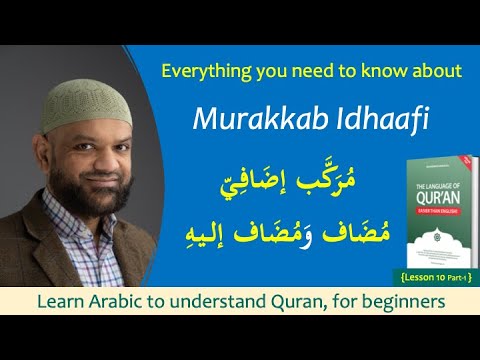 Click to play
Introduction
The idafah (الْإِضَافَة) — the possessive or genitive construct — is arguably the single most important grammatical structure in Arabic. It is found in virtually every line of the Quran and is the basis of innumerable Islamic proper nouns, phrases of worship, and Quranic titles. Surah names such as Surah Al-Fatihah's own internal structure, phrases like بِسْمِ اللهِ، رَبُّ الْعَالَمِينَ، مَالِكُ يَوْمِ الدِّينِ are all built on the idafah.
Along with the prepositional phrase studied in Lessons 8 and 9, the idafah is also the second and final reason a noun is in the jarr case in Arabic. The mudaf ilayhi — the second element of every idafah — is always and without exception in the jarr case.
This lesson — Part One of a two-part study of the idafah — focuses on the construct when both the mudaf and the mudaf ilayhi are nouns. Part Two covers the mudaf ilayhi when it is a pronoun, and adverbs that function as the mudaf.
Lesson Notes
What Is the Idafah?
The idafah is the Arabic device for expressing the possessive relationship between two nouns — the relationship that English expresses using either the preposition "of" or the apostrophe-s construction. Importantly, Arabic has no separate word for "of" in this grammatical sense. The idafah construct itself carries that meaning.
| English | Arabic idafah |
|---|---|
| a teacher's book / a book of a teacher | كِتَابُ مُعَلِّمٍ |
| the teacher's book / the book of the teacher | كِتَابُ الْمُعَلِّمِ |
| Hamid's house | بَيْتُ حَامِدٍ |
| his house | بَيْتُهُ |
The first noun is called the mudaf (مُضَاف) and the second noun is called the mudaf ilayhi (مُضَافٌ إِلَيْهِ). Together they form the murakkab idaafii (مُرَكَّبٌ إِضَافِيٌّ).
Rules of the Mudaf
The mudaf (first noun) has THREE rules: 1. It NEVER takes Al (the definite article) — even if the translation is definite. 2. It NEVER takes tanween — even if the word normally takes tanween. In its place it takes a single corresponding vowel (dammah, fathah, or kasrah). 3. In the dual and sound masculine plural, the final noon is removed. The i`rab (grammatical case) of the mudaf — rafa`, nasab, or jarr — depends on the role it plays in the sentence, not on the idafah itself.
Rules of the Mudaf Ilayhi
The mudaf ilayhi (second noun) has ONE rule: It is ALWAYS in the jarr (genitive) case — without exception. It may be definite or indefinite. If the mudaf ilayhi is definite, the entire idafah is translated as definite ("the teacher's book"). If the mudaf ilayhi is indefinite, the entire idafah is translated as indefinite ("a teacher's book"). Nothing may come between the mudaf and the mudaf ilayhi.
Making the Mudaf "Light" — Removing the N-Sound
The key operation of forming the mudaf from a normal noun is the removal of the N-sound (the nunation). This is called making the irab khafiif (light). The standard irab with tanween or the noon of dual/plural is called thaqiil (heavy).
| Noun type | Standard (heavy) | Mudaf (light) |
|---|---|---|
| Masc. sg. rafa` | مُعَلِّمٌ | مُعَلِّمُ |
| Masc. sg. nasab | مُعَلِّمًا | مُعَلِّمَ |
| Masc. sg. jarr | مُعَلِّمٍ | مُعَلِّمِ |
| Masc. du. rafa` | مُسْلِمَانِ | مُسْلِمَا |
| Masc. du. nasab/jarr | مُسْلِمَيْنِ | مُسْلِمَيْ |
| Sound masc. pl. rafa` | مُسْلِمُونَ | مُسْلِمُو |
| Sound masc. pl. nasab/jarr | مُسْلِمِينَ | مُسْلِمِي |
| Sound fem. pl. rafa` | مُسْلِمَاتٌ | مُسْلِمَاتُ |
| Sound fem. pl. jarr | مُسْلِمَاتٍ | مُسْلِمَاتِ |
The pattern is consistent: wherever there was an N-sound (tanween or noon), that N-sound is removed.
The Irab of the Mudaf Can Be Rafa, Nasab, or Jarr
This is a frequent source of confusion for learners. Because the mudaf ilayhi is always jarr, students sometimes assume the mudaf must always be rafa. This is incorrect. The mudaf takes its irab from its grammatical function in the sentence — exactly as any other noun would.
Example with بَيْتُ الْمُعَلِّمِ in three roles:
| Sentence | Role of mudaf | I`rab | Translation |
|---|---|---|---|
| هَذَا بَيْتُ الْمُعَلِّمِ | khabar (predicate) | rafa` | This is the teacher's house. |
| رَأَيْتُ بَيْتَ الْمُعَلِّمِ | object of verb | nasab | I saw the teacher's house. |
| صَلَّيْتُ فِي بَيْتِ الْمُعَلِّمِ | after harf of jarr | jarr | I prayed in the teacher's house. |
Only the mudaf ilayhi — الْمُعَلِّمِ — stays fixed in the jarr case throughout. The mudaf changes according to its role.
Ghayru Munsarif Nouns in the Idafah
Nouns classified as ghayru munsarif (partly declining — covered in Lesson 7) normally do not take tanween and, when in the jarr case, take a fathah rather than a kasrah. However, when such a noun becomes the mudaf, it behaves like a fully declining noun and takes a kasrah in the jarr case.
A ghayru munsarif noun that becomes the MUDAF takes a kasrah in the jarr case (not fathah). A ghayru munsarif noun that is the MUDAF ILAYHI also takes a kasrah (jarr) — not a fathah.
This is why عُلَمَاءُ الْعِرَاقِ (the scholars of Iraq) has a kasrah on عُلَمَاءِ even though عُلَمَاء is normally ghayru munsarif.
Recognising the Idafah in the Quran
Two signs identify the mudaf:
- A word that normally takes tanween but has only a single vowel instead — no tanween, no Al.
- In a dual or sound masculine plural: the final noon is missing.
Immediately after this word will come the mudaf ilayhi in the jarr case. These two signs together are a reliable detector of the idafah construct.
Summary
The idafah (مُرَكَّبٌ إِضَافِيٌّ) is the Arabic possessive construct, formed by placing two nouns side by side with no intervening word. There is no Arabic word for "of" — the idafah carries this meaning structurally.
Key rules:
- The mudaf (first noun): no Al, no tanween, no final noon (for duals and sound masculine plurals). Its i
rab — rafa, nasab, or jarr — reflects its role in the wider sentence. - The mudaf ilayhi (second noun): always in the jarr case, without exception. It may be definite or indefinite. The definiteness of the entire idafah follows the definiteness of the mudaf ilayhi.
This is the second and final reason a noun is in the jarr case in Arabic — the first being that it follows a harf of jarr (Lessons 8–9). Every jarr on a noun in the Quran must have one of these two explanations.
Learners who have memorised the Muslim table (from Lesson 4) are now equipped to form the idafah for every category of Arabic noun: singular, dual, sound masculine plural, and sound feminine plural.
Terminology Reference
| Arabic | Transliteration | Meaning | Type |
|---|---|---|---|
| الْإِضَافَةُ | al-idaafah | the genitive / possessive construct — two nouns joined to show a relationship of possession, belonging, or attribution | ISM |
| مُضَافٌ | mudaaf | the first noun in the idafah — the thing being possessed or attributed | ISM |
| مُضَافٌ إِلَيْهِ | mudaaf ilayhi | the second noun in the idafah — the possessor; always in the jarr case | ISM |
| مُرَكَّبٌ إِضَافِيٌّ | murakkab idaafii | the possessive phrase — another name for the idafah construct | ISM |
| تَنْوِينٌ | tanwiin | nunation — the double vowel ending on an indefinite noun (un/an/in sound) | ISM |
| خَفِيفٌ | khafiif | light — the i`rab of the mudaf after tanween and noon are removed | ISM |
| ثَقِيلٌ | thaqiil | heavy / standard — the normal i`rab of a noun with tanween or the noon of dual/plural | ISM |
| رَبُّ الْعَالَمِينَ | Rabbu-l-`Aalamiina | the Lord of all the worlds | ISM |
| مَالِكُ يَوْمِ الدِّينِ | Maaliku Yawmi-d-Diin | Master of the Day of Judgement | ISM |
| بِسْمِ اللهِ | Bismi-Llaah | in the name of Allah | ISM |
Linked Arabic terms open their full entry in the Arabic Grammar Guide.
📖 Grammar guide. Grammar terms are explained in the Arabic Grammar Guide — fully vocalised, searchable in Arabic, any transliteration, or the English meaning.
Lesson Transcript
Read the full transcript (8,482 words)
Auto-generated from the lesson video. Timestamps jump to that point in the video. May contain transcription errors.
0:00 The language of Qur'an, easier than English, Lesson 10. As-salamu alaykum. Alhamdulillah, we've reached lesson number 10.
0:08 In this lesson, we are studying the Idaafah, which is one of the most commonly used structures in the Arabic language. You will find it in almost every line of Qur'an. In many of the things that we name also, you will see this structure. So it's very, very important for us to grasp. Along with what we've learnt in the previous lesson, you'll see this construct used in combination with other constructs also. So it has two parts. The first part is called Mudaf and the second part is
called Mudaf Ilayhi. It has a bit more technicalities than the previous one which we've learnt. And Inshallah Ta'ala, it is also the second reason for an Ism to be Majroor or in Jar status. If you remember in the last one, we looked at an Ism will be Jar if there's a Harf of Jar before it. And the second reason why an Ism is Jar is because it is Mudaf Ilayhi. And this is the terms we're going to learn. We're going to take it very slowly, Inshallah
Ta'ala, over the next two lessons. We're going to look at each and every element of the two parts of this construct and we're going to see many, many examples. So let's begin by first of all beginning with the blessed name of Allah, Bismillahirrahmanirrahim seeking the help and the mercy of Allah with Dua We ask Allah subhanahu wa ta'ala Oh my Rabb, make it easy and not difficult and help us finish our affairs with goodness.
1:31 Right at the beginning, we began our journey by looking at the map and I shared with you the key elements that we need to learn. Alhamdulillah, now you're in lesson number 10. You have some idea of what is a nominal sentence and you also are aware of its basic rules. We've been through it many, many times, Inshallah, in the very numerous examples that we've seen. We've also studied Muraqqab Tawsifi, if you remember the descriptive phrase. And of course we've done in the previous lessons, a Muraqqab Jari, which occurs almost 13,000 times in the Quran.
2:04 Now we are picking up, Alhamdulillah, the possessive phrase or Muraqqab Idhaafi. So you can see from your map now, Alhamdulillah, we've got a few left and of course, Jumda Fi'aliya, I did promise you that we're going to look in detail in Book 2, when we're going to look at Sarf as well. So you can see here, Alhamdulillah, we are making progress through our map and Inshallah, hopefully by now, you are not at a stage where you will be able to recognise something in every line of
Quran. That's after only 10 lessons. So keep on praising Allah, keep on thanking Allah and making sincere efforts in your studies and Inshallah, very soon more and more of the text will be able or we will be able to understand more and more of the text. We need to do our effort, Inshallah of course, and remember always to ask Allah Azza wa Jal.
2:52 So let's now take a closer look at the Muraqqab Idhaafi. What is Al-Idhaafah? The Idhaafah is actually formed in Arabic by putting two Isms together based on a certain rules or set of rules to form one construct, an incomplete construct. The word Idhaafah in English, we could translate it as addition or annexation.
3:20 It is usually used for showing a possessive relationship between the two nouns. What do I mean by that? If we look at here, a teacher's book. What I'm saying is a book which belongs to the teacher. The teacher is possessor of the book or I could say the teacher's book. A teacher's book, the teacher's book. Meaning the specific teacher's book. Or I could say for example, a book of a teacher. Of course, I can also say the book of a teacher. So in English we use
the word O-F to show relationship between these two nouns. In Arabic to show the relationship between these two nouns, we use what's called an Idhaafah. Now please note, there is no word in the Arabic language for O-F. It does not exist. So there is no word for O-F Just like if you remember when we did the Jumla Ismiya, I said there was no word for is or are in Arabic. That is translated when you have the Mubtad and the Khabar coming together and you use your
knowledge of English to translate accordingly. Same thing here, there will be no O-F in the Arabic language, the specific word for O-F.
4:32 But you will translate it according to the rules of the English language. Either you can say a book of a teacher or you can say a teacher's book. Both, I hope you agree, is exactly the same. Similarly, I can say Hamid's house. A house of Hamid or Hamid's house or I can also say his house. Hamid's house his house. In all these circumstances, all of them would be translated in Arabic using the Idhaafah construct. This is very very important Insha'Allah and we'll see many examples of
it. Just for you to aware, what is the difference between English and in Arabic. So here, this is called the possessive, if you want to call it that in a simple term. And in Arabic we will call it Al-Idhaafah or the Idhaafah. So these are many different ways of calling the same thing. And this is showing two nouns coming together, two Isms and the relationship between the two using this construct. So the two parts of the constructs are called Mudhaaf and Mudhaaf Ilaihi. Mudhaaf and Mudhaaf
Ilaihi. The first part is called Mudhaaf and the second part is called Mudhaaf Ilaihi. That's all you need to remember Insha'Allah. Please note, of course Arabic is written this way, English is written that way.
5:53 So it will be this way. So the Mudhaaf comes first and the Mudhaaf Ilaihi will come after in the Arabic language. The rules for Mudhaaf are as follows. It will not have Al. Even though we may translate it as the teacher's book, we will not have Al in front of the Mudhaaf. Second thing, the Mudhaaf will be without Tanween. Even if the word normally takes Tanween, in this case it will not take Tanween when it becomes the Mudhaaf. So it will not have Tanween. It will
have a single corresponding vowel. Very similar to when we added Al. Second, in the dual and the plural, there is a Noon at the end. For example, Muslimoona. This Noon will be removed. And the I'arab of the Mudhaaf can be Rafa, Nasab or Jar depending on what role it is playing in the sentence. Please note that the rice role, I'arab and of course category and expression. So the I'arab will be either Rafa Nasab or Jar depending on the role it is playing. The Mudhaaf Ilaihi which
comes immediately after, please note there is no gap between the two is always Jar, always Majroor. There is no exception to this. So Mudhaaf Ilaihi will always be I'arab will always be Jar. Please note that. No exception to this rule. And you will translate the Mudhaaf whole construct, Al-Idhaaf as indefinite if the Mudhaaf Ilaihi is indefinite. So Mudhaaf Ilaihi can be definite or indefinite. If it's indefinite, for example here Kitabu Muallimin A teacher's book. You will translate the whole thing because Muallimin is indefinite in Jar.
And then we have Kitabul Muallimi. Here you can see the Mudhaaf Ilaihi is definite Why? Because it's got Al in front. That should be well easy for you now. So it will be translated as the teacher's book. So the I'arab of the Mudhaaf Ilaihi is always Jar. It can be definite or it can be indefinite. The translation will be definite if the Mudhaaf Ilaihi is definite and the translation will be indefinite if the Mudhaaf Ilaihi is indefinite. And of course lastly as I mentioned before, nothing
will come between the Mudhaaf and the Mudhaaf Ilaihi. They will be next to each other. So again you'll see that Inshallah Ta'ala. So the sign of recognising Mudhaaf is that if a word normally takes Tanween, it will not have Tanween. And after it, the Ism will be in Jar or Majroor. And that is the way to recognise the Idaafa. So please try and remember these basic rules. I'm going to go through each part in detail. So Inshallah Ta'ala by the end of the lesson, there is
no confusion of what is the Idaafa construct. And then of course then Inshallah through practise we will recognise it. And not only that Inshallah we'll translate correctly. On the screen we have two words. Baytun Muallimun. Baytun, a house. Muallimun, a teacher. I want to say in Arabic the teacher's house or the house of the teacher. So how do we follow the rules we just mentioned of the Muraqab Idaafi or Al-Idaafa. We make the Baytun which is the first word. Remember in Arabic it's the other way
around. So we'll say house first. And the thing that has been possessed will come after. Mudhaaf Ilaahi will come after. So house of. So the word house will come first. And the word teacher will come after. So we have Baytun will become Baytu because the Mudhaaf cannot take Tanween. So even though originally the word had Tanween there it is removed to only have a single vowel. It could be Bayta, Bayti. But in this case we are going with Rafa so it's Baytu. And then this word
here Al because we want the teacher's house not a teacher's house. We have Al in front. And of course it has to be Jar. There is no other except option. So it'll be Baytun Muallimun.
10:11 Baytun Muallimun. So Mudhaaf is Baytu and Al Muallim is Mudhaaf Ilaahi which is Jar. And in this case the Mudhaaf is Rafa. So this is the basic rules now being explained. And Insha'Allah do write this example down and make sure you're aware of what the changes there are from Baytun to Baytu. Al Muallim from Muallimun. This is your Idaafa construct. Your first example Insha'Allah. Do study it well and in the previous slides the rules that I shared with you Insha'Allah you can see it now as a practical example.
10:47 So just to distinguish between the teacher's house and a teacher's house. So Baytun Muallimun will be a teacher's house. Why? Because Mudhaaf Ilaahi is now indefinite. I hope Insha'Allah this is easy for you. So this word is indefinite because it has no Al and it does not fall into any of the other categories of definiteness that we know from lesson number two. So Baytun Muallimun. A teacher's house Mudhaaf plus Mudhaaf Ilaahi and which is of course has to be here Muallimun because it needs to be
Jar. On the other hand if I say the teacher's house we've already seen the example here Mudhaaf Mudhaaf Ilaahi. Baytun Muallimun. Now we translate it as the teacher's house. So again if you remember the second lesson where I gave you the five plus two seven categories of Isms that were always definite. This is the seventh one on your list. So again remember if the Mudhaaf Ilaahi is indefinite the translation will be indefinite. If the Mudhaaf Ilaahi is definite the translation will be definite. So again go
back to lesson number two and this is your seventh lesson. We covered it in 2.7 in the notes that I supplied in the books Inshallah Ta'ala or on the video also you'll find it numbered as 2.7. So this is your connected to something annexed to something which is definite. So Baytun could be any house but because it is the teacher's house now it becomes a specific house. And this is your seventh reason for something to be definite. And again if you recall we've gone through this
list. I think we have the vocative five and six remaining to be done. The rest have been covered Inshallah in some detail. Sorry pointing words will be covered in lesson number twelve. So you can see here Alhamdulillah that this course has been very well structured to follow a methodology in which you learn the most essential parts of the Arabic grammar that you need to begin to understand Quran. So this is your Mudhaaf, Mudhaaf Ilaahi and if the Mudhaaf Ilaahi is definite then the whole construct is
definite in translation and of course the Mudhaaf will become definite and debut to being related to something definite. That's all that you need to know Inshallah too many rules to remember. Simply write the examples down and that will make things easy for you. So Baytul Muallimin and Baytul Muallimi and all that stuff I just mentioned now should be able to become very clear in your knowledge base and if you write it down a couple of times Inshallah the rule will stick in your mind. Here are
some examples of the Idaafa from the Quran which I think you should be able to be familiar with. You may have read them yourself but first two Inshallah I think I'm confident we all know. The first one is Rabbil Alameen. Of course this is from Surah Al-Fatiha. The Lord of the Worlds. Again you can see why the translators have translated it. This is beginning with Al This is not Rabbin but Rabbi. So lost is Tanween. Rabbun Rabban Rabbin. So Rabbil Alameena The Lord of the Worlds.
Of course if you end you'll say Rabbil Alameen. That's how you'll end. The next one again it looks a bit complex but what's going on here we have originally it should have been Malikim Yawmin. But it is not. It's Maliki. So it's lost is Tanween. Why? Because it is Mudaaf. And the second one is the Mudaaf Ilayhi but it's also another Mudaaf. So we've got two Mudaaf Ilayhi construct here chained. Don't worry we're going to look at this example in detail in the next lesson Inshallah.
So Maliki Yawmin Deeni. And again you see the translation as Master of the Day of Judgement. So there are two Idaafa constructs joined together in a chain here and you can see it being combined there very beautifully. The next one should be easy for you. Ilaa means towards or to. Kitabin it should have been. Because towards a book. Ilaa Kitabin. But because it's got the word Allah Lafza Jalala straight after. And that is also Jar.
15:06 So what's happening here the Kitabin is now Ilaa Kitabin has to lose it's Tanween becomes Ilaa Kitabillahi. So towards the book of Allah. The book of Allah. Maas Sabireen Again this is from the Quran. Mudaaf Maas Sabireen Those who are patient. With those who are patient. Allah is with those who are patient. So these few examples Inshallah hopefully will motivate you. But what you're learning is very very commonly used in Arabic. Of course very commonly used in the Quran. And it's in every line of Quran. I hope Inshallah this you'll be able to now very soon at the end of this lesson open up the pages of Quran and see and recognise the Idaafa construct for yourself.
15:56 Three more examples we have Abduhu wa Rasuluhu Again this is now his slave and his messenger. This is actually from the Shahada when we declare our faith. So Abduhu his messenger his slave wa Rasuluhu and his messenger. Again this is also an Idaafa construct. Then we have Rabbana that part the first blue part is also a Idaafa construct. Okay.
16:27 May Allah grant all of us in this world that which is good. Our Lord. The Our Lord part is an Idaafa construct. Bismillahi Bi and Ism is Jaar and Majroor. Bismillahi it is your Ism and the word Allah afterwards combined together is your Muraqab Idaafi or Al-Idaafa and that is why the translation says in the name of Allah. In the name of Allah. Inshallah we're going to see this example also. So we can see here now Alhamdulillah how commonly used the Idaafa construct is and therefore
it is important that we learn this thoroughly and of course the Mudafilahi can be an Ism standard Ism or it can be a pronoun as we have seen here Inshallah. So in the first lesson I'm going to focus on the noun and the second video Inshallah I'll make a separate on the pronouns which is very commonly used. So in summary brothers and sisters the Idaafa construct is made up of two parts the Mudaf and the Mudafilahi. Mudaf and the Mudafilahi so we have the first part
is the Mudaf and it has no Tanween or Al and the Mudafilahi always Jar. That's all you need to know. So the name technical name given to them in the grammar books is Mudafun and Mudafilahi Mudafun and Mudafilahi for the two parts or you can of course call them combined together Muraqab Idaafi or Al-Idaafa. Just giving you here the names. A lot of these grammatical terms usually confuses us at the beginning but Inshallah through usage you'll learn them at this stage there is no need to
memorise them. Just make sure that you are aware you can call it Al-Idaafa, Mudaf or Mudafilahi whichever one you prefer but at the beginning focus on the rules. Once you've understood them through a bit of practise Inshallah you'll be also able to cover the terminology The A'arab of the Mudaf My experience of learning personally as well as that Alhamdulillah those who have studied with me what we find very confusing at the beginning is that what is the A'arab of the Mudaf? I'm talking about the first
part. The first part can be any A'arab, any of the three. It can be Rafa it can be Nasab or it can be Jar. Why is it Rafa, Nasab or Jar? It will be in the context that it's used. So please take a look at these three different grammatical sentences that we have in the example above. So we have here first of all we have Hadha. This is your Mubtada Hadha is your Mubtada. Baitul Mu'allim you've done many times you'd recognise is your Idaafa construct. Because
the Idaafa now is the Khabar, it will be Rafa. So therefore we have this is the teacher's house. So Baitu becomes Rafa Why? Because it is the Mubtada. It is the Mubtada Hadha and this is the Khabar. So this is the why it is Rafa. Now next one Ra'aytu, I saw Now I saw the teacher's house. Bait has to be now what? Nasab. Why? Because it is the object. I saw. What did I see? The house. House of the teacher. So it will become Baita So
this is Nasab. I hope that makes sense Inshallah. This is a Jumla Fa'aliya beginning with a verb and the object of the verb is and the doer of the verb is Tu which is I and I've done this many times for you already So Ra'aytu, I saw. What did I see? House Whose house? The teacher's house So this is why it is Nasab. So in the first example it is Rafa Why? Because it is Khabar. In the second example it is Nasab Why? Because it is
the object of seeing Baiti here is Jar. Why is it Jar? Because of Fi Fi means in. Of course we've done this in the previous lesson Salaytu, I prayed in the teacher's house. I prayed in the teacher's house. So this is now Jar. So the conclusion is the Mudaf can be Rafa, Nasab or Jar. It does not matter which one it is because it is the role that it is playing in the sentence. So Rafa Nasab and Jar. And hopefully by now you can tell why
is it Rafa? Why is it Nasab? Why is it Jar? So it is only the Mudaf Ilayhi that is Jar. And this is where the confusion comes. A lot of people expect the first one to always be Rafa or always to be Jar. I don't know why. But that is the rule. It is only the Mudaf Ilayhi which is always always Jar. I hope you can see that Inshallah Ta'ala in the three examples. So this is the two reasons why an Ism will be Jar in
Arabic 1. Because it comes after Harf of Jar lesson number 8 and 9. And now second reason because it is Mudaf Ilayhi. It will always be Jar Majroor and why? Because it is a Mudaf Ilayhi after coming after the Mudaf. That's it Inshallah Ta'ala as far as studying the two reasons for being something being Majroor in Arabic. The Aarab of the Mudaf is always light. By now it should now be very clear that we don't have the Tanween. If the word has Tanween we remove the
Tanween and put a single vowel corresponding vowel on the Mudaf. That hopefully is clear. So Baitun becomes Baitu. Baitun becomes Baitu. The removal of the Tanween we are going to call it light. Removal of the Tanween is light and the possession or having the Tanween is standard, heavy, standard, normal. So you can see there is an um sound at the end, an n sound at the end. And this is only with words that have Tanween. Of course there are others we know that don't have Tanween.
22:28 So what happens to those? We are going to take a look now. So the Aarab has to be light of the Mudaf. Alhamdulillah if you've taken my advice and memorised the Muslim table life will become very easy for you. And we covered this of course in lesson 4.8 as you can see here Inshallah Ta'ala. And this should be very easy for you. So I've written here as you can see let's quickly go through it. Muslimun, Musliman, Muslimin. Muslimani, Muslimayni, Muslimayni. Muslimuna, Muslimina, Muslimina. And then for the feminine we have Muslimatun, Muslimatan, Muslimatin. Muslimatani, Muslimatayni, Muslimatayni. And for the plural we have Muslimatun, Muslimatin, Muslimatin. Now what you'll notice with all of them there is an N sound at the end. So let's quickly transliterate that. And you can see here there's an N sound in what I'm saying.
23:31 And you can see that N sound in red here which I've highlighted for you to make it very clear. There's an N nonation sound at the end. So you can see that with all the words with Tanween.
23:43 In the dual also we have an N sound which you can see with the red at the end. So at the end we have Ni and of course Ayni, Ayni you can see here. And same in the dual for the feminine Inshallah Ta'ala. So you can see here that there's an N sound at the end of the dual also. Also in the plural we see an N sound. Muslimuna can you see the Na at the end? Muslimina and we have Muslimina. Okay this is your heavy
standard I'ram. And of course for the feminine we have the Tanween but it's not the same as the Tanween we have. It does not go Tun Tan Tin. This is a special case. So A Tun and we have A Tin and we have A Tin for Nasab and Jar. So you can see here very clearly N. So if I were to remove the N sound from any of these what will I end up with? So if I get rid of the N sound from all of
them so you can see here N is gone there. I remove the red. So what is the sound that I'm left with? And that is your light era. So for the ones with Tanween of course it's easy even for the duals now you can clearly see. I end up with Muslimaa, Muslimai Muslimai. Okay for the duals and we of course for the sound mask in the plural I'll become Muslimu, Muslimi, Muslimi and Muslimatu, Muslimati, Muslimati for the feminine. So the normal with the N sound is
your standard eraab and when I remove the N sound it will become light.
25:27 Also look at the eraab of the Munsarif. Those words that end with Tanween. So like we did before we're going to go slowly now inshallah to make sure that you've got this point. So we have Muslimun if I were to rewrite that I will end up in English transliteration like so. But if I were to write this Mun with Noon Saakin. Exactly the same sound. Remember it is written the way it is written on the top. Not like this but this is for illustration purposes. So
you can see here I've got the Noon Saakin at the end. So Mun exactly the same as this sound here. So again we have Muslimun exactly the same. You can see I've got Noon Saakin at the end, Muslimin. And exactly the same for Muslimatun Muslimatan and Muslimatin. I hope you can see that. If I remove the N now I end up with Muslimu, Muslima and Muslimi. Muslimatu Muslimata, Muslimati. You can see that very clearly now inshallah what I did earlier. This is what you do to
make it light for those words which are Munsarif i.e. they take Tanween and they decline in three different endings.
26:47 Three different endings. Muslimun, Musliman, Muslimin will become on its light. Muslimu, Muslima, Muslimi. That's exactly what we mean when we mean that the Tanween is lost and we replace it with a single vowel. I hope this is now very clear for you inshallah. Now let's make some Idaafah construct using this knowledge.
27:10 On the right hand side of the Arabic we have three sentences which I'm sure you're familiar with by now. A teacher came, I saw a teacher, I gave salam to a teacher. Now I want to say a school teacher came.
27:26 So school teacher will become your Idaafah and I saw a school teacher and I gave salam to a school teacher. So of course the word for teacher is school teacher, sorry it should be teacher of a school. So the word for school is Al-Madrasatu Let me change the colour so it's different from the ending of that one.
27:57 So Muallimun Al-Madrasatu. Of course that is incorrect. So what do I need to do? I need to make sure that the Mudaaf is light. So to get rid of the Tanween I put a single vowel sign and of course it will become Al-Madrasati. Al-Madrasati. Why? It needs to be Jarb. I hope this is very clear Inshallah In the second example I saw it is Nasab with Tanween, two Fathas and that's why you see the Alif. I need to get rid of that so it becomes a
single sign and then of course I need to put the word school afterwards and that will be Al-Madrasati. I'm copying and pasting to save time Inshallah. Then we have the third example Muallimin. It cannot be Min so it becomes Muallimi and of course I'll put Al-Madrasati afterwards to make it into Mudaaf Ilayhi which has to be Jarb. So in these three examples Inshallah we've seen the making of the I'rab of the Mudaaf light and we've seen the Mudaaf Ilayhi being made Majroor and this is the
basic rule and please do write these three sentences down. They will help you remember Inshallah. We have now the same thing this time with the feminine Exactly the same principle will follow we get rid of the Tanween to make it Mudaaf and of course it will become Al-Madrasati. I hope this is making sense Inshallah. As you'll note here in the Nasab version I don't have the Alif afterwards. Why? Covered in lesson number six in detail so we do not need to put the extra Alif that
we saw in the other one. So we put a single Fatha and we put here the Mudaaf Ilayhi. So Ra'aytu Muallimat Al-Madrasati. If you can see that Inshallah of course in the next example Muallimatin cannot be. It will be Muallimati and of course Al-Madrasati will come afterwards.
29:50 So I hope now Inshallah you can see both examples where the Mudaaf is being made light i.e. the Tanween removed and of course the Mudaaf Ilayhi being Majroor. These six examples Inshallah will help us learn the rules. Do again I repeat to write them down in your own notebook. Arab of the dual when it is Mudaaf The duals are listed above. You can easily see the presence of the N sound which has been highlighted in red. So again you can see here if I get rid
of the N I end up with Musleema I hope Inshallah that this is now very clear for you So I end up with Musleema just the Alif at the end and of course there will be a slight elongation because of the Fatha before the Alif And then in this one we have Musleemai the Noon is gone So Musleema Musleemai which you can see here that I have removed the Noon. So you can see it now how it is written in Arabic Inshallah and the translation is
below. Same thing with the Jar We have Musleemai again because of the Noon at the end has been removed. So the dual will be Musleema Musleemai, Musleemai. Please note that Inshallah And then again this feminine is exactly the same. Of course we have Musleemata, Musleematai, Musleematai Again ending is exactly the same as we have seen many many times before. So when it is light the N sound or the presence of the Noon is removed. And of course in writing you only see the Ya on the
Nasab and the Jar and in the Rafa you will only see the Fatha and this is the dual when it is light. As we have seen before now we have the exactly the same sentences but with the duals The first one in Arabic is Jaa Musleemani Raaytu Musleemaini, Sallamtu Alaa Musleemaini. Again, I hope this is not difficult for you Inshallah and you can recognise this if you are having difficulty go back and memorise the Muslim table. Now I want to say Muslims of Egypt. The word
Egypt is Misr. Let's put that in a different colour Inshallah So Misr. Now Misr is a word that is Ghairoo Munsarif. So it does not take Tanween. And in Jar it will end with a Fatha. Okay, please note that Inshallah So let me copy that. So that is Misr in Jar or Nasab. In this case of course it will be Jar because it is Mudaf Ilayhi But now I need to remove the N sound. I end up with Jaa Musleema Misr. I hope you can see
that Inshallah. And then Raaytu Musleemaini The noon is gone. It will be Misr Sallamtu Alaa Musleemaini. Remove the noon and we end up with Misr. And so that is now the translation of in English The two Muslims of Egypt came I saw the two Muslims of Egypt and I gave Salam to the two Muslims of Egypt. So you can see here now when it is the Rafa the noon is gone. So we end up with Musleema and then in the Nasab we end up with Musleemai
and in the Jar we end up with Musleemai. I hope Inshallah this is not causing any problems for you and it is relatively easy Inshallah. Again if you write it down it will make sense. On the screen I have the word Allah and of course I have the word Rasoolun. I am sure you know the meaning of both of these Messenger Rasoolun. Now I want to say two Messengers of Allah. Not one but two. So if I say here Rasoolullahi. I hope there is no problem
recognising that The Messenger of Allah. Rasoolullahi The Messenger of Allah. Two Messengers Rasoolani Rasoolani and of course we have the word Allah as we already know it. So in order to make that into Mudaf. Mudaf ilayhi that will be incorrect. So what we need to do is remove the noon. So we end up with Rasoolallahi. I hope you can see that here Inshallah. Of course in reading you will assimilate Rasoolallahi So you can see here the two Messengers of Allah The two Messengers of Allah. As
opposed to Rasoolullahi which will be one Messenger of Allah This is used in the Quran therefore I am highlighting for you. So please note that is how we recognise the dual when it is Mudaf The A'rab of the sound masculine plural when it is Mudaf. The sound masculine plural end with Oona, Eena, Eena sound. And of course you can easily see there is an N sound at the end which is represented by the noon that we can see Inshallah Ta'ala. So what we need to do
now again is remove the N sound. We end up with Muslimu. Please note there is a Wow there so there is an elongation of the sound. And of course we end up with Muslimee And we end up with Muslimee in the Nasab and Jar. So this is now the removal of the N sound and we end up with the light version of the sound masculine plural. As we have seen in the previous examples we have now the Muslims came, I saw the Muslims, I gave Salam
to the Muslims. Just the same sentence to illustrate what we mean by the A'rab becoming light and the Mudaf Mudaf Ilahi examples. So I want to say the Muslims of Egypt came instead of just the Muslims. Of course I would add the word Misr at the end which is Egypt and it will be Misra because it is Mudaf Ilahi. Please note Ibrahimu, Ibrahima, Ibrahima So what we have here is the noon needs to go so we will end up with Muslimu, Misra Muslimu, Misra. Again we
have Muslimeena here Get rid of the noon, we have that. And then of course we then put the Misra at the end. Ra'aytu Muslimee Misra and Salam to Ala. Exactly the same principle and we put in there the word Misra at the end So Misra is Majroor, Jarr. Why? Because it is Mudaf Ilahi Why isn't it showing the Kasra? Because it is Ghairu Munsarif, not partly declining. And that's all you need to know Inshallah Ta'ala. When you see the noon of the sound masculine plural missing,
this is the reason why it is missing because it is Mudaf and Mudaf cannot have that noon nor can it have Tanween. The Arab of the Mudaf when it is sound feminine plural. The sound feminine plural ends with Atun, Atin, Atin. So again we have here simply Muslimatun. Again all we are doing is removing the Tanween and we now end up with Muslimatu and we have Muslimati and we have Muslimati Please note the significant difference between the feminine version of the single Muslimatun, Muslimatan, Muslimatin, Muslimatu,
Muslimata Muslimati. Where this is completely different is Ati Atu, Ati, Ati ending sound. So you can see here now when it becomes light or when we remove the N sound at the end, this is how it is written and this is how it is read. On the screen we have Ja'at Muslimatun, Ra'aitu Muslimatin Salamtu Alaa Muslimatin. The female Muslims came, I saw the female Muslims and I gave Salam to the female Muslims. So you can see very clearly here Insha'Allah Atun, Atin, Atin. Please note I've
changed Ja'a to Ja'at and this has been explained to you in lesson number 3. The verb has to change if the doer is feminine. It doesn't matter whether singular, dual or plural. This will all be the same verb but it has to be Ja'at anyway. The rest of it is now going to be the same as the English translation we've done many times Ja'at and we've got Muslimatu, make it light and of course we put Misra at the end. Exactly the same as Ti and we
put Misra at the end. Ti and Misra at the end.
38:22 So you can see here now Alhamdulillah how we'll translate into Arabic of the Muslims of Egypt came of course I mean feminine. I saw the Muslims of Egypt feminine and I gave Salam to the Muslims of Egypt. Let me move that slightly so you can see it very clearly. Insha'Allah the scene in the front. So you can see here Alhamdulillah very very clearly the three sentences being translated into English and Arabic vice versa and now Alhamdulillah you've seen the singular with the Munsarif, you've seen the
dual and you've seen the sound masculine and plural and you've also seen the sound feminine and plural. Exactly the same principle it will follow all the way through in any examples that you come across Insha'Allah. Summary of the A'arab of heavy and light What we mean when we say the A'arab will be light or heavy when we say standard it is heavy meaning it has Tanween Tanween or it will have the N sound in the sound masculine and plural sound feminine and the duals. What we
mean by light is the removal of the Tanween and the Noon at the end of the dual sound masculine and plural and the sound feminine and plural and that is the difference between the two so when the Mudaf it becomes Mudaf there's two things to look out for no Alif Lam, no Al or no Tanween or the dual and the sound masculine and plural and the sound feminine and plural the Noon at the end has gone missing. If you see those things it's very likely that
it is the Mudaf. Particularly there are very few other reasons why it loses Tanween. One is Al so of course you won't see the Al there and very very likely it is Mudaf. There are a few exceptions Insha'Allah we'll cover later. So that's the sign for you to recognise the Idafah the Mudaf in particular and of course the Mudaf Ilahi will always come after and if you see the Ism after is Majroor this is your dead giveaway sign Insha'Allah that we are dealing with Al-Idafah structure
So please get a pen and paper if you haven't memorised this table please do so already. I did remind you in lesson 4.8 to do so. So this is the heavy standard version and this is the light version. So you can see here Muslimu, Muslima, Muslimi, Muslimatu, Muslimata, Muslimati, Muslima Muslimai, Muslimai, Muslimata, Muslimatai, Muslimatai Muslimu, Muslimi, Muslimi, Muslimatu, Muslimati Muslimati. That's all that's happened and all we've done with the standard one is there and of course the light version which you can see here. So make
a note of both of those Insha'Allah and that's all you need to know and I did promise you that if you learnt the Muslim table very very well you'll be able to recognise thousands and thousands of words in the Quran, in the Arabic language, in Hadith etc Examples of Mudaf Ilahi in different categories of Ism. We've seen many examples of the Idafah already. In this session Insha'Allah we're going to focus on the Mudaf Ilahi. Please note no matter what the Ism is it will be Majroor.
There is no option whereas with the Mudaf it could be Rafah, Nasab or Jar. So here Insha'Allah I'm going to give you illustrated examples of different categories of Ism and how they decline or how they express their A'arab when Jar. So please note this Insha'Allah. Remember rice, roll A'arab, category, expression. So now looking at different Isms and how they become Majroor. It has to be Majroor. There is no option Insha'Allah. So we have now the first one Rasoolun for singular Allahu. We want to make that
into the messenger of Allah So in Arabic it will be first the word Rasool It is Rasoolun but it becomes Rasoolu and then of course we have Allahi. Rasoolullahi Rasoolullahi, the messenger of Allah. Now you have the next word we have Yawman. So this is Mansub, Nasab I want to say the day of sorting. So you have the first word Yaw. Yawman will lose the Tanween. It will become Yawma and we don't need the extra Alif and then of course we have the word Yawmal Fasli
So it will be, Fasli will become Fasli Yawmal Fasli, the day of sorting Day of sorting So Ilahinnasu, of course we know the word Ilah so let me copy that for you. Ilah means god or deity and of course it will become Ilahi and it will be, the last example we have Ilahin. This is one word that takes Tanween. So it will become In one is Mudaf, Ilahi Ilahi, please note that and of course we have An An-Nasu will become An-Nasi. Again we go back to
Surah, Qul audhu bi rabbil nas Ilahinnasu, you can now see it. The god of mankind. So very simple examples Inshallah. Very common Quranic examples Inshallah. So please make a note of all three. You can now see that all the three words at the end are Majroor and of course Majroor with Kasra because they have the declension in this particular way Next I'd like you to translate into Arabic the sentences which you see on the right hand side or your left depends on which way you're looking
but these ones The scholars of Iraq came. I saw the scholars of Iraq I gave Salaam to the scholars of Iraq and I prayed in the mosques of Iraq. So you have here Ja'a, Ra'aytu, Salaamtu Sallaytu. Okay remember In with Fi and Ala is of course upon. You've seen many examples of this Please pause the video. Take all the time you want in the world and come back Please do not come back until you've written them down. So let's go through the answers Ja'a. Who came?
The scholars of Iraq. So the word scholars is Ulama'u Ulama'u. Remember it has to be Ulama'u because it is the Rafa version. It is the doer of the verb. But we need the word Iraq afterwards and Iraq will be in Jarb because it has Al. It takes Kasra so you can see that Insha'Allah. So you have now Ulama' again. Now it's Ulama'u What should it be? Is it Ulama'u or is it Ulama'a It will be Ulama'a. Y has to be Mansub Okay. And we have Al.
So who did I see? I saw the scholars of Iraq. I hope this is very easy and clear for you Insha'Allah. I gave Salam. Again Ulama'u or is it Ulama'a Okay so this word does not take Tanween remember and does not go to Kasra. Does not take Kasra in Jarb But because it is now Mudaf. Please go back to the lesson on Ghayru Munsarif where I did this in lesson number 7. This is the point I pointed you to in that lesson to tell you that
it can take a Kasra because when it becomes Mudaf it behaves like the Munsarif words. So it will become Ulama'il Ulama'i sorry and of course you join it to the Iraqi. So again when it becomes Mudaf the word Ulama' will now become Jarb with Kasra whereas before it didn't because it would not be it would be Ulama'a when it is Jarb. But because it is Mudaf it loses its quality of being Ghayru Munsarif partly declining but it becomes or acts like fully declining. Mosques. I'll give
you another example Insha'Allah.
47:40 Masajidu is Rafa. Da is Nasab and Jarb. But because now it has become Mudaf it will take a Kasra and of course we'll have Al. Let me reduce the size of that so you can see it in one screen Insha'Allah. So you can see here now. Sallaytu fee masajidil iraqi I prayed in the mosques of Iraq. This is going back to lesson number 7 when I said the Ghayru Munsarif the partly declining when they become Mudaf they will take Kasra. Very similarly when they take Al
they can take a Kasra as the example I gave you. Akbaru Akbara Akbara but it will be Al Akbaru Al Akbara Al Akbari. Please refer back to that lesson if you can't remember this point. Again it does occur that is why you need to make a note of that. So please note Ghayru Munsarif when it becomes Mudaf it will take a Kasra and of course the Mudafilahi in all these examples is always Majroor. Alhamdulillah on the right hand side you have two boxes with the words
that you need. On the left hand side I've also written the first one down for you just to save you if you're concerned which goes first which goes next. But nonetheless please complete or translate what is on the left hand side in Arabic by making the Idhaafah construct. Making the Idhaafah construct. So I want to say name of this. I want to say Isaskar I want to say path of those who. Those who is of course Al Lazeena and I want to say the reward, the
consequence or the reward of the world or the earnings of the world. This will be another translation for this. So please do the Idhaafah construct for these four pause the video, take as long as you want and come back Inshallah to check your answer. So the first one is name of this the word for this is Hatha and you should know that this word does not change so it will be Ismun will become Ismu and it will be Ismu Hatha Ismu Hatha. Let me increase the
size of that. Ismu Hatha The next one is Sayaratin. So of course it will lose the Kasra and of course the Isa is one of those words that does not change in the three different Arab. Again you can see it very clearly it will remain exactly the same. So we have now the car of Isa or Isa's car very very simple and Sayaratin is Jar for some other reason before that and Isa is also Majroor but you cannot see it at the end because it does
not change. Siratan so it will need to become light so what we will do is we will get rid of the Tanween and we put a single Fatha Sirata and of course Al Lazeena will go straight after let me copy that so it saves me typing and that's of course from Surah Al Fatiha. Sirata Al Lazeena and again that is an Idafa construct. I told you before if you see a single vowel on a word that is supposed to have Tanween very likely it is Mudaf
and of course Al Lazeena does not change so this is why a lot of people get confused in this one. So Al Lazeena is a set of words that is Mabni will not change in the three different Arabic but here we will say it is definitely Jar because it is coming after Mudaf and it is Mudaf Ilayhi. Again Thawabun will become Thawabu and of course I told you before the word Dunya does not change so it will be Thawabud Dunya. Reward or consequence or earnings of
the word. So you can see here Alhamdulillah how we've now done with words that do not change their ending but in all cases we have to say it is Majroor. Why? Because remember what I told you the logical way of following it. Role will tell us what Arabic should be and the category will tell us how it will express its Arabic so these are words that don't change but their role is telling us it is Jar. Why? Because it is Mudaf Ilayhi. I hope Inshallah Ta'ala
this is now cementing what we've been learning so far by the grace of Allah Azza wa Jal. Alhamdulillah that is now the end of part 1 of lesson number 10. A lot of feedback has said people prefer shorter videos so I'm trying to make this lesson not too long but I want to go through things very slowly so make sure that you understand them. And I cannot express the importance of learning the Idafah construct because it is the most common and you see it in almost
every line of Quran. Inshallah through very soon you'll see the proof of this. If not again I urge you to check for yourself. Inshallah in second part of this lesson we're going to see how the Mudaf Ilayhi when it is a pronoun, how it attaches to the Mudaf. So again please note the Mudaf Ilayhi can be a normal noun like for example Baitu Hamidin, Hamid's house but it can be also his house, Baituhu. So we're going to learn how they are attached Inshallah in the next
video. Very very important lesson because in the Quran and also in Arabic and Hadith the majority of the time you'll see or almost very often you'll see the Idafah construct where the Mudaf is a noun and the attached pronoun comes in as Mudaf Ilayhi. Again Jazakumullahu Khayran for all your feedback and your support. May Allah bless you with the very best in this world and in the hereafter for watching the videos commenting, giving feedback, subscribing, sharing and joining this cause and I look forward to seeing
you in the next video Assalamualaikum Warahmatullahi Wabarakatuhu
Test Yourself
After every lesson it is essential to test what you have learnt. Take the quiz, then check your understanding against the model answers provided.
Updated