
The Six Baabs of Morphology
Form-1 Verb Patterns · Madi & Mudari Scales · Root System
- Explain why Arabic uses a root-and-pattern (scale) system instead of arbitrary word forms
- Name and recognise all six baabs (conjugation patterns) of Form-1 (mujarrad) verbs
- Identify a verb's baab from its madi and mudari middle root-letter vowel
- Conjugate 14 madi and 14 mudari forms for any verb once its baab is known
- Use the mnemonic sentence to recall all six baabs in order
- Look up and cite a verb's baab using the short-form letter codes (Fa, Nun, Dad, Sin, Ha, Kaf)
Video Lesson
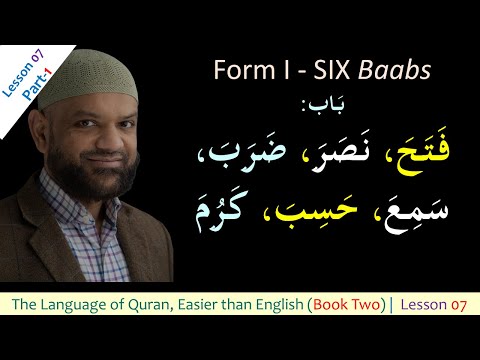 Click to play
Introduction
A key insight in Arabic morphology (الصَّرْف) is that most words are built on three root letters and pass through a predictable scale (وَزْن). The scale determines the vowels placed on the root letters in both the madi (past tense) and the mudari' (present/future). Instead of memorising endless individual vowel patterns, we group verbs into six baabs (أَبْوَاب), each named after a common example verb. Once you know a verb's baab, you can produce all 28 conjugated forms (14 madi + 14 mudari') automatically.
Lesson Notes
The Root-and-Scale System
Every Arabic verb in Form-1 is built on three root letters represented as ف ع ل (fa', 'ayn, lam). The only variable in the madi scale is the vowel on the middle root letter:
| Scale | Middle vowel (madi) | Example |
|---|---|---|
| فَعَلَ | fatha (a) | فَتَحَ |
| فَعِلَ | kasra (i) | سَمِعَ |
| فَعُلَ | dhamma (u) | كَرُمَ |
The mudari' scale adds the letter of mudari' (ي ت أ ن) at the front and may change the middle vowel. Of the nine theoretical combinations (3 x 3), only six actually exist in Arabic:
The Six Baabs
| Baab Name | Short Code | Madi scale | Mudari scale | Example verb |
|---|---|---|---|---|
| بَابُ فَتَحَ | Fa (ف) | فَعَلَ (a) | يَفْعَلُ (a) | فَتَحَ يَفْتَحُ — to open |
| بَابُ نَصَرَ | Nun (ن) | فَعَلَ (a) | يَفْعُلُ (u) | نَصَرَ يَنْصُرُ — to help |
| بَابُ ضَرَبَ | Dad (ض) | فَعَلَ (a) | يَفْعِلُ (i) | ضَرَبَ يَضْرِبُ — to strike |
| بَابُ سَمِعَ | Sin (س) | فَعِلَ (i) | يَفْعَلُ (a) | سَمِعَ يَسْمَعُ — to hear |
| بَابُ حَسِبَ | Ha (ح) | فَعِلَ (i) | يَفْعِلُ (i) | حَسِبَ يَحْسِبُ — to reckon (rare) |
| بَابُ كَرُمَ | Kaf (ك) | فَعُلَ (u) | يَفْعُلُ (u) | كَرُمَ يَكْرُمُ — to be noble (rare) |
Key rule: When the madi has dhamma (u), the mudari' will also have dhamma — Bab Karuma is the only possibility.
Mnemonic to Remember All Six in Order
> Open the Quran — فَتَحَ يَفْتَحُ > Allah will help you — نَصَرَ يَنْصُرُ > Otherwise the dunya will beat you — ضَرَبَ يَضْرِبُ > Therefore listen carefully — سَمِعَ يَسْمَعُ > And count your good deeds — حَسِبَ يَحْسِبُ > And be noble — كَرُمَ يَكْرُمُ
Focus: Baab Nasara (Most Common)
Bab Nasara is the most frequently encountered pattern in Quranic Arabic. Common verbs following this pattern:
| Root | Verb | Meaning |
|---|---|---|
| ك ف ر | كَفَرَ يَكْفُرُ | to disbelieve |
| خ ل ق | خَلَقَ يَخْلُقُ | to create |
| ذ ك ر | ذَكَرَ يَذْكُرُ | to remember |
| ع ب د | عَبَدَ يَعْبُدُ | to worship |
| ر ز ق | رَزَقَ يَرْزُقُ | to provide |
| ق ت ل | قَتَلَ يَقْتُلُ | to kill |
How to Use Baab Information
When vocabulary is presented with its baab code, you can immediately produce all forms. For example:
ج ع ل (Fa) → جَعَلَ يَجْعَلُ — he made / he makes ع ب د (Nun) → عَبَدَ يَعْبُدُ — he worshipped / he worships غ ف ر (Dad) → غَفَرَ يَغْفِرُ — he forgave / he forgives
Beyond Form-1: A Preview
Form-1 (mujarrad, six baabs) is the foundation. Forms 2–10 are called mazeed (مَزِيد) — they add extra letters to the root. The same conjugation rules apply to all forms; only the root template differs. Form-1 produces the majority of Quranic verbs.
Summary
- Arabic verb conjugation is rule-based: learn the root + baab, get 28 forms free
- Six baabs exist in Form-1 (mujarrad); three theoretical combinations do not exist in Arabic
- The middle root letter vowel identifies the baab: a/a = Fatha (Fa), a/u = Nasara (Nun), a/i = Daraba (Dad), i/a = Sami'a (Sin), i/i = Hasiba (Ha — rare), u/u = Karuma (Kaf — rare)
- Priority: focus on the first four baabs (Fa, Nun, Dad, Sin) — they cover the overwhelming majority of Quranic verbs
- Short codes (Fa, Nun, Dad, Sin, Ha, Kaf) will be used in all future vocabulary lists to indicate a verb's pattern
Terminology Reference
| Arabic | Transliteration | Meaning | Type |
|---|---|---|---|
| بَابٌ | bab | door / chapter — the conjugation pattern a verb follows | ISM |
| أَبْوَابٌ | abwab | doors / chapters — plural of bab | ISM |
| مُجَرَّدٌ | mujarrad | bare / stripped — Form-1 verb with three root letters only | ISM |
| فَتَحَ يَفْتَحُ | fataha yaftahu | he opened / he opens — template for Bab Fatha (Fa) | FIL |
| نَصَرَ يَنْصُرُ | nasara yansuru | he helped / he helps — template for Bab Nasara (Nun) | FIL |
| ضَرَبَ يَضْرِبُ | daraba yadribu | he struck / he strikes — template for Bab Daraba (Dad) | FIL |
| سَمِعَ يَسْمَعُ | sami`a yasma`u | he heard / he hears — template for Bab Sami'a (Sin) | FIL |
| حَسِبَ يَحْسِبُ | hasiba yahsibu | he reckoned / he reckons — template for Bab Hasiba (Ha), rare | FIL |
| كَرُمَ يَكْرُمُ | karuma yakrumu | he was noble / he is noble — template for Bab Karuma (Kaf), rare | FIL |
Linked Arabic terms open their full entry in the Arabic Grammar Guide.
📖 Grammar guide. Grammar terms are explained in the Arabic Grammar Guide — fully vocalised, searchable in Arabic, any transliteration, or the English meaning.
Lesson Transcript
Read the full transcript (8,308 words)
Auto-generated from the lesson video. Timestamps jump to that point in the video. May contain transcription errors.
0:00 Assalamu alaikum. Welcome dear brothers and sisters in Islam. We are on our 7th lesson. I think this is a very important milestone as well as a very important lesson for you to build a solid foundation in understanding morphology or Sarf in Arabic. What I'm going to do here in this lesson inshallah quickly review the scale of the maadi and the mudare. Both of this should be now familiar with you if you're going through the lessons in sequence. So the idea now is to join it together
to understand the concept of baab or abuab. Forms of letters or the scales of words in Arabic that will dictate to us what the maadi and the mudare should look like and of course along with that the other forms of verbs that we're going to learn in forthcoming lessons as well as the many types of derived nouns. So there are six baabs or abuab in form one and we're going to introduce all six of them here in this lesson and if you learn one of them
very well you will be able to conjugate as well as recognise any verb that follows that pattern. So we're looking at thousands and thousands of words or verbs rather in the maadi and the mudare which you should be able to recognise after this lesson. Again if you just watch the video I'm sure you will benefit inshallah but more importantly if you write and conjugate for yourself the knowledge will stick inshallah and in the future you will be able to draw on that knowledge as you come
across different verbs and as we complete this series in book two inshallah you'll be able to recognise the maadi, mudare, the amr all forms of verbs as well as many derived nouns for the most common baabs of root letters that are used in the Quran. So let us begin with the blessed name of Allah Bismillahirrahmanirrahim We make dua Alhamdulillah you're already familiar with the fact that we have three root letters that form the past tense al maadi for sulati, mujarrat, fuhum, one which are basically represented
by fa, ayn and lam. Three root letters and I've got them marked here for you and we have of course the first the second and the third root. Any in theory any of the Arabic letters consonants could go in here depending on the root that it is and in the maadi for the past tense the first root letter will take a fatha this last root letter will take a fatha it is the middle root letter that varies so you could have the scale of fa, a,
la and that will give you for example fataha which means he opened and nasara he helped or we could have fa, i, la and that will give us sami'a the root sin, mim, ayn goes through this form or this scale and we have alima, ayn, lam, mim and you note in both of these we have the kasra in the middle root letters so we have fa, ala, fa, ila. Then we have fa, u, la which is the middle root letter taking a dhamma and then we
have an example here ka, ru, ma meaning he was noble. At this stage don't worry too much about vocabulary which what each word means focus on the scales themselves. So in theory we have got that fully covered the only variation in the scale is the dhamma, fataha and kasra and again dhamma meaning pesh, fataha meaning zabar, kasra meaning zir. So these are the three middle root letter variation otherwise the scale is identical for the maadi. The scale of the mudara, the scale of the mudara is
also three root letters but there is an extra letter that comes in the beginning which is called the harf of mudara and the that is only four letters please note which is either ya, ta, hamza meaning a or na. These are the four letters that come at the beginning of the mudara. At this stage inshallah we'll cover that so the letters are ya, ta, hamza and noon. So these are the four letters and if there's no these four letters there is no prefix it is not
a present tense verb it is not a mudara. Mudara has to have this. After that you have your three letters fa, ain and lam and again it could be any root which is applicable and that goes through that scale so we have with and with three so we have yaf alu we have yaf ailu and we have yaf alu. For yaf alu we have yaf tahu he opens or yaf habu he goes. Again it could be any verb I'm just picking these as they are very
commonly used. Yaf ailu will give us yad ribu so again note he strikes as in the present tense translation I've used. Yad limu he wrongs and then we have yaf alu we could have yan suru and then we have yak rumu. So these are the scales the variation again being the second root letter either taking a fatha damma or kasra. Now when we look at them side by side we have the maadi and we have the mudara and of course you've got the sign of it
being a present tense verb by the ya in the front depending on the conjugation it could be tah, hamza or noon. Now long as you're familiar with these two the question might arise in your mind which one goes with the fatha damma kasra which one goes with the fatha damma kasra in the middle root letter for the maadi or the mudara how do we know well there is no way of logically working it out there are signs and things which we can learn later but really
at the beginning the best thing to do is to look ask your teacher or look at the dictionary and it will tell you what it should be. Through usage inshallah this topic will become clear but please note there is no fixed rule which you can say just because these root letters have this therefore it must go through this pattern it does not work like that. So we have now to learn which one will take the fatha damma kasra and fatha damma kasra in the middle root
letter for the maadi and the mudara. So this is the the concept of Baab. Baab will tell us what it should be. Before we go let us look at what happens in the English language. Let us say that I wanted to use a verb for example in the past tense so if I say the verb to go in English I would say he, she, they, you went in the past tense. I would say for example the man or XYZ went. So the doer can be a
pronoun or a noun and of course in English it always comes first and then the verb is separate. In Arabic you've seen that we don't need to do that. Now if I wanted to put it into the mudara tense in equivalence in English he goes would be one translation he is going will be another translation if it's if I'm doing it to the present continuous tense and he will go in the present future tense so I have to use will here which you can see I
have to use the word will and or is I add something in Arabic of course the meaning is within the verb itself we will learn the nuanced meanings later on inshallah. So instead of using went and go you can see that the root has completely changed if there is a root system in the English language there is no link between them whereas in Arabic the root letters remain intact the only thing difference is the scale so let's look at another verb for example I want to
say baked b-a-k-e-d he baked she baked you baked the man baked XYZ baked Mariam baked whatever somebody baked okay now in present tense he'll be he bakes he is baking he will bake so you can see that in English we use different techniques for achieving the same thing in Arabic it will only be the scale so in English you just learn each word you learn each word and you come along and you say okay this is the past tense and this is how I put it
into the present tense and you work your head around how this works in Arabic no there will be a fixed scale for the Maudi and a fixed scale for the Mudarit so you know from the scale of the word what it is referring to which tense it is so that's the contrast between English and Arabic as far as the conjugation of verbs are concerned again of course this is a very simplified example just to illustrate the point for our benefit so in theory brothers and sisters
if we say in the Maudi we can have fa-a-la so for example we have here fa-a-la or we can have fa-i-la or we can have fa-u-la three variations in the Mudarit is the same thing we can have ya-fa-a-lu, ya-fa-u-lu or ya-fa-i-lu three on top three down that gives us nine combinations so in possibility in Arabic we can have fa-a-la becoming ya-fa-a-lu in the Mudarit we can also have fa-a-la ya-fa-u-lu and we can have also fa-a-la ya-fa-i-lu then we see in Arabic we can have fa-i-la that
can also give us ya-fa-a-lu in theory it can also give us ya-fa-u-lu fa-i-la ya-fa-u-lu and we can also have fa-i-la ya-fa-i-lu and for fa-u-la we can have fa-u-la ya-fa-a-lu then we can have fa-u-la ya-fa-u-lu and fa-u-la ya-fa-i-lu of course these are nonsensical words I'm just just a scale I'm showing you please note so when we look into the entire Arabic language what we find is that there is no example in Arabic of a verb coming from this scale first three are found one two three this
one is also found but not this one this one is also found but there is no fa-i-la ya-fa-u-lu verb at all or anything that goes through that scale at all in the Arabic language when it comes to the middle root letter fa-u-la we note that there is not a single verb goes like this fa-u-la ya-fa-a-lu just doesn't exist we also note fa-u-la ya-fa-i-lu does not exist see the only one that exists is number six fa-u-la ya-fa-u-lu so when it is the maadi has a dhamma you
can almost be hundred percent certain that the mudare will also has a dhamma but when the mudare maadi has a fatha you cannot guess what it should be when the maadi has a fa-i-la there is two possibilities so again your guesswork goes reduced but nonetheless as I said there is no sure way of knowing which is which so there are only six possibilities out of nine only six are applicable so after the nine possible scales we know that this one this one and this one is
not used that leaves us six now instead of trying to memorise fa-a-la ya-fa-a-lu fa-a-la ya-fa-u-lu fa-a-la ya-fa-i-lu is quite difficult right I'm only able to recall them with a lot of focus and reading the screen you will not be able to remember them so instead of trying to remember it that way what we're gonna do is we're gonna use a verb that is commonly used in that scale or a very common verb that is used in that scale or that goes through the scale we're gonna
use that as our example and we're gonna try and memorise that one that way you'll find it a lot easier so fa-a-la ya-fa-a-lu example we're gonna use fataha yaftahu so our first verb is fataha yaftahu please note fataha means he opened yaftahu means he opens I'm not going to put translations on the screen otherwise it just makes the screen a bit cluttered next example fa-a-la ya-fa-u-lu rather than trying to remember that we're gonna call it nasara yansuru so we have two now fataha yaftahu nasara yansuru
and then we have daraba ya-dribu so instead of saying fa-a-la ya-fa-u-lu we're gonna say daraba ya-dribu so these are the three scales any root that goes into these three will follow it for every conjugation so all you need to learn is fataha and the hundreds and hundreds of verbs that will follow it will follow exactly the same same with nasara and daraba when the Mahdi now takes a kasra we have two options we have sami'a yasma'u sami'a yasma'u again rather than trying to remember fa-a-la ya-fa-u-lu
sami'a yasma'u and then of course the middle one does not exist our fifth scale will be ha-si-ba ya-h-si-bu ha-si-ba ya-h-si-bu that is your fifth scale where both the Mahdi and the Mudare take a kasra and the last scale that is available in the language is karuma ya-k-rumu rather than fa-a-la ya-fa-u-lu so we're not going to memorise scale in this way we're gonna remember an example verb just for your additional information this scale is very rare very rare this one and also this one rare you're very
unlikely to come across many verbs in these scales so really guesswork is almost gone as far as the sami'a is concerned it's here so we don't do guesswork we will look at the dictionary at the beginning until we get familiar with the scales and once we use them couple of times trust me you'll be able to recall them straight away so a root will come it will follow one of these six patterns long as you know which pattern it follows you can conjugate now 14 Mahdi
and 14 Mudare just like I've showed you in the previous lessons and the rules will follow all the way through okay all the way through the variation will only come with weak verbs we will discuss them later on in sha Allah when the root letter will have a wow or a yeah until we get to that stage you are going to assume that all the scales that you've learned will be exactly the same for any root that you're going to come across that follows one of
these patterns in sha Allah and there are only six Bab Fatha is where the Mahdi takes a fatha and the Mudare second root letter also takes a fatha so if you imagine the root letters fa fa and ha goes through this scale which we are naming as Bab Fatha it will be Fatha Yaftahu again this is just an example verb there will be hundreds that will go through the same scale and all of them collectively we are going to say follow the Bab Fatha pattern so
on this screen now you can see all 14 conjugated for Fatha you can see here the scale is Fatha Yaftahu and the example verb that we are using is Fatha Yaftahu and the short form of reference will use the letter fa to represent that the fact that this root will go through these set of patterns for the Mahdi and the Mudare as far as this lesson is concerned later on we will see the other verbs and derived nouns so the conjugation of this I've been through
in detail with you in the previous lesson here inshallah very briefly we will go through the conjugation please learn this inside out back to front top to bottom whichever way you need to do it read it and write it couple of times inshallah until it becomes second nature to you why because if you learn these 14 plus 14 scales which is gives you 28 you will be able to recognise thousands of verbs which will follow this scale as soon as you come across them inshallah you
recognise which is Mahdi or Mudare and then from there or looking up the dictionary will know which verb it follows so let's quickly quickly go through this scale and then I hope and pray that you're going to write them down in order to retain the knowledge for longer so I'll just highlight each one as I read through them inshallah take your own time and write them out of course you can see also the full screen you can take a screenshot of that until the resources are
available for you inshallah so we have Fataha first scale Fataha number one Fataha or dual Fatahoo so it's Fataha Fataha Fatahoo Fatahat Fatahata Fatahna Fatahta Fatahtuma Fatahtum Fatahti Fatahtuma Fatahtunna Fatahtoo Fatahna and again you can see how we conjugate previously this will be the same for every verb that goes through this scale so if you take a bit of time to rewrite these 14 inshallah the Mahdi verbs will become very very familiar now let's take a look at the Mudare since we know this follows the
Fataha pattern we know the Mudare will be Yathahoo again it Ftahhani Yathahna Ftahhoo Ftahhani Ftahhuna Ftahhina Ftahhani Ftahhna Ftahhoo Naftahhoo so here are the 14 of the Mudare and 14 of Seen of the Mahdi combined together they give us 28 different words 28 scales of which will be followed by many many other verbs that follow the same scales so this is your Bab Fatahah for the Maadi, the Mudari Inshallah Ta'ala very soon you'll see the Amr and also the derived nouns that are all derived based
upon the template scale that we're going to use which is Fatahah Yaftahu now there are many many verbs that will go through this scale or scales I'm going to show you a few examples Inshallah Ta'ala first of all we have so the way normally you will see it in the dictionary I'll explain later you will have the three root letters usually either separate letters are joined followed by brackets with Fa that tells you that that root will go through the Fatahah pattern of course they all
are Fatahah because I put them together but normally this is how I will present vocabulary to you so this saves a lot of space and very quick reference and this is the quickest way to do it I'll show you the others but this is the quickest way in my view to do it and to learn Inshallah so we have the example Fa'ala which is actually a word in Arabic means he did, Yaf'alu he does I've given you the basic translation here because I can't fit the
translation of everyone on this slide this is what the root letters mean so the example word that we have is Fatahah Yaf'tahu to open so Fatahah will be he opened Yaf'tahu he opens next we have the root Jeem Ayn and Lam going to the same pattern can you guess what it should be the Maadi will be Ja'ala Yaj'alu try to guess the next one Saad Lam and Ha again the the pattern is Fa so they'll be Salaha Yas'lahu and then we have Ba Ayn and Tha
so Ba'atha Yab'athu and then Sahara Yas'haru and then we have Nafa'a Yanfa'u and then we have Jama'a Yaj'ma'u so the root has basic meaning to gather for example so Jama'a he gathered Yaj'ma'u he gathers and this is the same with all of them so this is the quickest way inshallah once you learn the Maadi Mudare and then we will go to the Amr which is the scale you can see here and then we will learn the derived nouns and then of course there are many other
forms also like the passive forms of both Maadi and Mudare and we also the negative and we have a prohibitive etc etc so there are lots of things can be added but this is your template this is your foundation ground and this is how you will learn Arabic vocabulary very very quickly except without spending hundreds and hundreds of hours trying to memorise endless list of words so this is now the the verb that we've seen on the scale of Fa'ala Yafa'alu and Fatha Yafta'u being our
example so please make a note of the first pattern Baab Nasara our next patterns are called Baab Nasara and we're going to use the letter Noon for short now imagine again three root letters Noon Saad and Ra going through this two patterns that we got on the scale so we have Nasara can you see it Nasara Yansuru Nasara Yansuru so this is your scale now Fa'ala Yafa'alu yielding Nasara Yansuru which is a one of the common verbs that's used in this scale we're going to name
the whole lot of them after this pattern which is very easy to memorise so again Noon for short and the Baab we're going to call Baab Nasara let's quickly go through the conjugation of this Baab so Maadi Sigha 1 will be Nasara Nasara Nasaru Nasarat Nasarata Nasarna Nasarda Nasartuma Nasartum Nasarti Nasartuma Nasartunna Nasartu Nasarna so here the 14 Sigha of Nasara pattern we can see here all the way through the middle root letter taking a Fatha Nasara and all the way through any verb that follows
the Maadi will be on this scale and any verb that follows the Mudare will be in the next scale that we will look at now so all verbs will take the second root letter in the Mudare as Dhamma and in the Maadi as Fatha we've seen and this pattern would be called Baab Nasara and therefore we're going to have the Mudare as Yansuru Yansurani Yansuruna Tansuru Tansurani Yansurna Tansuru Tansurani Tansuruna Tansurina Tansurani Ansuru Nansuru so you can see the 14 that we conjugated earlier Sigha 1
to Sigha 14 following the rules of the or following the scales of the Fa'ala Yafu'ulu all the way through and this pattern we're going to call Baab Nasara so Baab Nasara is one of the most common patterns in Arabic probably the most common that you're going to come across in the study of form 1 inshallah so again take a few minutes extra to study this very very well I will now show you some common verbs so here are some examples of root that go through the
Nasara pattern and you can see here I've got Fa'ala Yafu'ulu so already you've seen the Nasara so should be Nasara Yansuru sorry I forgot to mention in the other slide these numbers represent the number of time that root is used in the Quran so it could be Maadi Mudare or any of the others but it gives you the idea of how commonly used these roots are within the scale of Nasara Yansuru so if I have Nasara Yansuru try to guess what Kafara would be of course
you probably guess it Kafara Yakfuru Kafara he disbelieved Yakfuru he disbelieves then we have Khaa, Laam and Qaaf so that would become Khalaqa Yakhluku to create so he created he creates Dhaal, Dhaal, Kaaf and Raa Bab Nasara will be Dhakara Yathkuru those of you reading Quran regularly I'm sure you started now light bulbs are coming that you've seen these words many many times in the Quran and this is a very beautiful word Alhamdulillah Ain, Baa and Dhaal it will be Abada Ya'budu to worship and then
we have Razaqa Yarzuqu and Nasara Yanzuru and Qatala Yakhtulu so you can see inshallah we don't need to spend hours learning lots and lots of vocabulary long as we know the root and which pattern it follows we can now at least at this stage conjugate 14 for each that means 28 words so learn one or buy one get 28 free so if you spend a little bit of time learning this Nasara pattern so far you can get 28 free from any of the other words inshallah
that I've seen you of course shown you of course there are hundreds and hundreds of others Bab Nasara is the most common pattern you're likely to come across Bab Daraba the next pattern we have we're going to call it Daraba pattern it goes through these Madhi and the Mudhari where the Madhi is Fatha and the Mudhari is Kasra and therefore if you put Dhaad, Raa and Baa through you get Daraba Yadribu Daraba Yadribu so you can see the three scales that are coming inshallah this pattern
you should already be familiar with from previous examples I've done so we have Daraba and then all the 14 Yadribu and all the 14 I'll go through a little bit quicker this time to save time on the video otherwise the video may be too long so you can see here the short form of this will be Dhaad anytime you see the root with Dhaad in the afterwards you know that root will follow this pattern and therefore you can conjugate 28 words Sighawan Mudhari Sighawan Yadribani Yadribuna
Adribu Adribani Yadribna Adribu Adribani Adribuna Adribina Adribani Adribna Adribu so here are your 28 buy one get 28 free learn the Daraba pattern again a very commonly used scales in Arabic Daraba Yadribu you will find many words for example you will see now inshallah a list of examples of words that follow this pattern Zalama Yadlimu as another example so if you learn these 28 inshallah ta'ala you will find a lot of dividend in your study in the future so please invest your time that you need
to build this solid foundation so let's quickly go through some patterns on the scale of Daraba Yadribu which is Fa'ala Yafailu Daad for short which you can see here and you can see I put an example here and long as you can see this if you can remember Daraba Yadribu then you can remember that it will be on the scale of Fa'ala Yafailu so the first one we have we've already done Daraba Yadribu then we have Zalama Yadlimu then we have Saad Ba and Ra Sabara
Yasbiru this is where the word Sabar comes from inshallah Gha Fa Ra Yagfiru then we have Ra Ja'a Yarji'u ok you should be able to say this before me inshallah now Ka Tha Ba Yakthibu Ka Tha Ba Yakthibu Arafa Ya'rifu Arafa Ya'rifu so again to recognise something he recognised he recognises he earned he earns etc etc so that's how you learn don't worry about the rest of them you're gonna learn all plus more this is just on the screen I couldn't get it all in one
screen but there are literally from the root you should be able to make several hundred words if not thousand inshallah just from one root long as you follow a structured pattern and these I'm only choosing the ones that are very very commonly used in the Quran my intention is to share with you all that you need to begin to appreciate the Quran in Arabic again the numbers are there for you to see the frequency of the use of that root and of course it could be
any of the sigha inshallah we will look at at a later date so this is your pattern Daraba Yadribu is all you need to remember and the rest will be free for you Baab Samee'a the next Baab we're gonna call Baab Samee'a again imagine Seen, Meem and Ain going through this scale, now this is the first time we're seeing the Madhi take the Kasra so you have Samee'a Samee'a and this will be Yasma'u Samee'a Yasma'u and this pattern we're gonna call Baab Samee'a this is our
template Baab Samee'a Yasma'u and this is a very common Baab also in Arabic so let's quickly go through this pattern I'm gonna just show you on the screen hopefully inshallah you'll get it, I'm gonna go very quickly here inshallah just to save time so Sigha 1 Madhi Samee'a Samee'a Samee'u Samee'at Samee'ata Samee'na Samee'ta Samee'tuma Samee'tum Samee'ti Samee'tuma Samee'tuna Samee'tu Samee'na so that's your Madhi in 14th scale let's quickly go to the Mudari Yasma'u Yasma'ani Yasma'una Tasma'u Tasma'ani Yasma'na Tasma'u Tasma'ani Tasma'una Tasma'ina Tasma'ani Tasma'na Asma'u Nasma'u
and you can now see all 14 plus 14 28 so again you're gonna come across many verbs that follow the Samee'a scale and all you need to remember is Samee'a Yasma'u and then you can do 14 plus 14 so now we have same thing for Bab Samee'a Yasma'u on the pattern of Fa'ila Yaf'alu and the letter seen for short which you can see after the root and the frequency here so Fa'ila Yaf'alu is Samee'a Yasma'u that's gonna be our template for the rest of them Inshallah
Alima Ya'lamu Amila Ya'amalu Rahima Yarhamu Shahida Yashadu Khasira Yakhsaru and then we have Hazina Yahzanu and we have Kariha Yakrahu and then we have Hafidha Yahfadhu and you can see here Masha'Allah the scales being followed and exactly the same as we've seen in many other examples and again there will be many many many other verbs that you will see following this three, this scale which is called Bab Samee'a seen for short Bab Haseeba the scales of Bab Haseeba is Kasra and Kasra, please note I mentioned
earlier there is no example with Kasra with Dhamma that is why we're not even looking at it, it doesn't exist so Fa'ila will be Haseeba and then we have Yahsebu Haseeba Yahsebu and this scale is very very rare so I'm gonna put it on the screen, do write it out once, you don't need to really spend a lot of time on it, if you learnt the others there's no really any variation here but Haseeba Yahsebu is a very very rare combination in Arabic that follows the
E and the I, so Fa'ila Yaf'ilu Haseeba Yahsebu and we're gonna use this short form now even though the verbs are rare, there are derived nouns which are used on this scale and we will come across them so therefore Insha'Allah I'm including this here as well but many books ignore this scale because it is very very rare so I'm not gonna give you any example except for the one that I've given you Haseeba Yahsebu that does not mean there aren't any, there are but they're very
very rare for as I know, there are about 30 odd verbs that follow this scale but some of them will also follow the other scale which is the Samee'a Yasma'u scale so Haseeba also appears as sorry there's a spelling mistake here it should be Yahsebu Haseeba Yahsebu can be also Haseeba Yahsebu, so again please don't get into the details of that what the difference is and so on, we will learn that later but it is a very very rare scale so Haseeba Yahsebu please note the
typo error here from me, Haseeba Yahsebu and that's it, that's not much more I can add, I can give you some verbs but it will be a waste of time for you to even learn to conjugate them but just practise the Haseeba Yahsebu pattern Insha'Allah Ta'ala once Baab Karuma Baab Karuma follows the pattern of U'u and U'u meaning the middle root letter taking a Dhamma or Pesh, now please note again, this is a very very rare scale, also when the Maadi takes the U'u Dhamma I
should say the Mudhari does not take Fatha or Kasra, so you can always identify very easily what the Mudhari should be, when the Mudhari takes the Dhamma you can't go backwards because it could also be Fa'ala pattern as we've seen with Nasara so again these are hints but a lot of people get spend a lot of time on this and confuse themselves, our job is not really to make words, our job is to recognise words and soon Insha'Allah the Baabs also but this is only your
first lesson so you can't expect to know all these nuance points but please don't focus on this, just trust me as I go through the patterns where the focus needs to be, the focus needs to be on the first four that we've done Insha'Allah Ta'ala, so again let's quickly go through the conjugation which you can see here, I'm not going to read it all out but please do take the time to write them out once if you can in your notebook, this will remind you to
the scale and again this is a very very rare scale so I've only got one example for you, Karuma, Yak, Rumu but there are many many derived nouns which is especially this one which we are going to learn on this scale, the verbs are rarely used I think no more than a handful you come across in all your studies, so we can again pick them up as we go along but there is no need to spend a lot of time on it so this is your
Baab, Karuma Karuma, Yak, Rumu on the screen you can see I've done the whole 6, 1, 2, 3, 4, 5, 6 Baabs for you written them down in vertical order so you can see them Insha'Allah do take a screenshot of this and by all means it's more important that you actually write them down in your notebook so the knowledge will stick I hope and pray there is no mistakes in this I've tried to double check, triple check but Insha'Allah let me know in the comments if
there are any typing errors, otherwise this will become your main focus of the 6 Baabs and you can see 14 and 14, 28 words on the scales which are fixed depending on the Baab that the root will go through and from now on please note Baab Fataha, Fa for short Baab Nasara, Noon for short Baab Daraba, Daad for short Baab Samia, Seen and Baab Hasiba, Ha and Baab Karuma, Kaaf and this is how we will refer to them Summary of the 6 Baabs Let me take
this opportunity to share with you how normally other books of reference just in case you come across them they may refer to the scales Some books, particularly English books that are written to teach Arabic grammar, they might give you AA meaning Fatha Fatha or Fatha Dhamma Fatha Kasra, so that's one way of referring to it, some will only give you the vowels so they put the root and then they put this so you guess from here, another way of doing it referring to the same thing
and of course A and U and A and E etc. So you can see different ways different books of reference use. Some dictionaries, especially the modern English dictionaries tend to have the root here they will tell you this and then they will put the Mudare as a single Haraka and for you to recognise ok this will be Baab Fatha and this will be Baab Nasara etc. I personally prefer the one that's used in the Indian subcontinent and other places also which have been used for many
many years and that is to give each one of these Baabs a name and the name that we give them is based upon a common verb that is used within those scales and therefore we use the example here, for example I went through this with you Fatha Yaftahu so Fa for short form Noon for Baab Nasara Daad for Baab Daraba that gives us a very precise way of naming the Baab. Even though you could technically agree or argue that these are very similar. The only thing
happening is the middle root letter changing the sign on the middle root letter I should say. So what's the reason? Why do we need it? Well you need precision therefore knowing the scale helps you to know the Maadi and the Mudare and the dictionary will tell you this as I mentioned already and as long as you know the Baab Samia, Baab Hasiba and Baab Karuma the rest is very very easy So this is the methodology that I tend to follow and I find it easier and
I advise you to also follow. It saves you trying to remember Aa, Oo and Ee and Oo, Aa these things I find quite confusing but if you find the others suitable by all means follow that but I follow the route that's the easiest for me So again just to show you how different ways do it, we're going to call them Baab Fatha Fa for short, Baab Nasara Noon for short, Baab Daraba Daad, Baab Samia Seen, Baab Hasiba Ha, Baab Karuma Kaf and that's basically the short
form or the summary of the six Baabs So from now on the vocabulary will be given this way Jeem, Ain and Lam So we have Ja'ala, Ya Ja'alu because it follows the Fatha pattern Nafa'a, Ya Nfa'u Abada, Ya Abudu Nasara, Khalaqa Ya Khluku, Raja'a Ya Raji'u because it follows the Daraba pattern, Ghafara Ya Ghafiru, again Daraba pattern, Daraba Yadribu Hafidha, Ya Hafadhu Alima, Ya Alamu This is a very common verb he knew He guarded or he protected Na'ima, I've given you another one from Baab Hasiba
It will be following the Na'ima pattern because it follows the Hasiba And then we have two from the Karuma as an example Ha, Seen and Noon, so it will be Hasuna and Ba'uda Very very easy Inshallah reference And this is what I'm going to be using from now on Inshallah Ta'ala So how are you going to remember all six patterns? I'm going to give you a very quick way of remembering. If you remember these English sentences Inshallah Ta'ala in the way I'm reading them out, repeat
it a couple of times for the rest of your life Inshallah Ta'ala These six patterns will be second nature to you So again remember Fataha, Yaftahu, Nasara, Yansuru, Daraba Yaduribu, Samia, Yasma'u Hasiba, Yahsibu, and Karuma, Yakrumu How to remember all six of them in the order? This is what you need to say to yourself. Ready? Open the Quran, Fataha Yaftahu Allah will help you, Nasara Yansuru, otherwise the Dunya will beat you, Daraba Yaduribu, therefore listen carefully, Samia Yasma'u, and count your good deeds, Hasiba, Yahsibu and
be noble, Karuma, Yakrumu So if you remember this order, Inshallah Ta'ala these sentences will help you remember the order of the Babs, and of course recall the pattern also. Let's go through it one more time Open the Quran, Fataha, Yaftahu Allah will help you, Nasara Yansuru, otherwise the Dunya will beat you, Daraba Yaduribu, therefore listen carefully, Samia, Yasma'u, and count your good deeds, Hasiba, Yahsibu, and be noble, Karuma, Yakrumu. I hope and pray Inshallah Ta'ala this will help you to remember the six patterns and in
the order, and Alhamdulillah you've got the most important tool now to recognise thousands and thousands of verbs and derived nouns Inshallah we'll build our solid foundation on these patterns So before concluding just a very quick overview of the terms I didn't want to focus on the terms but if you learn them it will help. The term Bab is plural is Abwab so written here for you, Bab, Abwab each one is called a Bab and Abwab, literally means door in Arabic or doors, we've covered this word
before in book one. It is used for the science of Sarf so basically it tells us the scale pattern of the Ma, Di, Mudari, the Amr, all the verbs and all the derived nouns that come These patterns organise the formation of verbs and derived nouns, Asma into consistent and predictable structures what that technical term means that is predictable, you know exactly so as soon as you know the root, the Bab it follows you can make the rest of the words yourself allowing learners to understand how
words are conjugated and constructed in Arabic. Now you can refer to Bab as patterns, templates as I've been doing throughout this lesson, categories models, chapters, sections, whatever you like but I prefer you start using the term Bab even though it means door but it literally is the way the scholars of the past have done it Bab meaning the root goes through this door and everything else follows. So this is the terminology part, Bab and Abwab So what will happen if you study the Babs? First of
all you will have a systematic learning system A Bab provides a template for easy learning and formation Big picture view, the Abwab gives you an overview, it's like a map of all the words that are derived from that root. Accelerate your learning of Arabic very very quickly and of course vocabulary expansion I mentioned that. If you know the root, the door it goes through hundreds, at least hundreds if not thousand words is in your vocabulary list and of course this is the quickest way to unlock
the learning of Arabic. Very very quick you might see many books being sold in the market buy this book and you learn 80% of the words of Quran, 95% of the words of Quran These books are available freely on the internet, you can get them but the point is nobody learns from lists. What they learn from is usage and this is where we need to focus. So unlocking Arabic, vocabulary expansion acceleration, accelerating your learning big picture overview, like a map an overview of all the words
that are derived, either verbs or Asma and of course systematic learning are the purpose or the aim of studying in this methodology So imagine there is a door if the root goes through door, we're going to call it for short if it goes we're going to call it for short will be and of course will be will be and we have which is the last one that's not all, then we have other doors which are extra, so the first group is called Mujarrad and of course
different people use the methodology I'm going to use Noon, Fa, Noon, Zad, Sin, Ha and Kaf this will give you the precision that you need and then in the English books you'll find Form 1 but Form 1 has 6 variations and that is why I split it. Form 2 to Form 10 and there are others by the way but that's all we need Form 2 to 10 again not all of them are common as the others, Form 9 is very rare but Form 2 to Form
10 will give you almost all that you need to learn for understanding the usage of derived verbs and Asma in the Quran. That's it. There are very few words outside that very few four letter words, very few that fall outside these patterns there are but few. So why worry about 3% or 2% or 1% when you can learn 98% very very easily. So these are the patterns and again don't worry what they are. Fa'ala, Fa'ala Af'ala and Tafa'ala and so on and so forth. I will
explain each one. Allah give Tawfiq and life I will explain each one to you in forthcoming lessons and we will do enough revision, enough overview as well as revision of it to get to understand and recognise these patterns but now we're focussing on Form 1 because whatever rules we learn is applicable So it is not only that we derive the verbs from it. I'm just giving you a quick overview here inshallah ta'ala. Some of this has been mentioned in the introductory session So you will also
get the Maadi which we already done, Mudari we've done but we haven't done the passive form. So the Maadi has a passive form, Mudari has a passive form. Then we have the imperative as well as the prohibitive meaning telling somebody to do something telling somebody not to do something Then we have the Asma, the derived nouns and there's quite a few patterns and we have also the verbal noun The verbal noun is predictable for all 2 to 10 but not for 1 and then we have
the derived nouns the noun of the doer, noun of the object etc etc etc. So there is a quite a lot of derived words and as I said each one if you can imagine this is giving us 14 this is giving us 14 this is giving us 14, 28 14 here, 14 here, 6 here 6 there. You just add the numbers up you can see hundreds of words have been formed just from the root for as long as we know which door they go through and
that's all we need to learn the principles are exactly the same So again I've illustrated a few more things here which you can see. I haven't put all the derivation on the column otherwise you won't be able to read the text there are literally many many types of verbs and nouns that we can put here. We only put in the main headline ones. So you can see even for form 2, 3, 4 there are predictable scales. At this stage please don't try to memorise them. I
will show you quick ways as and when we come across them Inshallah Ta'ala So all of these are called Mazeed meaning extra because they not only have the 3 root letters they have something extra. For example there's an extra Alif here, there's an extra Hamza here, there's an extra Ta' and a doubling of the second root letter same thing doubling of the second root letter etc etc. So this is how it works these are the letters split up for you additions are in blue. Everything is
there ready for us Inshallah Allah grant Tawfiq to continue the lessons for me to produce them Inshallah Ta'ala and Inshallah I've done the plan for the course. I'm just going through as quickly as I can and we will be going through all of this. A lot of you asked many many questions and I can understand that I was the same I used to ask hundreds of questions and think of all these weird rules and so on but please try to trust me on this I'm sharing
with you that which you need to know. There is absolutely no benefit in learning things that are rare, very unlikely to come across because you're going to lose yourself in that. The best is to learn what's going to come most common and if you take care of 80-90% the 10% will look after themselves. So it's very very important Inshallah Ta'ala that we try to focus at the beginning. Just trust me on this all these patterns look daunting but they're a lot easier than the first one
that we're learning. A lot lot easier and you just need to learn one verb in each one and you will be on the motorway going 70 miles an hour Inshallah Ta'ala or faster in your Arabic learning Alhamdulillah by the grace of Allah Azza wa Jal we have completed this lesson. I'm not going to split the video into two just put it in one Inshallah Ta'ala I will put timestamps so you can follow it through May Allah reward you all for your efforts and I'm just hoping
and pray that whatever I'm doing is actually helping you. I'm doing my level best to make the lessons as beneficial to you as possible. I don't want the lesson to be entertaining or viral or anything like that. It's just that you can benefit from them. That's the whole purpose of doing that. I do really want to apologise to many of you and I'm getting so many emails and I'm really grateful for your duas. It's just the speed of the lessons being produced I'm a one man
band so I'm doing everything on my own that is the filming the editing the checking of errors everything has been done and therefore the process is very very slow I don't have to have the access to resources unfortunately to produce more videos but I will try my level best to try to keep as quick as I can in producing these videos. They take a lot of time from my notes back down to the powerpoint and making sure everything is included and also making sure the video
is edited correctly as well. All of these are time consuming so I sincerely apologise to all of you for the delay. I know some of you wait for weeks sometimes and it is to do with the busy schedule that I have in terms of work and other commitments. So anyway may Allah bless you, reward you May I want to thank you from the bottom of your heart for all your help and all your suggestions and your duas and your support. May I cannot really thank you
enough It is the reward that Allah will grant us all if we pursue the study of Arabic. Until the next video Assalamualaikum Warahmatullahi Wabarakatuhu
Test Yourself
After every lesson it is essential to test what you have learnt. We are working hard to produce the full set of resources for every lesson — thank you for your patience.
If you would like to support the production of content and the running of this site, you can do so on our support page.
Updated