
Modifying Al-Madi — Part One
Negation · Qad · Idha and In · Du'a
- Negate the madi using مَا and لَا
- Use قَدْ to express emphasis and the near past
- Use إِذَا with the madi to express a certain future action
- Use إِنْ with the madi to express a conditional future
- Recognise al-madi used as du'a (supplication)
Video Lesson
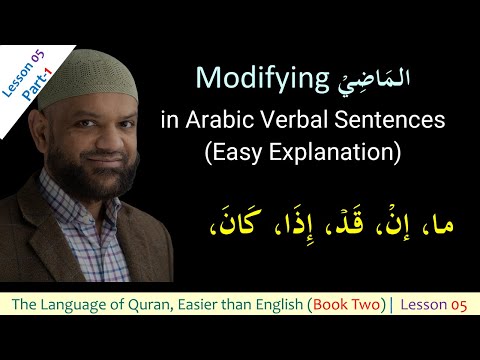 Click to play
Introduction
Lesson 5 builds directly on the foundation of the madi conjugation. We now learn the particles and constructions that modify the perfect tense verb — negating it, emphasising it, shifting its meaning to the future, and using it in du'a. These patterns appear hundreds of times in the Quran and in everyday Islamic speech.
Lesson Notes
1 — Negating the Madi with مَا
The simplest tool for negating the perfect tense: place مَا before the verb. Nothing else in the sentence changes.
مَا + [madi verb] = negation of the past action No change to case endings, gender, or number.
Examples:
- ذَهَبْتُ إِلَى الْمَدْرَسَةِ → I went to school
- مَا ذَهَبْتُ إِلَى الْمَسْجِدِ → I did not go to the mosque
- مَا سَمِعْتُ الْأَذَانَ → I did not hear the adhan
- مَا نَصَرَ زَيْدٌ حَامِدًا → Zayd did not help Hamid
مَا has many uses in Arabic (question word, relative pronoun, negation of nominal sentences). Here it negates the perfect tense verb.
2 — Negating the Madi with لَا
لَا can also negate the madi, but is typically used in double negation — denying two things together with وَلَا:
لَا [verb] وَلَا [verb] = "neither... nor..."
Examples:
- لَا أَكَلْتُ وَلَا شَرِبْتُ — I neither ate nor drank
- لَا قَرَأَ وَلَا كَتَبَ — He neither read nor wrote
Quranic example: فَلَا صَدَّقَ وَلَا صَلَّى (Al-Qiyamah, 75:31) — "So he neither believed nor prayed."
3 — Emphasising and Expressing the Near Past with قَدْ
قَدْ placed before the madi does two related things:
Near past — the action just happened / has recently been completed:
- قَدْ فَتَحُوا الْمَسْجِدَ — They have just opened the mosque
- قَدْ نَصَرْتُ حَامِدًا — I have just helped Hamid
Emphasis/certainty — the action has definitely occurred:
- قَدْ ذَهَبَ حَامِدٌ — Hamid has certainly gone
The two meanings are related — both bring the past action closer to the present moment of speaking. Context determines which English translation works best.
قَدْ is a particle (harf) — it never changes for gender, number, or person. It appears approximately 400 times in the Quran.
It may combine with لَ for double emphasis: لَقَدْ — "certainly indeed":
- لَقَدْ كَفَرَ الَّذِينَ قَالُوا... — They have certainly disbelieved, those who said... (Al-Ma'idah, 5:72)
4 — Moving the Madi to the Future with إِذَا
إِذَا placed before a madi verb shifts the action from past to a certain future. In English this becomes "when":
إِذَا + [madi verb] = "when [action happens]" — future with certainty
Examples:
- إِذَا وَقَبَ — when it becomes intense (Al-Falaq, 113:3)
- إِذَا جَاءَ — when he/it comes
- إِذَا قُمْتُمْ — when you stand up
إِذَا is an adverbial particle of time. It takes the past tense form of the verb but carries a future meaning — the event is expected to happen with certainty.
5 — Conditional Future with إِنْ
إِنْ with the madi expresses a conditional uncertain future — translated as "if":
إِنْ + [madi verb] = "if [action happens]" — conditional, may or may not occur
Difference from إِذَا: إِذَا signals something that will certainly happen; إِنْ signals something that depends on a condition.
6 — Al-Madi as Du'a
The perfect tense is used in supplications with a future meaning — not because the action has occurred, but because the du'a is made with such certainty of acceptance that the past tense is used.
| Du'a | Transliteration | Meaning |
|---|---|---|
| رَحِمَهُ اللَّهُ | Rahimahullah | May Allah have mercy on him |
| غَفَرَ اللَّهُ لَهُ | Ghafara Allahu lahu | May Allah forgive him |
| جَزَاكَ اللَّهُ خَيْرًا | Jazakallahu khayran | May Allah reward you with good |
| حَفِظَهُ اللَّهُ | Hafizahullah | May Allah protect him |
Note: Saying جَزَاكَ اللَّهُ alone is incomplete — always add خَيْرًا to complete the meaning.
Summary
- مَا placed before any madi verb negates it. No change to the verb's form.
- لَا is typically used for double negation: لَا... وَلَا... (neither... nor...)
- قَدْ before the madi expresses either the near past ("has just...") or strong emphasis ("certainly has..."). It appears ~400 times in the Quran.
- إِذَا + madi = "when" — shifts the action to a certain future event.
- إِنْ + madi = "if" — shifts the action to a conditional future event.
- Du'a uses the madi with a future meaning — the certain hope of acceptance makes the past tense appropriate.
Terminology Reference
| Arabic | Transliteration | Meaning | Type |
|---|---|---|---|
| مَا | ma | particle of negation for the perfect tense — "did not" | HARF |
| لَا | la | particle of negation (often doubled) — "neither... nor..." | HARF |
| قَدْ | qad | particle of emphasis/near past — "certainly" / "has just..." | HARF |
| إِذَا | idha | adverbial particle — moves madi meaning to the future with certainty — "when" | HARF |
| إِنْ | in | conditional particle — moves madi meaning to an uncertain future — "if" | HARF |
| دُعَاءٌ | du'a | supplication — the madi is used to express it with certainty | ISM |
Linked Arabic terms open their full entry in the Arabic Grammar Guide.
📖 Grammar guide. Grammar terms are explained in the Arabic Grammar Guide — fully vocalised, searchable in Arabic, any transliteration, or the English meaning.
Lesson Transcript
Read the full transcript (10,840 words)
Auto-generated from the lesson video. Timestamps jump to that point in the video. May contain transcription errors.
(0:00 - 1:07:23) Assalamu alaikum, welcome brothers and sisters to lesson number five in this lesson we're going to learn a little bit more detail about the verbal sentence remember we're still using the perfect tense verb al maadi but the rules apply equally to other types of verbs also but we're going to learn this lesson to negate the maadi in the verbal sentence how to say negative version of what we've been learning so far we also going to learn how to make it certain put emphasis on
the meaning of the verb how to move it to the near past and the distance past we'll also look at the situation of putting it in the future you by using certain tools and we will learn how to use the maadi in the form of dua and inshallah you see these variations and they're very repeatedly used in the Quran and hadith so you'll find them very very useful and I hope and pray like all the other lessons your knowledge will begin to develop and you'll become
familiar with the structures of Arabic grammar then inshallah when you get to study the Quran or hadith either on your own or through supervision a lot of what you're learning now will come back inshallah through practise so let us begin with the blessed name of Allah bismillahirrahmanirrahim and making the dua rabbi zidni ilma oh my lord increase me in knowledge this is the map we began with and again a quick reminder we've already covered significant amount alhamdulillah that we are talking about still the maadi verb
the perfect tense verb which is here inshallah from the next lesson we're going to be moving over to the imperfect and in the previous or the first lesson after the introduction of the words we learned about the file and in the last lesson we've looked at the mouth all in more detail meaning the object my phone and the file the doer so this is where we are in Charlotte Allah and in conclusion most important points to note whether the the doer is a pronoun or a
noun or whether the object is a noun or a pronoun in either situation the doer is always metaphor ie Rafa and the object is also Mansur and I also gave you examples of five different types of Mansur which you will see in Charlotte Allah my phone be he my phone la who my phone my who etc etc so you see those in Charlotte Allah as well but we're just focussing still on my full be and later on when we go into more detailed structures that will
also open up for us so what we're going to do now look at some of the other tools that we can use with the verbal sentences again keeping a focus that we are still on the the perfect tense verb al-mahdi and in Charlotte Allah once we introduce the mudara we will look at some variations there also as this is a lot more detail than the Mahdi and therefore it is best to practise with that one until we've learned the most essential rules negating al-mahdi a verb
can confirm or it can also negate for example if I say an affirmative verb in the sense that I ate breakfast so of course I'm saying in the past tense that I have eaten breakfast but on the other hand I can also say I did not eat breakfast so I'm negating the fact or the statement or the action of eating or having it so this is the difference between the two now in Arabic we have a number of ways of doing that the most important here
is with the Mahdi is using a particle a half called ma now look at the sentence on the screen in Charlotte Allah you can see that I have to which of course you by now you should be able to tell I went they have to illa towards or to al-madrasa T so the hub to illa madrasa T I went to the school so you can see here I went to the school so that's a positive statement confirming an action but if I were to put ma
in front I've changed the wording slightly just to give you variation so if I say ma they have to I did not go I did not go illa al-masjidi to the mosque so I did not go to the mosque so it does not matter what the affirmative verb is we can negate it simply by putting ma in front so another example ma sami itul adhana I did not hear the adhan I did not hear the adhan so again you can see here a very simple there's
nothing really new here to learn only got a note is that ma can be used for negating the past tense please note I've said this before in shallow in the advanced lesson I will do a detailed lesson on the different types of ma in Arabic I think is quite important but ma can be used in many many different ways one of them we've already seen ma for asking question in Jumla ismia I've already seen also ma for negating a Jumla ismia here we are seeing ma
used for negating a past tense or perfect tense verb ma sorry I forgot to mention also we've seen used as a relative pronoun so quite a range of uses inshallah after you've learnt intermediate level grammar it will be good to do a review on ma but for now please note it's another use of ma that it can also be used to negate a perfect tense or al-mawdi so take an example of this sentence here I think this sentence should be very easy for you here Zaydun
is my doer and Hamidan is my object Nasara Zaydun Hamidan Hamid helped Zayd I hope I don't need to translate that you should be able to work that yourself now if I put ma the translation becomes Zayd did not Zayd did not help Hamid so inshallah excuse the poor writing there but inshallah I hope you can see the translations very very clear so all ma is doing there is no change to anything else there is no issue with the Arab or anything like this there's no
issue with the masculine feminine or anything like that it's a very simple application simply putting ma in front and that's all we need to do to negate the past tense another tool for negating the past tense meaning is also la la we've also already seen alhamdulillah quite a few times we've used it with the jumla ismiya in the previous book one lesson that I gave with you inshallah ta'ala but here we can see la when it's used with the madi perfect tense verb or negating verbs
usually the la is repeated when it comes to negating two things it can be used singularly but you will see it more often with two things so here for example I have here la akaltu so here you can see akaltu I did not eat so inshallah akaltu shouldn't be difficult for you so the verb is a la and of course at the end we are adding the suffix to which is of course for I so inshallah ta'ala this should not be posing too much posing too
much problem for you akaltu I ate in the past tense then we have wa which is your at the linking the two parts together la again now and I've repeated the half of negation and we have sharibtu sharibtu and of course sheen ra and ba that's the verb and of course at the end I add the two to which is for I so you can see I'm negating two and then I'm saying no I did not do this and that so in English of course I've
chosen to translate it like this I have neither eaten nor drunk I have neither eaten nor drunk so this is a very simple double negation and it's usually la is used for that ma is used generally for singular time but there are mixed uses also another one example for you he has neither read nor written so I gave him a task to read the lesson and to write it he didn't do either so I'm saying la ara'a you've seen this verb already so he neither read
nor wrote probably better nor had written will probably be a better translation anyhow you got the idea la ara'a wala kathaba he did not read nor write the lesson if that's what I was implying to do so these are the two tools that we're learning in this lesson for negating the maadi meaning of the maadi ma and la to go back to the original conjugation lesson that we've done of course you can see the details of it here the doer is being displayed here for your
benefit and I did ask you several times to try and memorise this at least one table and then we did the three different version fataha alima and karuma these three variations in the middle root so really in principle it doesn't matter which of the 14 that you're looking at or which sigla it comes from whether it is 1 to 14 or whichever version it is whether it is fa'ala, fa'ila or fa'ula whichever it doesn't really matter or even if it's any of the other forms that
you're going to learn inshallah later form 2 to form whatever number that you come across ma will simply negate so ma will just negate there is nothing else to worry about nothing to worry about in terms of gender number or anything like that of or a change in arab of anything it's a very simple negation of the maadi and the maadi above does not really change so all you need to remember is the ma coming first before the verb if it's used for the tool of
negation it will mean the meaning of the verb in the negative so again to illustrate the 14 variation you can see here inshallah this is I'm not going to go through all of this for you but this is a revision from the previous lessons that we have done we went through this in detail alhamdulillah so whether it is alima, alima, alimu and again we're only using ayn lam meme version as a as a example only alima means he knew so you can see it here inshallah
let me show you the full the full screen which you can see and alhamdulillah you can see all 14 of them in the screen all I need to do is put ma in front and I will negate all of them and that's all that we are doing so adding ma in front that's all we are doing it's a very very simple lesson for us to note so how will you translate it again you put it into the English version whichever one sounds the nicest in English
so you will have for example he did add ma add ma on it becomes he did not do and they did will become they did not do etc etc etc so you can see in English I'm using a lot more words than I am in Arabic to express the same thing it's just a different way the two languages work so ma you will need to use the English language style to translate but all you're doing is the message the action is being negated so let's conclude
with a few more examples inshallah they dual masculine the dual masculine did not open so the verb is fataha so how do we say that in Arabic ma fataha again I hope you can recognise that the Alif is now my doer Alif is the pronoun for Huma and then I did not go to the school similar to what we did before ma dahabtu ilal madrasati I did not go to the school Khadija did not go to school will be ma dahabat again notice is the sign
of feminine singer number four Khadija too so this is our doer ilal madrasati to the school this is jar majroor to the joining to the verb so alhamdulillah there is nothing really complex in this part of the lesson ma simply negating again we look at la again just for sake of example again inshallah ta'ala and you see here la being added firstly we have la la then fatahu again I hope you this is not difficult this while here representing they masculine plural which is a whom
they did not open but normally so it is twice so again la kataba wala qara'a he did not write nor reader just move the words around there is uses of it in the Quran the variation of the verb that it is from this surah here inshallah ta'ala is slightly different we have a form to this is called inshallah we'll study it later but I'm just including here just to show you that that example is also from Quran Fala so the fire is therefore or thus la
is the negation particle looked at sadaqa wala salla so he did not believe or affirm nor had he prayed so again both being denied two things Fala sadaqa wala salla so both of this and this is how la is normally used so now we're going to take a look at a Quranic example of this negation inshallah ta'ala now we can see here oma khalaqtul jinnah wal insa illa liyabudoon now this part you're not going to recognise okay this is more advanced we are going to look
at that very soon because there is the mudara verb but the rest of it I'm hoping you will have no problem with recognising inshallah so if you want to pause the video and have a look and see what you can work out what's going on that would be great the verb kha so now so now so now la and then qa so khalaqa means he created he created so khalaqtul will be I created I think that should be easy for you al jinnah what is jinnah
what what what is this ayah now of course let me change the colour hopefully it will stand out so this is nasab nasab and this is also nasab so what is jinnah and what is wal insa what is the difference between the two what are they so jinn of course means jinns and ins of course means humans so oma khalaqtul so if you were to not translate the ma first khalaqtul jinnah wal insa would be I created the jinn and human beings I created jinn and
mankind so this is the translation here ma comes in negates it so I did not create jinn and mankind so this is what the ma is doing now ma is giving us the meaning of did not create did not and of course khalaqtul I created now is coming through so I did not create in the past tense the jinn and the humans okay illah means except to worship me liabudoon means so that they may worship me or so that they worship me would be more correct
inshallah so that is a ma of negation khalaqtul is your faalun and your faalun al jinnah is your mafool bihi waaw I haven't put the waaw reference here because it's too cluttering on the screen but waaw is your atf harf of atf and this al insa is copying the i'rab of al jinnah why because this is mautoof to the word al jinnah and that's all it is and we've been through this quite a few times inshallah so you can see the method we I'm going through
with you is now you're beginning to understand significant portions of an ayat of Quran please do check the reference when you have time inshallah that I hope the details are correct there so check it on your own time see similarly when you see a verb in the Quran when you see an ayah try to work as much as you can and of course don't worry about translation translations of the ayat of Quran are available alhamdulillah in many many languages and English of course very widely available
many websites got word for word translations but try to understand the structure in particular the verbs now of the maadi from the babs that we went through for example fa'ala fa'ila and fa'ula these are the scales sorry I should say that we went through so far and as each lesson goes you will see inshallah you can pick up significant portions of the ayat using the particle qad the particle qad is very frequently used with al maadi it is also used with mudari we'll look at that
later but it qad very frequently used with maadi what does it do it does two things one is that it gives the meaning in the perfect present tense what does that mean it means that that action just has been completed in the near past so for example let's look at some English translations inshallah hopefully it will make make sense but nasartu haamidan nasartu of course I nasartu I have helped Hamid as opposed to I helped Hamid I when I say I helped Hamid it could be
ten years ago it could be six months ago whatever but this is now saying I have helped meaning fairly recently and in our conversation I'm telling you that I have helped Hamid meaning he came to me or something and I just helped him a while ago so it's bringing the present tense to more closer to closer to the time of speaking meaning recent past that's what it means inshallah just now or recently or if I said for example qad fatahoo meaning this is my dua nawaw
which is representing whom they opened the mosque so what qad does is gives us meaning that they just opened the masjid so qad fatahoo al masjidah or qad fatahoo al masjidah they have just opened the masjid so this is one very important use of qad that it gives the meaning in the present sorry in the past tense near near recently or just now it is also used for emphasis to emphasise the action has been done so this is a the grammatical terminology don't worry but at
this stage but just note that it is used for emphasis so it means to emphasise something now let's look at an example I say Hamid certainly has gone right Hamid certainly has gone wherever I got that certainly from from qad qad zahaba haamidun qad zahaba haamidun Hamid has gone certainly meaning the you're asking has Hamid gone I said certainly Hamid has gone meaning I'm confirming or further emphasising the fact that he has gone now a question might come to you how do you know the difference
the contents will tell you but generally speaking it's primarily used for qad for emphasis and also again if you said that it's just been done you're reaffirming something so both of them have some link in meaning but nonetheless this is the main use of qad with al maadi let's take an example of qad being used from the Quran itself I've given you the references here so if you look at the section without qad first alima means he knew he knew alima he knew so this is
the maadi and again we looked at this verb already kullu means every unasin so what is going on here I hope inshallah you recognise that this this part is with a single dhamma and this is jar I hope this is making sense since this is now with a single dhamma and originally it was kullun that is your fa'il the doer of this verb so who knew every but kullun becomes kullu unasin meaning people kullu groups every group of people kullu unasin what is unasin it is
mudath ilayhi and that is why it is jar so this is jar and this is rafa with one thanween sorry thanween missing so you end up with one vowel and this is the rule of mudath mudath ilayhi these are all covered in our previous series so qad alima kullu unasin every people knew certainly every people knew okay mashrabahum what is mashrabah this is mudath and whom is your mudath ilayhi so what is the mudath here this is also in its arab is I should say nasab
now what is going on here so alima kullu unasin every people knew what do they know mashrabah mashrabah means the place of drinking whom their place of drinking so you can see here alhamdulillah a lot more detail I've just given you a very basic translation that I want I've taken from one of the official translations of the ayaat so you can see here now qad is your particle of emphasis alima is your and my doer is mudath mudath ilayhi so I've got my faa'il there the
doer is mudath mudath ilayhi and my mafoolun bihi is also mudath mudath ilayhi I have not given the marking here just to not to clutter it but the mafoolun bihi is also the mudath mudath ilayhi structure so I will again show you how to split that up into two this part and remember I repeated so many times in the previous session that whenever you see an ism with a attached pronoun there could be nothing else but mudath mudath ilayhi and this is exactly what we have
here so every people knew its watering place meaning the place that they should go to drink their water so there it was the designated area every group every group of people had the or has a demarcation they knew exactly which was their drinking place or place of drinking water so similar to maa there is no drama you're using it there is actually no change is qad qad qad because it's a harf it does not change in any way whether it's masculine feminine singular dual plural whichever
sila it is you simply put qad in front and of course the translation would be the most suitable in the English language here I've just then I get a very simple one so if I say fataha he open qad fataha certainly he has opened so I'll be using things like has certainly to give the emphasis and bringing it to the near future so if I say he opened the door it could be long long time ago if I say he has opened the door so you
can go to the masjid now he has opened the door so again you can see the difference in translation emphasis bringing the past tense to the near past near past I should say near past inshallah this is qad please note it's been used in the Quran around 400 times from the data that I've got so you can see you have very very frequent and these are subtle differences and inshallah as I've mentioned before in book one repeatedly that there are so much detail in the Arabic
text unless you learn Arabic you will not get that from any translation lots of lots of nuance meeting meanings and details that we will get so this is another window opening for us and we need to praise Allah for whatever we have learned and appreciate the journey that we are on inshallah for more and more blessings from Allah so this is along with other there are other tools for emphasising another example is la now la we know that it is the particle of emphasis it's been
covered in book one it is can be also used with qad in combination to double emphasise let me give you just a quick example from the Quran so what we have here laqad laqad certainly certainly that is the basic loose translation I can give you kafara kafara means he disbelieved but allatheena is coming afterwards so this is our doer now who disbelieve those who and then it gives us details of those who qalu they said we haven't done this verb yet indeed in go back to
book one inshallah tallah in Allah indeed Allah who are he and Masih who the Messiah okay this is Hamza the Russell so if you read it with other being is it you know so you don't say you know here because I'm so Russell you will frame from here who are Masih who know Mariam a Mariam a is a viral moon serif so they have certainly disbelieve those who say Allah is now the villa Christ the son of Mary or Messiah the son of Mary so again
you can see how strongly Allah subhanallah negating their claim of that this being the case that a messenger of Allah could be the son of God now over the villa so you can see here this is just not in the translation so we have la emphasis but emphasis a double emphasising what that they have disbelieved those who said that Allah is Jesus the son of Mary so you can see here the son of Mary or Christ the son of Mary I should say is the exact
translation so Christ means Messiah you can see that in Charlotte Allah in the translations will often see a car be used with other variation wah means and I'm sure you know this by now ah means so or thus so or thus in Charlotte Allah once we come in to finish book to Allah give Taufiq I will be doing a series explaining these roof because they they have a lot of detail in them and variations and so on but it's very early a stage at the moment
to go through that because unless you've learnt the other rules you'll not make sense but wah means and farming so now we've already known is emphasis emphasis and cut of course is emphasis we have odd what God and certainly a cut so certainly luck odd certainly certainly wah-wah odd and certainly certainly this is the only loose translation I can give you but you can see here how these are words are used they're not different words all it is a combination of two or three words Wow
far and lamb even though they're single letter words they're actually words on their own and their own right and there's a wonderful rule in Arabic language which I've explained in book one that Wow far lamb or any single letter word in Arabic and there's quite a few of them are always written attached to the next word or without a space in the case of Wow because Wow does not join the next word so you can see here this is actually three words three one two three
this is two words and this is also two this is also two this is one word and it's quite important that you get to recognise these otherwise you think it's a different word or it is you know it has a something else with it in Shana Tala so this is very very important in Shana Tala just to give you the variations and all of them can come in front of the Mahdi okay and to do the same thing and of course give the additional information and
I just give you the basic of what they come and I remember these variations around 400 times in the Quran and you also find it in many Hadith so pay attention to Qad very very important particle using either with Al Mahdi either is also another particle that is used with Al Mahdi is as number of other uses we will look at them later but here with Mahdi what it does it do it it transforms the event described by the verbs whatever you're saying in the verb
from being a past occurrence to a conditional future occurrence I know a bit wordy but this occurrence is certain to have or to happen so either plus Mahdi puts the meaning of the Mahdi in the future but with certainty so for example if somebody is certain something will happen they will use either but with the Mahdi to give the emphasis on to it and the fact that moving it so normally in English you translate as when so for example if I say when I go to
work I will become very busy or something like that so when I am in work I'll be very busy so again you can see it's been used for the future with the past tense verb but the past and meaning has moved to the future and this is very common in the Quran either is a very very important particle in the Quran and of course when you go to advanced grammar we will look at it in detail in also does something very similar we'll look at in
very briefly but either is the most important so we have here now waqaba is a verb you all know it is a very famous surah you probably read it almost every day okay check it inshallah where it comes from waqaba means he or it became or become became intense okay became intense it should be became intense waqaba hasada he envied in the past tense all of them wa qaf and ba is the root here ha seen and dal is the root so if I put either
in front either waqaba either waqaba the translation will be now when it becomes intense or when he or it becomes intense either waqaba when it becomes intense when he envies from envied to envies in the future why because of either so meaning the action is now the meaning of it's gone into the future and this either this will happen though this is the difference and in the Quran you see it many many times the past tense being moved in meaning to the future tense so let's
look at a couple of examples one couple more examples these are irregular verbs the ones we haven't studied but just for the sake of example inshallah jaa he or it came so either jaa when he comes again you could see it either jaa when he comes or when it comes and of course you will see that in either jaa nasrullah I'm sure you know the surah inshallah okay qultum means you all said you all said the translation with either will be either qultum when you say
qultum when you say qamu either qamu when they stand when they stand whereas qamu means they stood so these are a few examples from the Quran highlighting this use of either moving the meaning to the future meaning but take a close look at this text now inshallah I'll go through it a little bit slowly so they can understand it all I'll give you the verb the verb here is seen but take a look at the root of the verb I should say a Hamza but take
it sir but take it Salah Salah means he asked okay he asked so what is this car doing here what is Ibadi this is a bit complex inshallah on me well I shall you'll get it it's a bit complex on me what is on me fine in me caribou all of it is a revision of what we did in book one all of it inshallah that this is the only new part in the structure so have a good look inshallah Salah you can pause the video
if you like and see if you can work out what is going on of course the translations is there and the reference is also there inshallah Talha I'll go through it now step by step but explain this portion of the text I'm going to use a slightly different method than I've used with the video so far this one is inshallah I'm hoping is better than the scribbling that I've been doing on the tablet and it's not really clear on the screen this way the text will
become clear the video will be slightly longer but inshallah to help me explain the text to you in more detail now the first thing I want you to consider is to look at the text very carefully and the reference is there surah number two ayah 186 and this is surah al-baqarah this is the portion of the ayah now everything in this section you should be able to understand not only every word of it but all the grammar up to the lesson that I've just taught you
now including this one inshallah Talha so what I first done is I've split it up the text into portions and it's not necessarily just words there are spaces in between but sometimes the box may contain more than one word so let's quickly translate you should work with me inshallah and see if you can also before I translate you know what the words are so the first one of course is going to be a and d and and some continuation of a discussion that's already going on
so we're looking at a portion only either I've explained earlier we're going to translate as when when what does it do it takes the mouthy and puts the meaning into the future with some certainty this is the lesson that we are on now salah is actually the verb to ask so I'm going to translate this as asked you and I'm going to put in brackets before let's do it before he or it asked you again of course that's just a rough because the doer is who
are and look you I'm getting from the car I hope you can recognise that inshallah you by the my slaves I mean I'll translate is about me it can be about me concerning me regarding me etc far in me is actually three words if you recognise it as three words you're doing very very well there are three words in there so we have far in and the yeah far in and the yeah far in me indeed I far in me indeed I so I'm going to
translate as th thus indeed and then I'll put the word I there so there's three words here but in me and then curry bun means near so this is the translation and we see that the translation of the scholars that are given above so we can now look at each part in terms of grammar now Wow is up again we don't need to mention much about that because that should be very clear in Charlotte or half of us that's what we should be writing in the
box I just put up for short now that of course the continuation of all the discussion that's gone on before so we start at this part translate and now either of course we translate as when what is it is actually a zarf meaning an adverb the action taking place but what kind of zarf is it it's of course of time where in the future so maadi meaning of the verb but moved to the future so the single-word translation of it asked you but when we combine
it with either we're going to translate when they ask you in the future okay and from asked to ask this is the English variation inshallah ta'ala so either with a maadi so one just as a reminder of the rule either either plus al maadi future meaning okay meaning that's all we need to remember for now inshallah ta'ala so that's the grammar of that now sa'alaka what is sa'alaka let's I'm gonna put this above it just so you can see it clearly so the verb that we
have is sa'ala so sa'ala literally means he he asked he asked he asked sa'ala he asked now we have at the end of sa'ala we have ka so we have sa'ala and then we have attached to it the ka ka is the object so we have your fa'alun and your maf'ulun bihi here please pay attention to that we have the fa'alun the verb and the maf'ul bihi let me write it underneath so you can see it maf'ulun bihi we're gonna assume that the doer is huwa
so I'll put that in brackets here huwa because that is mustatir in the verb so the translation with the combination of so the translation with the combination of either translates from he asked you okay he asked you sa'alaka I put either in front now it'll become either when he when he asks you so that'll be the change transformation now in the translation when he asks you we're gonna look at the he bit in a second now so that's so far what we've got so we have
your either you have your maadi going into the future in terms of meaning and of course the doer now we've identified as huwa and the maf'ulun bihi has to be ka now please remember this you will not get confused if you remember this very simple rule whenever you see an attached pronoun attached to a verb whenever you see an attached pronoun attached to a verb it will always always be maf'ulun bihi there is no exception to this so there is no thing to consider what is
the object there could be other objects but this is the first one so whenever you see a maadi or a mudare or a amr any type of verb with the attached pronoun after it as a suffix that attached pronoun will be maf'ulun bihi now we've got to the three words now alhamdulillah we are there the third one we will notice that it says ibadi this is the word we have ibadi now most important thing to note about this is that what kind of construct this is
and this is total revision from book one if you recognise that this is a pronoun the attached pronoun then alhamdulillah you're doing very well this is your attached pronoun for I or me or my depends on the translation you do it ibadi my slave so again another rule to remember and I repeat it so many times that if you see an attached pronoun attached to an ism okay not a harf not a verb fi'alun to an ism it will always always be mudaf mudaf ilayhi so
this structure we have here is mudafun and mudaf ilayhi so you have ibadi my slave so mudafun and mudaf ilayhi but what is it doing in the sentence is it maful bihi no it isn't right so is it and how is it linking to the to the verb itself so it's mudaf mudaf ilayhi we need to now look at the link of it to understand the contextual meaning so we go back here and we look at the word originally originally the word is abdun is the
singular version of the word ibad abdun means a slave slave servant worshipper all those meanings are there inshallah ta'ala so the abdun is a munsarif word so it could be abdun for rafa, abdun for nasab, abdun for jar so but the word here is not abd is ibad so the word ibad again it could be dun it could be dun or it could be din any of those three could possibly be rafa nasab or jar this should be easy inshallah so ibad means slaves ibad means
slaves the ya coming is my slave so which one is it is it rafa nasab or jar the rule is that it does not matter in Arabic whether the mudaf is rafa nasab or jar rafa nasab or jar so it could be mudaf I'm going very slowly here inshallah hopefully this is now reminding of all the things that we've learned so ibadun, ibadan or ibadin it does not matter when I add the ya mutakallim the ya of the first person meaning I to the end and
make it mudaf mudaf ilayhi what happens this ya always demands that the word before that is going to attach to takes a kasra so even in rafa form it will be ibadi in nasab form it will be ibadi in jar form it will also be exactly the same so how do we now know when how do we say what it arab is so rafa nasab and jar look exactly the same so what is the arab of the mudaf this is the question now you cannot tell
because there's nothing visible and this is the biggest mistake a lot of you are asking questions how is it nasab how is it jar how can I tell you need to look at context also and remember rice, roll, arab, category, expression this category ya mutakallim you cannot tell visually what it is so what you need to do is look into context to find out is it rafa is it nasab or is it jar well from the context we can tell they can't really be jar because
there's nothing to make a jar so it's possibility it could be rafa or nasab and we could say but where the sentence is is imadi we've got our we got our object already so when they ask you my slave cannot be another object right the asking is not object here so this is now the fa'il this is the fa'il who asked you my slave so this is the fa'il and the fa'il is always marfoor so this is the version it is rafa okay if they ask
you for example the sentence was sa'alaka ibadu or al ibadu then that would be very simple they ask you the slaves so the slaves ask you but here it is not it's ibadi and that is the reason why we cannot see the damma on the daal and this is hidden it's a special category and it has been covered in book one so ibadi my slaves so who's the doing it who's doing the asking the slaves so the Prophet Sallallahu Alaihi Wasallam here has been told by
Allah Azza wa Jall that when when my slaves my devotees they ask you right when so meaning that there's an inside there's a craving inside the human being to know about who God is who is the creator they ask you or Muhammad Sallallahu Alaihi Wasallam this ka is referring to the Prophet Sallallahu Alaihi Wasallam ibadi what do they ask you and then we'll go to the next bit inshallah the next word is actually a combination of two an and we got the ya again an is
a harf of jar covered in lesson number seven and eight in book one I particularly believe it's in lesson number 18 specifically we've covered this so when an comes and again the yamutakallim an is originally with sukoon this one's once a kasra this one once a kasra before so what happens is another moon comes in between for protection of the original word and becomes an like this and then of course it merges and we end up with anni okay anni about me so jar majroor so
let me write that down here inshallah it's a majroor I'm just shortening it here inshallah so anni about me anni about me so you can see that now that is now your mutallik let me write that also to the verb so when they ask you my slaves concerning me now of course I'm going to know in English put the subject first the file I will translate now and when and when when my slaves ask you of course in bracket the Prophet peace and blessings of Allah
be upon him so when my slaves ask you anni regarding me concerning me concerning me sounds better here so put concerning me concerning me ah now what is that doing next bit inshallah Allah so this is now three words we have our fa we have our inna and then we have our ya which we've been seeing now almost I was a one two three times so what is going on here the fa is here a conditional response conditional response let me just without going to too
many grammatical terms if or when they ask you this is the response therefore this and that's how it's working so fa here is a of course a particle and it's a particle responding to when the asking happens this is what you do in simple terms so let's see that one inshallah Allah so we have the word fa first so we have fa followed by inna so what happens now this fa is a one-letter word it needs to join the next word this is a rule in
Arabic whenever you see single letter word it is always written join so what happens fa joins the Hamza so this becomes like this and that's why you see the Kasra underneath here which you can see above inshallah fa in now of course the word is inna fa inna but now I need to join the ya afterwards again this has been covered in lesson number 13 so inna can join the ya afterwards in two different ways it can be inna plus ya becoming inni or it can
be joined inna plus the additional noon to protect the fatha on the inna and any of the ya so that becomes inna inna then it becomes me in any you see both forms inshallah again I went through this in detail in lesson number 13 in the previous playlist please see that inshallah so here we have fa inni so you have this version here okay fa inni fa inni now what's going on with inna again I'm going through very slowly because all the revision what does inna
do inna converts the mubtada to nasab should remember this and the khabar to rafa khabar remains rafa so for example if the original sentence was ana qaribun ana is your mubtada and qaribun is your khabar I want to now add inna to put emphasis onto the sentence so inna plus ana since the mubtada now is going to become mansub changes it it's going to be called ismu inna so ismu inna cannot be rafa ana can only be rafa so we have to use the attached pronoun
which could be nasab or jar so in this case inna converts the rafa pronoun to the nasab pronoun that's the one we need so it becomes inna plus ana becomes inni and that's what's happened here so inna plus ya is your ismu inna and this is mansub ismu inna it is now called let me give you the mubtada that changes to ismu inna so ismu inna is always always mansub is one of the mansub so that's we got it so what happens to a khabar? khabar
inna now is of course qaribun so ana qaribun now is no longer called khabar on its own it's called khabar inna so here it will be let me write that term so you can see it khabar inna in ismu inna plus khabar inna now makes our jumla ismiya alright so what we're gonna call this fa inni sorry fa we leave so inna plus ya will become our inna plus ismu inna if that makes sense inshallah inna plus and then that becomes khabar khabaru inna so what
we have now inshallah ta'ala let me roll that up sorry couldn't see that earlier so inna ismu inna khabaru inna ismu inna khabaru inna and that's what we've got so we got fa then another sentence afterwards which is an emphasised meaning of inni qaribun without doubt certainly I'm close this is the kind of meaning that we have and this is the benefit of using inna here or giving emphasis to the sentence itself so look how beautiful the structure of the sentence is and this is the
thing I've always tried to emphasise in the in the class right from the beginning that as you learn more and more you will see that the scholars may Allah subhana reward them and grant them the highest maqam those who have translated the Quran in English how difficult the challenge really is because the nuanced meanings are very very difficult to translate into any language and the Quran cannot be translated and one of the benefits that you get is using translations you can actually see how the scholars
explaining the ayat but when you learn the Arabic grammar and the rules and surf and so on you start seeing more nuanced meaning so what is going on here in sentence inshallah that I can see what either Salika when ask you my slaves when my slaves ask you about me meaning Allah's those are saying to Muhammad sallallahu alayhi wasallam they're gonna come ask you who is Allah and so on and so forth tell them and me but Allah is not distant from us he is mercy
is always with us is always with us in his knowledge we are always there but in me but Allah is always near us and in other ayat of Quran we find that Allah subhana is closer to us than our jugular vein who am I come I in a Macintosh in surah hadid and so on so this is a reminder for us that our desire to get close to Allah azza wajal we want to know who our Creator is our Creator is indeed close to us and
that is the basic meaning I'm sharing with you inshallah tala but more importantly I hope I've been able to convince you that everything here again of course we could go into a lot more detail about how fire works and so on that will be more advanced lessons inshallah tala so if you've been following playlist one and now here you are here and we've got a little bit of understanding of verbs significant portions of the Quran you should now be able to understand translate and of course
see the nuance details in it so may Allah grant us Tawfiq inshallah tala to continue with our studies again please let me know if this method is better than the scribbling that I've been doing so far if it is yes the danger is the videos will be a little bit longer but I should be able to inshallah do this relatively easy it takes a lot of time to design the PowerPoint slides and so on a lot of you've been asked for lots of examples so from
now on inshallah try to introduce as many examples as I can if need be I will do a separate video after each section of the course to show you more and more text that we can understand so I look forward to your feedback and based on what you guys prefer I will inshallah continue to the best of my ability to produce more videos in this way Jazakumullah Khairan let's continue so this is the portion I went through on the where you could see the text inshallah
so this is the portion I went through so in conclusion what either we've done what as and either is now the particle half of adverb adverbial particle you can call it that if you like love and it puts the meaning into the future Salaka they he asked you but here Ibadi is my file so mudaf mudaf ilayhi when my servants or slaves asked you and me concerning me concerning me is there by in me a Kareem I'm sorry I didn't put all this in because of
the clutter on the screen but far is another sent a division and then a new sentence starts so far is the response to the asking when they ask you this this is the response in me indeed I are even certainly near so in now plus the mix your originally so because in a plus is more in and the cover is Kareem one of course is or I do not exist in the Arabic language so you put that in between the move further and the cover and
has the translation indeed I am near indeed I am near I hope inshallah this method has given you a lot more insight into the text and inshallah if Allah gives topic we will try to continue based upon your feedback next we look at in and mouthy exactly the same principle but what is the difference the translation is again future but in is used is more of a condition that it may or may not happen or it's dependent upon certain action occurring and that's the difference between
the two and often in English this is translated as if if you do this this will happen so if you do not revise you're going to fail your exam for example or if you don't look after your health you're going to fall ill so this is the kind of statement that is made within something in the future based on some condition uncertain but relatively speaking we're gonna happen so if you do this this will happen or when you do this this will happen so this is
the basic use of in with al-mahdi giving the future meaning so let's quickly take a look at this angel I'm not going to go through in detail as this is a lot more complexities here inshallah tala if you want details I can do the video but I'm really worried about the video being too long but the basic meaning here is la in shakartum so shakara is the verb shakara means he thanked sorry shakara means he thanked shakartum you all thanked in the past tense but la
is coming in laam is the same la as we've seen with laqad so this is emphasis certainly in if shakartum you were all grateful but because of in it moves to the future so and your Lord complained if proclaimed if you are grateful la in shakartum this is a complex verb inshallah tala we will look at later on once we've done the mudarik la azidannakum I will certainly increase for you so if you're grateful to Allah Allah will increase for you whatever the blessing Allah has
given you you show gratitude that blessing will be increased wala in again wa is and la is again the laam of emphasis and the same in here wala in and if kafartum here the word kafartum means you are all ungrateful so kafartum means you were ungrateful but in now but if you or or if you okay or if you become ungrateful that is the future tense meaning in indeed and again this is another we looked at slightly earlier azabi azabi my punishment la shadeedun again using
in now with laam please refer to lesson number 13 using in now with laam what it does it double emphasises the two parts you can see there's so much emphasis in Quranic text it really isn't within the translation into English or any other language I think because each language works in their own beautiful way English has his beautiful idioms and styles Arabic has very unique classical Arabic has many many different uses and precisions and extra detail which is available within the original text that simply cannot
be translated into any other language and when Quran is translated it is not Quran it is an interpretation of a scholar and we are grateful for their hard work in translating and bringing the meaning to us but we should really all of us make an extra effort to learn as much Arabic as we can so we can begin to appreciate the deeper meaning within the text so the message really is that if you are grateful meaning in the future if you're grateful then Allah subhanallah will
give you more and if you are or if you are but if you are ungrateful then the punishment of Allah is severe may Allah subhanallah protect us ever from an ungrateful for all the blessings that Allah subhanallah given you and I just think of one blessing inshallah and you'll really melt your heart how on earth do you ever be grateful for your eyes or for your tongue for your ears for your you know your ears to hear with the legs to walk with how on earth
we can be enough gratitude so we begin everything by saying alhamdulillah all the praises and thanks are due to Allah so these are the messages in this ayat hopefully the little bit of grammar that we are learning is helping to open it up for us and when our heart opens up to the Quran inshallah or learning will be more and more motivated may Allah grant all of us Tawfiq. Al-Madi meaning in the future examples with Dua another very beautiful use of Al-Madi is in Dua it
is used the Madi is used but the meaning is in the future let me explain with one example inshallah ta'ala here Rahima means he showed mercy who he showed mercy upon him mercy upon him the word upon is coming here because of the English language in English we don't say mercy him it means mercy on him or upon him so Rahima who okay have mercy on him he had mercy upon him would be the translation but here we have the word Allahu afterwards which is the
fa'il so what is the meaning here how is the meaning meant may Allah have mercy upon you of course the translation now tells you it's in the future so when I say may Allah have mercy upon him I should say whenever we make this may Allah have mercy upon him meaning the meaning in the future so Dua's are made in this way because when we make a Dua for some somebody we expect that Dua with the intention that Allah subhanallah has accepted of course Allah accepts
all Dua's so Allah accepted the Dua for this person and when we make a Dua for somebody Allah always accepts our Dua for them and we also get the reward for making Dua so Rahimahullah may Allah have mercy upon him of course is used sometimes when somebody passes you you say it you say it in memory of that person may Allah subhanallah have mercy upon him so you're making a Dua but using the past tense the meaning is in the future please note with this one
there is no tools there is no words or anything it's the contextual that when you say it in this sense somebody's hearing it understands very clearly that this is a Dua and appeal to Allah Azza wa Jal three more examples you see many once we learned all the verbs you can see these are commonly used first one is Aghafara means he forgave who forgave Allah Lahu Hurhim may Allah forgive him I changed the meaning now may Allah forgive him so when I mention somebody I say
Aghafara Allahu Lahu may Allah have mercy may Allah Allah has already forgiven him it becomes may Allah forgive him the other one Jazakallahu Khairan okay or Khaira Jazakallah Jazaka is the same structure the verb is slightly different is a weak verb we learn that later but I wanted to include it here because we all use this one every day Jazaka mean you so give you or has given you Allah okay what Khairan goodness so please also we are in the habit of saying Jazakallah Jazakallah it's
actually better to say Jazakallahu Khairan or Jazakallahu Khaira why because we need to add something what is it just just say Jazakallah it means may Allah give you but may Allah give you what so make it very clear Jazakallahu Khairan the verb is in the past tense we're using it to give the meaning may Allah give you something better more may Allah subhanahu wa'ta'ala reward you may Allah grant you something better and Hafidahullah we often use it may Allah protect him Hafidah means he protected Hafidahullah
and the dua means may Allah protect him so again we can see here three different uses and is very very commonly used in Arabic so please make a note of these points inshallah Ta'ala when you see it it is the past tense but contextually because it is used in this sense of dua it gives a certainty meaning we are appealing to Allah subhanahu wa'ta'ala accept this dua if it's used in of course with Allah azza wa jal in making dua so please make a note of
these points inshallah Ta'ala just write a few example with English translation and then hopefully this knowledge will become second nature to you Alhamdulillah we've reached the end of lesson number five part one video I didn't want to again I repeat don't make the video too long in the second video inshallah Ta'ala we're going to look at a few more points here we looked at negating it we looked at certainty near past we haven't looked at distance past that's what we're going to be doing inshallah Ta'ala
in the next video how to put the message of the past tense into the distance past using kana which is a very very important lesson inshallah Ta'ala we looked at the future certain and uncertain how to do that we've also looked at al-mahdi uses as dua I appreciate I'm going through a lot and I'm going through maybe too slow for some of you or maybe too fast for others but I'm trying to make sure that I cover all the points and again from your feedback it
looks like it is working may Allah subhanahu wa'ta'ala accept our efforts and may Allah subhanahu wa'ta'ala reward you double than our efforts for your patience in going through the lessons remember you're here for only one reason and that is that you want to begin to understand the Quran we're not selling anything to you we're not trying to convince you to learn Arabic for work purposes or anything like that or buying and selling it is the to understand you know what you're using when you're reading Quran
understanding and we're listening to Quran when you are understanding it inshallah and of course we'll begin with our salah when we are praying we understand what we are saying all of this hour is our intention so you're the one making all the efforts so may Allah subhanahu wa'ta'ala bless you for the time that you're taking the energy for your doors and for all your support but please don't give up and if there's anything here that is not working as bad quality whatever and there's any way
I can improve it do let me know I'm there is no other intention behind doing these lessons really then to share with you that the whatever little knowledge I have to make it easy for you and if it becomes complex or unmanageable for you then whatever I'm doing is not working so the only test is really if you are as a group or as individuals benefiting anyway I will conclude here and may Allah subhanahu wa'ta'ala bless you all of you may Allah reward you abundantly for
all your support your duas and inshallah your continuous encouragement until the next video I look forward to seeing you inshallah please make the notes and work hard and the reward is there inshallah from Allah as-salamu alaikum warahmatullahi wabarakatuh
Test Yourself
After every lesson it is essential to test what you have learnt. We are working hard to produce the full set of resources for every lesson — thank you for your patience.
If you would like to support the production of content and the running of this site, you can do so on our support page.
Updated