
Al-Madi — Anatomy
A complete breakdown of all 14 verb forms of the perfect tense — suffixes, doers, and the three vowel scales
- Identify the suffix (ending) on any al-maadi verb and name the pronoun it represents
- Distinguish between a hidden (mustatir) doer and a visible (baariz) doer
- Understand why Sighahs 1 and 4 can have an external noun doer after them
- Conjugate any Form I verb across all 14 sighahs on the fa`ala, fa`ila, and fa`ula scales
Video Lesson
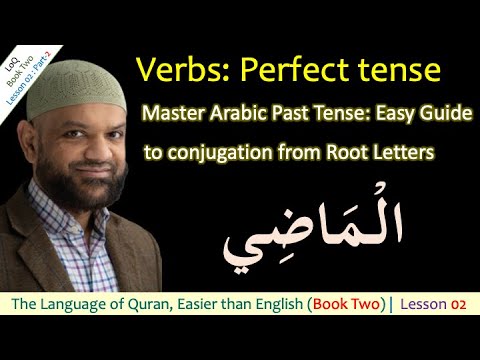 Click to play
Introduction
In Part 1 of this lesson the 14 verb forms (sighahs) of al-maadi were introduced and the verb was conjugated using the examples فَتَحَ (fataha — he opened) and نَصَرَ (nasara — he helped). Part 2 goes deeper: it examines every component of those 14 sighahs in detail — what each suffix is, what pronoun it represents, and whether the doer is hidden or visible. The teacher calls this the "anatomy of al-maadi."
The key insight of the lesson is that the same set of suffixes applies to every al-maadi verb regardless of its form — Form I, II, III, or all the way to Form X. Learning these suffixes once gives the student a lifetime tool. The lesson closes by demonstrating this principle on the other two Form I vowel scales: faila (middle root letter with kasra, example: عَلِمَ) and faula (middle root letter with dhamma, example: كَرُمَ).
A practical warning is also given: the suffixes نَا (nahnun — we) and نَ (hunna — they fem. plural) look and sound similar, and misreading them in the Quran changes the meaning entirely. Careful attention to vowel marks (tashkeel) is therefore essential.
Lesson Notes
Every al-maadi verb carries three pieces of information inside a single word: (1) the action, from the three root letters; (2) the doer, from the suffix; and (3) the tense, from the overall vowel pattern (scale/sigha).
The doer of al-maadi is identified by looking at the suffix added to the three root letters. Sighahs 1 and 4 have NO suffix indicating the doer — the doer (huwa / hiya) is HIDDEN (mustatir). All other sighahs carry a VISIBLE (baariz) suffix that directly represents the pronoun doer.
The 14 Sighahs — Suffixes and Doers
Using the example verb ذَهَبَ (dhahaba — he went):
| # | Sighah | Suffix | Doer | Pronoun | Translation |
|---|---|---|---|---|---|
| 1 | ذَهَبَ | — | mustatir | هُوَ | he/it went |
| 2 | ذَهَبَا | ا (alif) | alif | هُمَا (m.) | they two (m.) went |
| 3 | ذَهَبُوا | وا (waw + alif of protection) | waw | هُمْ | they (m. pl.) went |
| 4 | ذَهَبَتْ | تْ (ta with sukoon) | mustatir | هِيَ | she/it went |
| 5 | ذَهَبَتَا | تَا (ta + alif) | alif | هُمَا (f.) | they two (f.) went |
| 6 | ذَهَبْنَ | نَ (na) | na | هُنَّ | they (f. pl.) went |
| 7 | ذَهَبْتَ | تَ (ta) | ta | أَنْتَ | you (m. sg.) went |
| 8 | ذَهَبْتُمَا | تُمَا (tuma) | tuma | أَنْتُمَا | you two (m.) went |
| 9 | ذَهَبْتُمْ | تُمْ (tum) | tum | أَنْتُمْ | you (m. pl.) went |
| 10 | ذَهَبْتِ | تِ (ti) | ti | أَنْتِ | you (f. sg.) went |
| 11 | ذَهَبْتُمَا | تُمَا (tuma) | tuma | أَنْتُمَا (f.) | you two (f.) went |
| 12 | ذَهَبْتُنَّ | تُنَّ (tunna) | tunna | أَنْتُنَّ | you (f. pl.) went |
| 13 | ذَهَبْتُ | تُ (tu) | tu | أَنَا | I went |
| 14 | ذَهَبْنَا | نَا (naa) | naa | نَحْنُ | we went |
Critical notes:
- From Sighah 6 onward, the third root letter always takes a sukoon (e.g., ذَهَبْنَ not ذَهَبَنَ). This is because the suffixes from 6 onward begin with a vowelled letter (mutaharrik), making the root's final letter sukoon.
- The alif in Sighah 3 (ذَهَبُوا) is called أَلِفُ الْوِقَايَة (alifu l-wiqaayah) — the protective alif. It prevents the waw of the plural from being confused with the waw of the conjunction وَ (and) in handwritten text.
- Sighahs 1 and 4 are highlighted because an external noun doer can follow them (masculine after 1, feminine after 4). This is the subject of the next lesson.
- The تْ in Sighah 4 (تَاءُ التَّأْنِيث) marks femininity — it is NOT the doer; the doer remains hidden (mustatir).
The Three Form I Vowel Scales
All three Form I scales (fa`ala, fa`ila, fa`ula) share IDENTICAL suffixes. Only the middle root letter's vowel changes: fa`ala — middle root letter: fatha (e.g., فَتَحَ) fa`ila — middle root letter: kasra (e.g., عَلِمَ) fa`ula — middle root letter: dhamma (e.g., كَرُمَ)
Faila example — عَلِمَ (alima — he knew): عَلِمَ، عَلِمَا، عَلِمُوا، عَلِمَتْ، عَلِمَتَا، عَلِمْنَ، عَلِمْتَ، عَلِمْتُمَا، عَلِمْتُمْ، عَلِمْتِ، عَلِمْتُمَا، عَلِمْتُنَّ، عَلِمْتُ، عَلِمْنَا
Fa`ula example — كَرُمَ (karuma — he was noble): كَرُمَ، كَرُمَا، كَرُمُوا، كَرُمَتْ، كَرُمَتَا، كَرُمْنَ، كَرُمْتَ، كَرُمْتُمَا، كَرُمْتُمْ، كَرُمْتِ، كَرُمْتُمَا، كَرُمْتُنَّ، كَرُمْتُ، كَرُمْنَا
Note: the fa`ula scale is very rare in verbs; it more commonly produces derived adjectives such as كَرِيم (kariim — noble). Its suffixes are nonetheless identical to the other two scales.
Summary
- Every al-maadi verb encodes three things: action (root letters), doer (suffix), and tense (overall scale).
- Sighahs 1 and 4 have a hidden doer (mustatir — huwa / hiya); all other sighahs have a visible doer (baariz) as a suffix.
- The protective alif (أَلِفُ الْوِقَايَة) in Sighah 3 guards the waw of the plural from misreading — it is not a doer.
- From Sighah 6 onward, the third root letter always carries sukoon.
- The suffixes are identical across all verb forms (Form I–X) for al-maadi — learn them once, apply them everywhere.
- The fa
ala, faila, and fa`ula scales differ only in the vowel on the middle root letter; suffixes do not change. - Careful reading of نَا (naa — we) versus نَ (na — they fem. pl.) is critical: misreading one for the other changes the meaning of the Quranic text.
Terminology Reference
| Arabic | Transliteration | Meaning | Type |
|---|---|---|---|
| اَلْمَاضِي | al-maadii | the perfect tense verb (completed action) | ISM |
| صِيغَة | siighah | verb form / conjugation pattern | ISM |
| فَاعِل | faa`il | the doer — the one who performed the action | ISM |
| مُسْتَتِر | mustatir | hidden — a doer pronoun not visible in the verb form | ISM |
| بَارِز | baariz | visible — a doer pronoun that appears as a suffix on the verb | ISM |
| أَلِفُ الْوِقَايَة | alifu l-wiqaayah | the protective alif — alif added after waw al-jamaa`ah to prevent misreading | ISM |
| ذَهَبَ | dhahaba | he went | FIL |
| فَتَحَ | fataha | he opened | FIL |
| عَلِمَ | `alima | he knew | FIL |
| كَرُمَ | karuma | he was noble | FIL |
Linked Arabic terms open their full entry in the Arabic Grammar Guide.
📖 Grammar guide. Grammar terms are explained in the Arabic Grammar Guide — fully vocalised, searchable in Arabic, any transliteration, or the English meaning.
Lesson Transcript
Read the full transcript (7,167 words)
Auto-generated from the lesson video. Timestamps jump to that point in the video. May contain transcription errors.
0:00 Asalaamu Alaikum, welcome to part 2 of our lesson on the perfect tense verb al-maadi. In part 1 we covered the introduction to it, we looked at it in some detail and also alhamdulillah we conjugated into 14 variations of the verb. In this video, second part inshaAllah we're going to look at some detailed explanation of each of those sigha. The reason why I want to do it early, some of this is actually taught in more advanced lessons but if I believe that at the beginning if you
get a full understanding of the variations what the changes represent then inshaAllah we can use that same knowledge in every verb which is the maadi that we're going to come across. It will be slightly different from the mudare which we are going to of course cover in the forthcoming lessons. So this lesson is not necessarily that you are taught at this early stage but I believe the information that you're going to gain from this lesson or this part inshaAllah is going to be very beneficial for
you and even though it looks some detail inshaAllah through practise every time you see the verbs, every time you see the sigha, you will be able to inshaAllah relate to this part. So I've called it the anatomy of al-maadi where we look at every component of it in detail and of course the purpose of looking at it is not just information for the sake of information but more importantly for you to understand and I believe if you learn it right first time even though you may
not be able to recall everything but if you learn it right first time you can always refer back to it and again when you go to more complex translations of ayat and so on this lesson will become inshaAllah very fruitful for you. The last part of this lesson inshaAllah we're going to look at the conjugation of the variations in the maadi. So we looked at fa'ala where we did fataha, nasara so we looked at those verbs inshaAllah in here we're going to look at fa'ila and
fa'ula which the example verb being sami'a and karuma so we're going to complete the form one variation in the maadi inshaAllah in this video. So we have a lot to cover so let us begin with the blessed name of Allah bismillahirrahmanirrahim seeking Allah's help in understanding what the lesson we're going to do so make dua to Allah rabbi zidni ilma oh my Lord increase me in knowledge. Anatomy of al maadi the perfect tense verb. You should now be familiar with the three pieces of information that
we get from every verb. How do we get this information of course you looked at it in the previous part one but here we can look at each of this variation especially the pronoun bit in some detail. So the example verb that you have on the screen is fatahtu which means I opened of course here you can easily see the three pieces of information first being the action and we get that from the three root letters here fataha and then we got the doer who's done
the action we get that tu bit which relates to I. So I here is represented by tu in the verb. So this is the second piece of information and of course the whole scale tells us that this is al maadi meaning the perfect tense. So three pieces of information we're getting from every maadi the action itself from the root the doer by looking at the suffix at the end and third the tense which is the whole shape of or the scale of the verb. So in
order to understand this for every verb we're going to look at this session which is called the anatomy of the maadi in which we look at detail each of the variations for the 14 different ones that we have come across so far. So how do we recognise the maadi verb? The answer is very simple you look at the back end the suffix of the verb. So the root will be at the beginning and then at the end of the verb there will be some additions not
always but there will be addition in all of them except for sira number one which you can see here there is no addition there but for all the others we see there are some additions of letters which represent certain things and this is the anatomy we're going to look at each of those components that are added to the end of the maadi and please note the suffixes that you see on the screen now are exactly the same suffixes you will see for every maadi. It does
not matter whether it belongs to form one two three four or all of them okay all of them will have these suffixes added for each corresponding verb. So you will see this across so that is why investing a little bit of extra time now and learning this well will pay dividends in the future inshallah. So inshallah I'm going to use the verb dhahaba. Dhahaba means he went to demonstrate these suffixes that we spoke about just now for each one we're going to look at detail. So
the first one we have is number one which is dhahaba. Dhahaba means he went. Now you will see that in dhahaba there is no suffix added please note that there is no suffix added at the end to for sira number one. This means the scholars of Arabic say that the doer here is mustathir which means hidden there is nothing expressing the doer or representing the doer which is huwa. So the pronoun that is within the meaning of the verb is huwa meaning the doer of the
verb being huwa. So anytime you see a verb in sira number one dhahaba he went. dhahaba he went. fataha he opened. nasara he helped. These are the three verbs we did earlier inshallah ta'ala. So the first point to note is sira number one he went and of course please note that in Arabic we don't have a neutral gender so it could be it went also he or it is both the same pronoun in Arabic huwa. So it is the base form also from which all the
others are conjugated. If you know this one you can easily add the suffixes that we spoke about earlier to every verb every other sira I should say that comes along and form your 14. Second thing to note here that there is nothing representing he or it in the meaning. So we will say who is the doer? We will say the doer is hidden mustatir and representing huwa meaning he or it. So dhahaba he or it went. Then we have the most important point about sira number
one which please note is the subject of our next lesson is that the after this verb scale number one sira is possible to have a external doer and that's what we're going to be spoken speaking about in the next lesson. I briefly mentioned it in the introduction. What I mean by that here I'm saying he went but if instead of saying he went I want to say the student went or the teacher went or Hamid went whoever the noun that did the action I will put
it after number one if it's masculine. Again we're going to cover that in detail in the next lesson so I'm not going to go through great examples but please be patient. So but the external doer ie where the doer is not a pronoun has to be after number one if it's masculine. So this is why it's very important to note this one and I've coloured it in black just to make sure that it triggers your memory. So the first one dhahaba he went meaning he or
it did the action and the other point to note that there is nothing that representing the doer and the third point to note there's a possibility not always there's a possibility of a noun coming as a doer after number one. So these are the three points about dhahaba or Sighah number one. Number two represents Huma. Huma is masculine dual so instead of saying Huma then dhahaba in Arabic you could simply say dhahaba with an alif elongation here which makes it they two masculine went. Of course
the only suffix we have here is the alif so the doer itself is the alif. So who's the doer here you say alif what does it represent it represents Huma. So here we have Sighah number two they masculine dual went of course it could be any other verb and the doer here is alif represented by or Huma represented by the alif. So that's the addition please note the suffix there alif and alif is actually representing Huma. The third verb that we're going to look at in
the third person masculine range so we have Hua and Huma done now we're gonna look at Hum. Now on Hum you note there are two things in the suffix I have the waw and the alif. The waw is my doer. The waw is the one that represents Hum. What is the alif doing? As I briefly mentioned to you before the alif is there to protect the waw been mistaken for another word ie A and D. So they put an alif there so you know that this
is the Habu they went. So of course the reason I explained earlier in the part one and it could be a dal or it could be even a waw or some other letter that doesn't allow a letter to join afterwards and in writing it could be confused with that waw of A and D and therefore this alif is there for protection. So the three points to note here is that it represents Sighah number three represents Hum and of course it is they masculine plural went and
again plural in Arabic of course is three or more. The alif is called the alif of protection so it's in a different colour so you can easily see it inshallah so it's called the alif of protection and protects the waw which is the waw plural okay wawul jama'a please don't worry about that at this moment in time this terminology but it is the alif of protection that's all you need to know aliful wuqayah the alif of protection it is again protecting it from being mistaken for
A and D and of course the doer here is waw so if anybody asks you who is the doer you said the doer is waw and it's representing Hum i.e. they masculine plural so we have our three now you can see dahaba he went so it's same as saying huwa dahaba huma dahaba they too went and hum dahabu they went so we are representing the three pronouns of course in Arabic I don't need to say huwa huma hum because that pronoun is embedded within the verb
and that's where I get my doer from so that is your third person masculine done the next three we have are the third person feminine of course in the pronoun we already know should be here huma hunna here huma hunna so here means she huma means they too hunna means they three or more so the first one we have is dahabat that it ends with a ta with sukoon this ta is not our doer okay please note it is not the doer of the verb that
you see listed here the doer is still considered to be mustathir hidden meaning there's nothing there representing the doer the ta is representing it being feminine so what we have here sign number four simply translated as she or it went dahabat dahabat now the ta is called the ta feminine please note its name if you want to record the terminology but at this stage you don't need to know this so ta with ta anith so again you have the ta of feminine it is not the
doer then we have the doer we will say here is hidden so if anybody asked you what is the doer he said the doer is mustathir and what is the doer representing she or it and the last point of course is highlighted in black to remind you that after this there's a possibility of an external doer a lot of people are confused when it comes to verbal sentences remember the doer can be singular dual or plural the doer of the verb can also be definite or
indefinite but as far as the four properties are concerned it's Arab will always always be Rafa always the doer is always Rafa so when you see a noun coming after a verb in the Rafa state it is very likely it will be the doer only only a repeat if it's Sikha number one or Sikha number four in all others it cannot be now if the doer is masculine it will come after Sikha number one if the doer is feminine it will come after doer number four
so after number four there's a possibility of having a feminine doer meaning the doer being feminine as far as the link language is concerned in Arabic as I explained in I believe back in lesson number three in book one that in Arabic you only have masculine or feminine if you just remember those points inshallah most confusion when it comes to translating jumlah fairly in particular will be removed so remember number four there's a possibility of an external doer and we're going to cover that inshallah in
the next lesson so again highlighted in black to remind you of that point after here we have the Huma version very simple again the ta here we have two things in the suffix ta plus the alif together so ta with fatha the alif alif always prefers a fatha and therefore that sukoon is now changed to a fatha so you become otherwise you couldn't pronounce it so you have the habit that habit and this is our door again exactly the one we've seen earlier the alif here
representing the doer Huma so the habit that that are feminine and the alif of the doer so again just to illustrate that point to you Huma is represented by alif so who is my doer alif and what is it representing Huma so when I translate I will say the habit that they to feminine or females went the Huma version which is number six see that you will note Huma is here and the addition we have is a noon with fatha and that is your doer that
is representing Huma so again Zahabna now few points to note about this one of course Zahabna they female plural went plural is three or more the other thing to note here the na bit represents Hunna so again I don't need to have a separate word here Hunna is represented by na and one very important point from number six onwards from number six onwards meaning this one and onwards the root letter the third one it takes a sukoon so it's not Zahabna Zahabna so make sure you
read it correctly they female plural did the action here Zahabna they went and it's relatively easy from now to read them quite quickly and to memorise them one of the reasons I give you additional information inshallah for your information why does that the the third root letter takes sukoon because from now on all the doers which are the suffixes you will see they have a vowel sign on them afterwards straight after and therefore they call them mutaharrik pronouns again this is more advanced no need to
know but it's useful to know so from now on you will see every number seven eight nine ten all of them will have the third root letter will be with a sukoon and after that you will get your doer and again there's no more hidden doers or anything to worry about the rest are relatively easy inshallah so the three third person feminine are Zahabat, Zahabata, Zahabna and of course all six of them will be Zahaba, Zahaba, Zahabu, Zahabat, Zahabata, Zahabna now we go to the second
person meaning you second person as you know there are six pronouns in Arabic for you whereas in English we only have one you so the if you wanted to give the detail of the translation you'd have to put something in the bracket otherwise you in English could mean singular, dual, plural, masculine, feminine no difference so in Arabic we have six in English we have you so you note please pay attention to what's in the brackets so the first one we have after the six of the
second we've done a third person the seventh one is Anta, Anta is very easy to remember Anta Zahabta, Anta Zahabta and it is this Ta that is now our doer so it's the only suffix so Ta is our doer and it's representing Anta Anta Zahabta again as I said to you from now on is sukoon here so very easy to read also Zahabta, Zahabta, Anta Zahabta your doer is Ta which is your fa'il next we have Zahabtuma now Zahabtuma is again very easy Antuma Zahabtuma Antuma
Zahabtuma and you can see that there is nothing here of surprise sukoon here and of course and the doer here being Tuma what is your doer Tuma representing Antuma and the third again very simple Antum Zahabtum, Antum Zahabtum what is my suffix Tum what is the doer Tum, Tum representing Antum Zahabtum you masculine plural meaning all of you went all of you went again very very simple from now on inshallah so I'll quickly mention them for you just for you to note so Ta Tuma Tum
are representing directly Anta Antuma Antum and that's again you see that as I repeat in every maadi it will be exactly the same suffixes so for the second person Anti Antuma Antum version again very very simple you have Anti Zahabti T is your suffix T is your doer so what is the doer T representing Anti Zahabti you female singular went the same for Tuma Antuma the addition is Tuma Tuma representing Antuma and of course it is feminine dual feminine dual so it's Zahabti Zahab Tuma Tuma
so exactly the same a very easy to remember and inshallah connect between the two the last being Antuna represented by Zahab Tuna so the suffix is Tuna which is your the doer Antuna represented here the you female plural not the you female plural went and that is your Sighah number 12 so we have now the 12 of them covered and the six which are representing second person ie you version in English are Zahabta you went Zahab Tuma you too went Zahab Tum you masculine plural went
and for the feminine Zahab T Zahab Tuma Zahab Tuna so again you can see inshallah Taala how easy it is that the six very sound similar to the pronoun so they're easy to recall and remember so the first column shows you the suffix and exactly the same so it means the doer is that inshallah Taala so that's your six only two remaining now for I and we so for another suffix is to the have to I went I went and again the two is representing Anna
and that is your doer for the we version is very very easy and again is the hub now the hub now we went now here okay the now representing your doer and of course it is national we went all of us we went they have been now we went so that's your detail look at all the 14 Siga of the past tense so on the screen now on the right hand side I put them all there for you that you can see the first column here
is showing the verb scale so faala faala faaloo faalat and again it could be any Mahdi and the second one showing what suffix there are there is nothing here and it's the third one telling you who the doer is who the doer is again you see it very soon inshallah why I'm going through it so slowly and so meticulously why because translation will become very easy for you for any Mahdi inshallah you know exactly how to translate and I will do the doer bit inshallah Taala
in the next lesson which is dedicated to studying the doer of the verb Al Mahdi verb inshallah Taala so this screen represent for you what the information I've gone through just a few quick points for you to note again I will be reminding you of all of these so please note after number six all of them will take sukoon so it's number six included the third root letter takes sukoon so reading it becomes very easy when you come to conjugation so for example let me give
you one so I can illustrate for you Fataha so you can see here Fataha Fataha there Fatahu Fatahat okay Fatahata Fatahna and from there I can say it very quickly Fatahna Fatahna Fatahta Fatahtuma Fatahtun Fatahti Fatahtuma Fatahtunna Fatahtu Fatahna so you can see here Alhamdulillah is there like almost a rhythm very easy and that's how you need to practise it and if you've done three or four verbs inshallah you invested into lifetime learning and it will be there for you forever just noting the pronunciation this
one is na there is no elongation whereas this is na so often when people read and we have to be extra careful when we read the Quran we could completely change the meaning from for example they female did the action plural to we did the action or vice versa just by reading it incorrectly so be careful when you read Quran be careful when you read the text because we will change the alter the meaning and this is in one area of example the other thing to
note is that this one is sukoon let me change the colour so you can see it this one sukoon ends with a sukoon and this one also ends with a sukoon so there is possibility of something coming afterwards which will have like a Hamzatul Wasl or there'll be meeting of two sukoons in this case you will all often see that this ta is read with a kasra this is not changing the verb please note this is to do with the meeting of two sukoons again I
will highlight these points to you and an tum if it's followed by something afterwards then which has a sukoon also of course there will be some changes to this and tumu would be the change there but again I'll highlight those for the others there will be there no change and they're very very easy to recognise Alhamdulillah and as I say if you get into the rhythm of practising these then every single maadi will become easy for you Inshallah Ta'ala on the screen a final summary sheet
of all the points I've been mentioning to you and Inshallah Ta'ala this will help you and please don't worry I am trying my best to get this on a website and it will be in the description for you to get this sheet Inshallah Ta'ala which I'll be sharing with you but now for now until then just make a note the first column a represents the translation in English and then this is the of course the Arabic verb and you can see why we need additional words
in Arabic Inshallah Ta'ala which we don't necessarily need in the additional words in the English I should say which you don't necessarily need in the Arabic because there's so many detailed additional information which is embedded within the word you will also note here I've numbered them again for your convenience 1 to 14 and this is called Sighah and instead of going into all these complex terminology I'll just say 1 and 4 and hopefully that will help you remember then we have the pronoun that is within
each verb and again I don't need to labour that point you should hopefully it's clear then in the in the verb itself the three root letters are represented at the beginning and again I've rewritten it now you got the doer on the column and a little bit stressed so that it makes it clear to you who the doer is and the points that we need to note Hua it is hidden and here it is hidden Mustatir and it is only Sighah number 1 and 4 where
it is hidden okay there can be an external doer again please don't worry about this point that is what I'm going to be showing you in the next lesson and if you do not see an external doer you simply translate it as the pronoun so for example here Fataha he went or Fatahat she went that's all this point means Inshallah Taala in all the others you will not hesitate but to translate with the pronoun only and because the pronoun always comes first in English translation it
will not be coming after the verb and the doer will never you know in Arabic comes after the verb in English it is always first because the subject comes first so that's where there can be some confusion then we have the Alif okay this is the Alif of protection just for your information Inshallah Taala and of course we have that in number three so number one and four is your prime ones and number three is where the doer of the Alif is representing the protection of
the doer five and two the doer is Alif again representing the pronoun that you can see and Inshallah Taala you can see four and five that is representing the letter that is representing what femininity it is not the doer and that's really it a summary of all the key points of the verbs that you can see I've highlighted there for your benefit I hope Inshallah Taala this lesson or this part of the lesson you will see it as really a lifetime of resource for you for
all the Mahdi study that you're going to do I don't think there is anything much more I can add to this that is our benefit because we're gonna go into all sorts of unnecessary detail but it's not going to benefit us so at the end of the day we are here to try and get to the quickest way we can to begin to understand the ayat of Quran and the book one already the lessons I've shared with you Inshallah Taala I'm hoping is going to give
you something from every line of Quran at least three four components and once we get the verbs in we are there 70 80 percent Inshallah Taala and after that is the complexities and variations that we will look at so in conclusion does not matter which of the scale we are talking about Taala, Faila, Faula the suffixes will be exactly the same of course these three scales are only for form one which is mentioned above but form two three four five six seven eight nine ten the
suffixes will be always identical to the ones we've looked at so again as I repeat whatever we've done you will see it now Inshallah I'll demonstrate it for you that we're going to look at Faila version where we're going to practise with the verb Samee'a and then Karuma will practise for Faula it'll be exactly identical to Faula the only variation will be the middle root letter taking the vowel change otherwise it is all the same so in Arabic I always tell and remind myself and the
students if you learn one thing very very well then everything else will follow because you get thousands of things for free you don't have to relearn every other verb one verb is good enough for us for detailed study so Inshallah now we're going to take a look at the Faila construct and Faula construct one of each at least and don't worry we're going to revise them again because Madhi will be studied with the Mudare'a after we've done two more lessons on the verbal sentences then Inshallah
after that we should be in a very very strong position to start understanding more and more Arabic text conjugation of the perfect tense Al-Madi on the scale of Fa'ila Alhamdulillah this scale of Fa'ala meaning all the three root letters taking Fatha Fatha Fatha one two and three the middle root letter here of course is taking a Fatha we used an example verb Fatha he opened you should now be very familiar with this and should be able to conjugate this again I went through it in detail
now all the and all the variations of the suffixes which are critical to understanding the verb I hope Inshallah you've written them out a couple of times and you've also practised the scale and you should be able to if you practise to recall the whole chart whole table from memory write it as well as read it so for example you can say Fatha Fatha Fatha Fatha Fatha Fatha Fatha Fatha Fatha Fatha Fatha Fatha Fatha Fatha Fatha Fatha Fatha Fatha Fatha Fatha Fatha that should be relatively
easy for you and of course you can easily translate as well long as you know what the root means so this is how you recognise and what I'm going to show you now is a almost identical there is no change all we are doing is adding the same suffixes that we already familiar with that you can see here to the scale of Fa I La so let me give you the example of the scale we have Fa I La at the top you can see the
Ain the second root letter is taking a Kasra the example verb I'm going to use is Ain Lam and Min which is the root that you can see here and what we need to note is the first root letter takes a Fatha the last one takes a Fatha here is the variation in the middle root letter is taking a Kasra so we have Alima Alima not Alama Alima Alima Alima means he knew he or it knew so we're going to fill the 14 here inshallah and
you're going to see there is no difference than what we have done previously with all the other Fa I La scales this should be very easy for us if we've learned the Fa I La scale so in the first box I have the first root letter taking a Fatha second root letter taking a Kasra and the third root letter taking a Fatha Alima he knew he or it knew now if I wanted to do both dual for example Alima okay Alima again you can see in
the box here the Alif representing Huma I want to do home version so Sighah number three again you see the extra Alif for protection there so Alima he knew Alima they too knew Alimu they know or they knew sorry in the past tense Alimu they plural masculine knew now the feminine version is for here Alimat Alimat remember the Ta takes a Sukun and it is the dual hidden that are representing femininity number one and number four remember that the Dhuuma version Alimata and of course for
the Unna version we have Alimna again for the Anta version Alimta again remember number six the third root letter now will take the Sukun so we have Alimta Anta Alimta Antuma Alimtuma and Antum Alimtum so again you can see all of them from number six taking Sukun and all I'm doing is adding is the suffix as the dual and the rest of them are very very easy so the Anti version is Anta Alimta Anti Alimti okay Alimtuma and of course the last one Antunna will be
Alimtunna Alimtunna note the Sukun on the third root letter from number six all the way down and of course they're all easy Alimtu and lastly Alimna again all 14 of them conjugated very easily so if you do one the rest are easy all we're doing here is variation by adding the Kasra on the middle root letter everything else being fixed I prepared on the screen for you the coloured version so that you can see the same principles inshallah hopefully these colours will help you get the
knowledge inside your heart and your mind inshallah so you can see here now exactly the same as the Fala pattern with Fataha with Dahaba with Nasara you can see the same here with Faila that is really no drama now nothing different except for the second root letter taking the Kasra so it's understanding the scale recognising the scale that's all we need to do and that any verb that comes on the Alimna pattern there's many Faila pattern there will be for example Rahima there is Samia and
all of them we will see them inshallah a little bit more detail later but if you practise one you get them all so practise practise practise read from by looking couple of times so until it becomes in your memory write at least once or twice down in this order inshallah and then once you've written it couple of times said it couple of times you should be able to do it inshallah with from memory and I would advise you all to practise with some break in between
don't try to do it all in one go so for example read couple of times take a break next day or three hours after read again take a break and then that's that's the way to do it and the same thing in writing don't write ten times in one go write once next day next hour three hours whatever again and again and you have to have done a couple of times in this cycle inshallah you will be able to just go out you know read them
at bullet speed inshallah so practise practise practise conjugation of Al-Madi on the scale of Pa-Ula we're going to conjugate now the scale of Pa-Ula again please note all that's happening is the middle root letter taking a a dhamma which you can see here inshallah Ta-Fa-Ula and the suffixes will be exactly identical now this scale Fa-Ula with the middle root letter taking dhamma is very rare there are there are only few verbs that you're likely to come across which takes this scale and the verbs are rarely
used is more the derived nouns that is why in the introduction I mentioned about derived nouns on this scale so for example Kareem noble comes from this scale so it's very very rare so we don't really need to spend a lot of time practising it but in theory there is no difference here nothing really to worry about so I've only used one example here Ka-Ru-Ma and you can see here Fa-Ula he was noble and Kareem means somebody is noble we will look at the noun derivation
inshallah Ta-Fa-Ula in coming lessons is bit too early for that but for now we're going to complete this table for Kareem and because it's very rare we just need to show you one examples with it inshallah Ta-Fa-Ula so please pay attention to the conjugation I'm going to just read them out to you so let's begin the first one Hua is Kareem I can see here Ka-Ru-Ma there's nothing new all I'm doing is the second root letter taking a dhamma then it's Kareem Ka-Ru-Ma, Ka-Ru-Mu, Ka-Ru-Mat, Ka-Ru-Ma-Ta,
Ka-Rum-Na, Ka-Rum-Ta, Ka-Rum-Tu-Ma, Ka-Rum-Tum, Ka-Rum-Ti, Ka-Rum-Tu-Ma, Ka-Rum-Tun-Na, Ka-Rum-Tu, Ka-Rum-Na again just practise it once inshallah Ta-Fa-Ula the nouns from this scale but it is there and that is why I include it it's quite important when we look at the Mudare I'll show you the link between them inshallah Ta-Fa-Ula but this particular scale with the Ma-Di where the middle root letter takes a dhamma are very few verbs and they're also being coloured here for your convenience so you can see the same principle happening again if you learned
the first scale well there is nothing new here for us to concern about so in conclusion my dear brothers and sisters in Islam whether it is the Fa-Ala whether it is the Fa-Ila whether it is the Fa-Ula scale you can see the conjugation is identical in all the way through the only difference being the first the middle root letter taking a Fatha, Zabar, Dhamma, Kasra, Zer or Dhamma, Pesh one of the three variations are those exactly the same the suffixes exactly the same the Sifas are
the same they all they would rhyme if we were to read them all out one next to the other the other point inshallah which we will see later whether it is form 2, form 3, 4, 5, 6, 7, 8, 9, 10 all the way that you want to go all of them will have the same suffixes for the Ma-Di please note Mudara is different we will learn the scale of Mudara in the same focus as we're learning the Ma-Di because that's a bit more detailed but
if you learn this one well you got the idea of the Sifa the rest is relatively easy so please note this down the three that are there all conjugated for our benefit inshallah by the grace of Allah Azza wa Jal we have completed what all that I wanted to cover with you or the Ma-Di we learned about the it's in detail it's the perfect tense the tense how it works and so on we covered the 14 different Sifa the 14 variation each one about each pronoun
in Arabic we also covered a detailed analysis of the entire 14 verbs and all the variation that occurs what they are and how they are used and what the pronoun is etc and of course we covered the last point which was the three different variations of form one what I've taught you I repeat again everything that you've learned in this lesson that's that is the reason why I wanted to make it comprehensive is equally applicable to all other Ma-Di that you're going to study and I've
covered a lot more detail than normally is covered because I don't want you to be surprised by additional stuff later on as far as the whole thing and the good thing about it even though it's a lot to cover I personally feel every time you see it inshallah Ta'ala you will be able to go back and refer back and you see it two three four times it will become second nature and that's how human beings learn we don't learn by reading we don't learn by just
watching somebody or watching a video we learn by practise before that of course is the initial state for understanding but actual learning takes place through practise so inshallah that's we're going to focus as a result in the next lesson I'm not going to go to the second type of verb which is the Ma-Dari I'm gonna go to some details of how verbal sentences work so you can practise what we have learned so next lesson will be about the doer and the lesson after will be about
the object so for example if I say Hamid wrote the letter so here Hamid is the doer of the writing or has written and the object of the writing of course is the letter if I said she wrote the letter again she would be the doer and the letter will be the object so in the first next lesson we're going to look at the doer in detail and then lesson after we look at the object of course there are different types of object but we've been
looking at the direct object I found this method a lot better because the quicker you get to understanding how sent a verbs work inshallah you can start practising with proper text when I say properties I mean actual text from either ayat of Quran hadith or even for any classical Arabic or even modern standard Arabic you can make a lot more progress inshallah this way so may Allah grant us Tawfiq to continue may Allah grant us Tawfiq to be determined to put the time and the effort
necessary to be able to learn inshallah and as I'm hoping you are convinced now slowly that it is not as difficult as it has been made and as you have thought and how Shaitaan has influenced us we've got to put our trust in Allah keep on making dua rabbi zidni ilma oh my lord increase me in knowledge and Allah subhanahu wa ta'ala in his infinite mercy will make it easy for us so again I thank you all for your support and your messages Jazakumullahu khairan do
kindly link like share and also subscribe and try to encourage the ummah at large the more of you make comment and add subscription inshallah more Muslims will find this resource or anybody else wants to learn Arabic inshallah talent will help to spread the dawah and spread the message so again I want to thank you for your support and all your positive messages encouragements duas that you're sending me and support that you're sending to the channel may Allah bless you with the very best in this world
in the hereafter please make dua for me that I can find the time the resources and the focus necessary to deliver the lessons in the best way possible until the next lesson Assalamualaikum warahmatullahi wabarakatuhu may Allah subhanahu wa ta'ala bless you with the very best in this world and in the hereafter
Test Yourself
After every lesson it is essential to test what you have learnt. We are working hard to produce the full set of resources for every lesson — thank you for your patience.
If you would like to support the production of content and the running of this site, you can do so on our support page.
Updated