
Kana with Al-Madi
Using كَانَ to Express the Distant Past in the Verbal Sentence
- Understand the difference between the near past (al-maadi al-qareeb) and the distant past (al-maadi al-ba'eed)
- Use كَانَ with a maadi verb to express that an action happened in the distant past
- Match the sigha of كَانَ with the sigha of the following maadi verb
- Recognise كَانَ as a fi'lun naaqis (defective verb) and understand what that means
Video Lesson
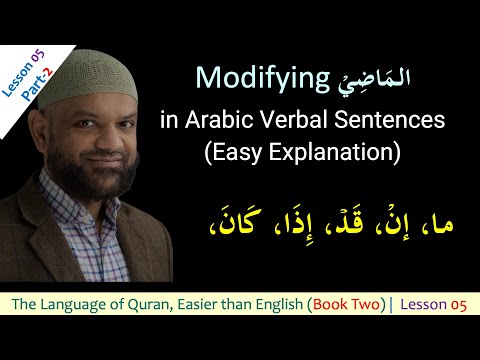 Click to play
Introduction
In the previous parts of Lesson 5 the teacher covered all the main ways to modify the meaning of a maadi verb: negation with مَا and لَا, emphasis and near-past meaning with قَدْ, future meaning with إِذَا and إِنْ, and certainty with لَ. The one thing that remained was expressing an action that happened in the distant past — something that occurred a long time ago rather than just recently. That is the subject of this part of the lesson.
The lesson opens with a review screen showing every modifier learned so far alongside example sentences, so students can see the full picture before the new concept is introduced. Once the review is complete, the teacher turns to كَانَ and explains its unique grammatical category and how it shifts the time frame of any maadi verb it is placed before.
A key practical note is that كَانَ itself must be conjugated to match the internal doer of the following maadi verb. Because كَانَ contains a weak middle letter (originally كَوَنَ with a waaw), its forms look slightly different from a sound verb, but the principle of matching the sigha is exactly the same as with any other verb.
Lesson Notes
Qad vs Kana — Near Past vs Distant Past
قَدْ is a harf (particle) of emphasis. When placed before a maadi verb it also adds the meaning of "just recently" or "has certainly done." For example:
قَدْ نَصَرَ = he has just helped / he has certainly helped (al-maadi al-qareeb — near past)
كَانَ, by contrast, is itself a verb — a fi'lun naaqis. When placed before a maadi verb it pushes the meaning back into the distant past:
كَانَ نَصَرَ = he had helped (al-maadi al-ba'eed — distant past)
The term fi'lun naaqis (defective verb) means that كَانَ alone does not give a complete picture. It describes a state or time frame but needs something more to complete its meaning. That is why it is always paired with another element — either a jumlah ismiyyah (as studied in Book One) or, as in this lesson, a maadi verb.
Kana with Jumlah Ismiyyah — A Reminder
When كَانَ is used with a nominal sentence (jumlah ismiyyah) it converts the khabar (predicate) from rafa' to nasb. The subject is then called ismu kaana and the predicate is called khabaru kaana, which must be mansoob. This was covered in Book One with لَيْسَ as well.
كَانَ الرَّجُلُ كَرِيمًا kaana ar-rajulu kariiman The man was generous. (ismu kaana = ar-rajulu [rafa'], khabaru kaana = kariiman [nasb])
Kana with Al-Madi — Matching the Sigha
When كَانَ precedes a maadi verb, both verbs must share the same sigha — the same person, gender, and number. There is no irab change to worry about because both are maadi forms, but the internal doer of كَانَ and the internal doer of the following verb must match exactly.
Examples using the verb فَتَحَ:
| كَانَ form | Maadi form | Meaning |
|---|---|---|
| كَانَ | فَتَحَ | he had opened |
| كَانَا | فَتَحَا | they two (m.) had opened |
| كَانُوا | فَتَحُوا | they (m.pl.) had opened |
| كَانَتْ | فَتَحَتْ | she had opened |
| كَانَتَا | فَتَحَتَا | they two (f.) had opened |
| كُنَّ | فَتَحْنَ | they (f.pl.) had opened |
| كُنْتَ | فَتَحْتَ | you (m.sg.) had opened |
| كُنْتُمَا | فَتَحْتُمَا | you two had opened |
| كُنْتُمْ | فَتَحْتُمْ | you (m.pl.) had opened |
| كُنْتِ | فَتَحْتِ | you (f.sg.) had opened |
| كُنْتُمَا | فَتَحْتُمَا | you two (f.) had opened |
| كُنْتُنَّ | فَتَحْتُنَّ | you (f.pl.) had opened |
| كُنْتُ | فَتَحْتُ | I had opened |
| كُنَّا | فَتَحْنَا | we had opened |
Note: the middle letter of كَانَ is a weak waaw. In the past tense forms it becomes an alif (كَانَ), and in forms where it would follow a vowelless letter it disappears (كُنْتُ, كُنَّا, etc.). The same sigha principle applies regardless of this phonetic change.
Summary of Maadi Prefixes
The teacher concludes with a full summary chart of everything that can be placed before a maadi verb:
| Prefix | Type | Function |
|---|---|---|
| وَ | harf | and |
| فَ | harf | so / then |
| لَ | harf | emphasis |
| قَدْ | harf | emphasis / near past |
| مَا | harf | negation |
| لَا | harf | negation (repeated) |
| إِذَا | harf | future (certain event) |
| إِنْ | harf | future (possible event) |
| كَانَ | fi'l naaqis | distant past |
Common combinations include: وَقَدْ، فَقَدْ، لَقَدْ، وَلَقَدْ، وَكَانَ، فَكَانَ.
Summary
- قَدْ before a maadi verb adds emphasis and the sense of "just recently" (al-maadi al-qareeb — near past).
- كَانَ before a maadi verb shifts the action to the distant past (al-maadi al-ba'eed) — "he had done."
- كَانَ is a fi'lun naaqis (defective verb): its meaning is incomplete on its own and it needs a complement to give a full picture.
- Both كَانَ and the maadi verb that follows it must share the same sigha (person, gender, number).
- The root ك-و-ن (kaana / yakuunu / kun) appears approximately 1,400 times in the Quran, making it one of the most important verbs to master.
- All modifiers of the maadi — negation, emphasis, future, near past, distant past — are now complete and can be combined (e.g. وَلَقَدْ، فَكَانَ).
Terminology Reference
| Arabic | Transliteration | Meaning | Type |
|---|---|---|---|
| كَانَ | kaana | he was / he had (auxiliary — distant past marker) | FIL |
| الْمَاضِي الْقَرِيبُ | al-maadii al-qareeb | the near past ("he has just done") | ISM |
| الْمَاضِي الْبَعِيدُ | al-maadii al-ba'eed | the distant past ("he had done") | ISM |
| فِعْلٌ نَاقِصٌ | fi'lun naaqis | defective verb — a verb whose meaning is incomplete without a complement | ISM |
| أَفْعَالٌ نَاقِصَةٌ | af'aalun naaqisa | defective verbs (plural) | ISM |
| قَدْ | qad | particle of emphasis / near past marker ("certainly / has just") | HARF |
| نَصَرَ | nasara | he helped | FIL |
| فَتَحَ | fataha | he opened | FIL |
Linked Arabic terms open their full entry in the Arabic Grammar Guide.
📖 Grammar guide. Grammar terms are explained in the Arabic Grammar Guide — fully vocalised, searchable in Arabic, any transliteration, or the English meaning.
Lesson Transcript
Read the full transcript (3,166 words)
Auto-generated from the lesson video. Timestamps jump to that point in the video. May contain transcription errors.
0:00 As-salamu alaykum. Welcome brothers and sisters to our lesson number five part two. Alhamdulillah we have learned significant amount of rules related to the verbal sentence of course in particular using Al-Ma'di. We learned how to negate the verbal sentence. We also learned how to put certainty in the verbal sentence as well as making the meaning in the near past. We also learned to how to use it in to give the meaning of the future as well as of course The thing that is left is to study
the verbal sentence or Al-Ma'di verb in the distant past. So this is going to be the main part of this lesson or this part of the video. Lesson number five part two video Inshallah ta'ala. We're going to look at how to put the Ma'di into the distant past and we will look at some examples from the Quran and Hadith Inshallah ta'ala in the remaining part of the video. So let us begin with the blessed name of Allah. Bismillahir-Rahmanir-Rahim. Making Dua.
1:02 Oh my Lord increase me in knowledge. The sentences that I've written on the screen will help us review everything we've learned so far. Firstly we have the standard verbal sentence with Al-Ma'di at the beginning here which you can see the doer is Rafa and the object is Nasab. So that's a basic essential rule that we've learned. Nasara Hamidun Zaidan. So the translation in English will be Hamid helped Zaid. If I want to negate I simply put Ma in front so I end up with Ma Nasara
Zaidun Hamidan which gives me the translation of Hamid did not help. La can also be used for negation so La Kataba Wala Qara'a. He did not write nor so you can see did not nor read. So again La is used when it's repeated so twice and this is the normal use of it. Then we've learned how to use it in the future meaning and particularly when it's used for Dua. So Jazakallahu Khayran which is very commonly used. May Allah give you something better or may Allah
give you reward with something more. Something better would be a better translation. So Jazakallahu Khayran. May Allah bless you or reward you or give you something more or something better. And then we learn how to use it with Itha. Wa Itha Sa'alaka Ibadi. So Sa'alaka means he asked in the past tense but when Itha is used it moves the meaning to the future tense. So when my slaves ask you not asked you ask you so that's what Itha does. La of course for emphasis then we
have in. In is exactly the same so for example here we have La In Shakartum La Adhidannakum. Then again you can see if you are grateful I will certainly give you more. So in here exactly the same putting the meaning in the future tense. Again I told you the subtle difference between Itha and in. The difference is that Itha is when something's used primarily when something is certain to happen in may or may not happen. And then Qad generally does two things. It gives an emphasis
to the meaning. Qad Nasartu Hamidan. Certainly I have helped. I have helped Hamid or I have just helped him. That kind of meaning. So Qad is a particle. Itha is a Harf. Qad is a Harf. La is a Harf.
3:27 Ma is used also for a particle of negation. So these are the some common additions with which we can modify the meaning of Al Mawdi. And you see them very very commonly used in the Quran. So please make a note of this and Alhamdulillah we have covered most of the rules that we needed to cover as far as using verbal sentences with Al Mawdi is concerned. Using Kana with Al Mawdi. Kana, past tense, Yakunu, present and future tense is a very very important verb. We've used
Kana already with Jumla Ismiya in some of the lessons in book one. What it is known as in Arabic grammar is known as a defective verb. Okay. Defective verb. And now it is a special category of verbs and that are considered to be incomplete. So when they're used, they're used very powerfully in the language but the meaning is not fully complete. It doesn't really give us a detail of an action or a state of being. So we need something additional to complete the meaning. So when
it is used to a Jumla Ismiya, for example, it acts as a helper verb which modifies the time frame of the sentence.
4:43 So Kana is used with Jumla Ismiya. We've seen, I'll show you one or two examples inshallah, to put it the meaning more of in the past tense. And they do not really denote an action being performed by the subject. Instead they describe a state. So for example Kana is he was but what was he? So you need something more in addition. So that's why they're called Af'alun Naqisa.
5:07 Af'alun Naqisa. The defective verbs. We are going to have a dedicated lesson which is going to come across again and again inshallah in our study because this root is used almost 1,400 times in the Quran. And when you note that there are only 600 pages, so on every page you will find at least two if not more on the average per page of a verb that is derived from Kaf Wa'unun which is the root of the verb Kana Yaqoonu. So don't worry about it. We're going
to have a dedicated lesson and it's quite important without which we cannot make significant progress. But inshallah we'll do that after we've studied the standard Maadi Mudara and Amr. We will look at weak verbs at that state. But for now please note number one it's used with Jumla Ismiya and number two it's used with Al Maadi. And this is what we're going to be doing in this lesson inshallah So as a review for what we used it for with Jumla Ismiya, please note this is a
Jumla Ismiya because it begins with an Ism. Okay. Muqtada and Khabar. The two parts. Again I'm hoping you're very familiar with this. Arrajulu. Arrajulu Kareemun. And I'm sure you know to note that this is Rafa and this is also Rafa. So we have Arrajulu Kareemun. And this is definite and this is indefinite. And of course the gender and the number is matching. So we have a sentence here. The man is generous. The man is generous. The man is noble. Now this meaning if I were to
say that on its own in English you will understand as a state. Meaning he is at this moment or he is known for his generosity. He is generous. But if I want to say the man was generous in a Jumla Ismiya, what I would do is I would put Kana in the front. Kana. So what is Kana? Kana is a Fi'alun Naqisun. A defective verb. What does it do? Well when we put that in front again I'm emphasising the fact that I'm talking about Jumla Ismiya
at this stage. Kana Arrajulu. So Arrajulu is as you can see Rafa. And this is also Rafa. Kareemun is Rafa. That's easy for you now Inshallah Ta'ala. But when Kana is used it makes some changes to the structure of the sentence. We cannot now no longer call this Mubtada or Khabar. We have to call it Ismu Kana and Khabaru Kana. Why? Khabaru Kana is Mansoob, Nasab. Please remember that Inshallah. We covered it before. We did it also with Laysa. So Kana is not the only verb
that does this. There are others. Laysa is another one. And we will Inshallah cover the ones that are necessary for Quran in the lesson that is appropriate for it at this stage. This is just an introduction. So Kana converts the Khabar to Mansoob. This is the addition of Kana. Converts it to Mansoob, the Khabar. And that is why it's called Khabaru Kana, Ismu Kana. And they combine together to make our Jumla Ismia. The two things are added together. So that is why the grammatical structure is
changed now from Rafa to Mansoob for the Khabar. And the subject now is called Ismu Kana. And that is the most significant part. And again please note it is not only Kana that does this. There are many other verbs. We have seen Laysa and Kana so far in our study. Others include like Asbaha and so on. And again, as I said, we will cover them later. So don't worry. Why? Because this root, it's the past, Madi, Mudariya and Amr, is covered around 1390 times in the
Quran. So very, very important verb to study. But as far as Jumla Ismia is concerned, this is what you need to know about Kana. It puts the meaning in the past rather than saying a state is something. For example, he is young or I can say he was young. Or he is small, he was small. He is a student, he was a student. Of course we can also use that she and they and so on. But that's the example you need to remember. Now what does
it do with Madi? Inshallah, let's continue look at that. So using Kana with Al-Madi. Please note the few points, Inshallah Ta'ala, which will make the subject very easy for us. Firstly, let us look at what happens when we add Qad. Now Qad is actually a Harf. Qad is a Harf. It's a Harf of emphasis. So if I say Qad Nasara, this is called Al-Madi Al-Qareeb, meaning close. Qareeb means near. Okay. So close past, as in just recently this action has taken place. So Qad gives us
the meaning he has or he has certainly helped. We've covered that in the previous video. But if I want to say he had helped as in long time ago, whether it's in the morning, hours ago, lots of long long time ago, whatever, the Kana would can now be added in front to give the meaning of Al-Madi Al-Ba'eed. Ba'eed means distant. Okay. Al-Madi Al-Ba'eed. So that means distant past. So this gives us the meaning of, let me write that here, distant. So distant past. So that's all
we've done. Kana Nasara. There is no issue with the Arab here because we're dealing with Madi verbs. So he had helped. He had helped. So the difference between Qad and that is a significant difference in meaning. In the past he had helped. So this is what Kana does. Now unlike Qad, Kana is of course a Fi'alun, a verb. So we need to make sure that the doer here and the doer here they match. So I cannot use Kana when the verb here is any other Sifah
than Nasara for example. Because here this is masculine of course, he, and singular. So if I wanted to say she had helped, I would have to use the feminine version of Nasara and of course and I would also have to use this feminine version of Kana. So we have to match the Sifah. Again if you've gone through the lessons now in book two that I've been going, in the last few lessons you should be able to be familiar with the Sifah and you should be able
to now memorise Nasara verb and tell me that the feminine version of Nasara is Nasarat. I hope that bit Inshallah Ta'ala is clear so far. So let us have a look at now the example here. He had helped, Kana Nasara. But to say she had helped, I need to say Kana Nasarat. She had helped. Please note that very important distinction. And that's all. We just got to match the Sifah one with the other. And again if you learnt the Sifah in the 1 to 14 order
that I showed you and I went through in detail in every verb, it will be exactly the same as in the verb Kana with Nasara. But there is one little trick. With Kana, the root letter in the middle is weak. Okay so it's Waw. Originally Ka Wa Na. It gets converted to Kana because it is easier to read. There are phonetic reasons why changes occur. Again we are going to go through this in detail. I'm just giving you a brief example. So Kana Nasara and then
the feminine version will be Kanat Nasarat. So you can see here the middle weak letter is here. Changes to an Alif. Originally it was a Waw. And that's the why it's slightly different. It's not Ka Wa Na. It's like so it's Nasarat. It's not Kawanat. Okay so it is here Kanat. Again we're going to go through the rules of that later. But just making make sure that yes it is the same Sifah. The pattern is slightly different because of a weak letter in the root. I
have helped of course is Nasartu. We had helped is of course Nasarna. And you all had helped will be Nasartun. So to match the Kana version we say Kuntu Nasartu. And then Kunna Nasarna. And of course Kuntun Nasartun. And that's all it is. Again don't worry Inshallah Ta'ala you are going to learn all of these in the forthcoming lessons when we deal with this topic in detail. But for now just note that the Kana conjugates like so. And if you have time Inshallah do rewrite these
until you have memorised them. As I said this verb Ka Wa Nun root yielding Kana Yakunu in the present tense and Kun in the command form is used in the Quran almost 1,400 times. So it's very important. I'm only giving you the Maadi at this stage. So you have Kana Kana Kanu. Again you should be able to work out is Hua Hum Ahum. Kana Kana Kunna.
14:28 Again please note a significant change there because the weak letter in the middle. Then we have Kunta Kuntuma Kuntum. Kunti Kuntuma Kuntunna.
14:47 Kuntu Kunna. These are your 14 Sigha of Al Maadi with Kana. It will make a great investment in your study if you did memorise these without worrying about the changes because the rules will come later Inshallah Ta'ala. But for now if you memorise it like you memorise the Nasara table you will not have any problems Inshallah. So Kana can be used with any Maadi but what we got to make sure is that we match the Sigha i.e. the internal doer with the verb that we're using
it with. So it can be any form anything of the Maadi as long as we match the Sigha. So we have on the screen here the Kana conjugated in its 14 forms. Please note I have written it down in faint the pronoun that is within the verb itself. So Kana is Hua. Kana is Huma. Kanu is Hum. All that's been explained to you in the previous lessons Inshallah. So if we want to use it with Fataha we would say Kana Fataha. What will it do? It
will change the meaning Fataha from he has opened or he opened to he has opened as in the distant past. So we have Kana Fataha. Kana Fataha. Kanu Fatahu. Kanat Fatahat.
16:04 Kanata Fatahata. Kunna Fatahna. Kunta Fatahta. Kuntuma Fatahtuma. Kuntum Fatahtum. Kunti Fatahti. Kuntuma Fatahtuma. Kuntunna Fatahtunna. Kuntu Fatahtu. Kunna Fatahna. It's simple as that. So long as you've learned the conjugation of the very well Al Maadi, then the rest is relatively easy Inshallah. You should be able to recognise the form and now with Kana and the Maadi following you should now also be able to translate it correctly. So again a very simple lesson Inshallah. There is nothing really technical here just a case of recognising the Sighah
number 1 to Sighah number 14. Summary of the prefixes used with Al Maadi. So on the screen I put a summary of all the prefixes that you are most commonly likely to come across with Al Maadi. So of course here we have the conjugation of the 14 forms. So it could be any of them. You could have WAW in front which is AND. FA, SO or DAS. LAM for emphasis. All of these you should be familiar with. WAW, AND, FA, SO or DAS. LAM for emphasis.
Along with that you could also have QAD which is also a particle of emphasis. MA negation, LA negation. ITHA to put in the future meaning. IN exactly the same. Put it into the future meaning and KANA put it into the distant past. So they will come in combination with Al Maadi. We will learn the ones with the Mudari later on Inshallah Ta'ala and you could also get a combination like this. QAD certainly. WAQAD and certainly. FA then QAD so certainly and of course LAQAD which often
isn't translated fully. Certainly certainly. WA LAQAD and of course you could have other combination also. WA KANA FA KANA etc etc etc. So these are the prefixes, the subtle changes that the meaning will change to which you again Inshallah Ta'ala I'm hoping since you've this you should be able to be familiar with these changes within the the meaning of the nuanced changes meaning within the verbs itself Inshallah Ta'ala. So none of this I hope and pray is going to cause you any major issues. So this
is this is a summary of all we have done. Alhamdulillah we have now come to the conclusion of lesson number five part two. Alhamdulillah I hope and pray that you have found these lessons of benefit and again please continue to watch the lessons in series. If you are coming to this video first on this series first you may not be familiar with the rules that we've learned in series one which is I called it book one just to make thing as a simple reference. Please watch
those videos first and come here as I will not be able to repeat every rule in every lesson. So again I hope and pray Inshallah Ta'ala you are benefiting Jazakumullahu Khayran for all your support and your duas and encouragement and Inshallah Ta'ala your feedback they're all helping and I hope and pray that each lesson is of benefit to you and if there's any way that I can feasibly do anything to make the lessons better Inshallah I will do my level best. Kindly remember me in your
duas until the next video Assalamu Alaikum Warahmatullahi Wabarakatuhu
Test Yourself
After every lesson it is essential to test what you have learnt. We are working hard to produce the full set of resources for every lesson — thank you for your patience.
If you would like to support the production of content and the running of this site, you can do so on our support page.
Updated