
Mapping Arabic Morphology
Word Derivation and the Root System — الصرف Simplified
- Understand the three types of Arabic words (اِسْم، فِعْل، حَرْف) and how morphology (الصَّرْف) builds on them
- Recognise that Arabic words are derived from three-letter roots through fixed scales (أَوْزَان)
- Distinguish between the ten verb forms (أَبْوَاب) and the key noun categories derived from the root
- Identify the difference between sound (سَالِم) and irregular/weak (مُعْتَل) roots
Video Lesson
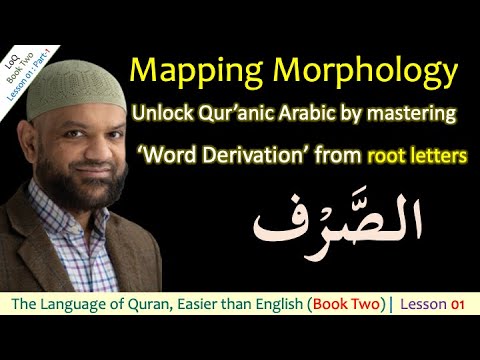 Click to play
Introduction
This is the opening lesson of Book Two, which takes the map introduced in Book One and adds a new dimension: the science of Arabic morphology (الصَّرْف). In Book One the focus was on how words combine into phrases and sentences — the مُرَكَّب تَوْصِيفِي، مُرَكَّب إِضَافِي، الجُمْلَة الاِسْمِيَّة and so on. Book Two deepens that study by looking at how individual words themselves are formed from root letters, and how recognising that structure unlocks hundreds of words at once.
The instructor opens by revisiting the three-type map: every Arabic word is an اِسْم (noun-plus), فِعْل (verb), or حَرْف (particle). Sentences are either الجُمْلَة الاِسْمِيَّة (beginning with a noun) or الجُمْلَة الفِعْلِيَّة (beginning with a verb). Book Two will complete the study of الجُمْلَة الفِعْلِيَّة and introduce the science by which all verbs and many nouns are derived.
The central claim of this lesson is motivating: by learning a handful of scales and the ten doors (أَبْوَاب)، a student gains the ability to recognise and even produce hundreds of Arabic words from a single root. The lesson is an overview — a road map — not a detailed grammar rule yet.
Lesson Notes
The Root System
99% of derived words in Arabic come from three root letters. These three consonants carry a core meaning. Every word derived from them preserves some connection to that meaning.
The scholars of Arabic use a template system: the letters فَ، عَ، لَ (Fa, `Ayn, Lam) stand for the first, second, and third root letters respectively — exactly as x, y, z stand for unknowns in algebra. This system is called the مِيزَان الصَّرْفِي (morphological scale).
Every derived Arabic word (verb or noun) is formed by placing three root letters into a fixed scale (وَزْن). The scale determines the vowels, any added letters, and the grammatical meaning of the result.
Example: the root ك–ت–ب
The root ك، ت، ب (k–t–b) has the basic meaning "to write." From it, the scale system produces:
| Scale result | Meaning |
|---|---|
| كَتَبَ | he wrote (past tense verb) |
| يَكْتُبُ | he writes / will write (present-future verb) |
| اُكْتُبْ | write! (command form) |
| كُتِبَ | it was written (passive past) |
| كِتَابٌ | book (verbal noun category) |
| كِتَابَةٌ | writing (masdar) |
| كُتُبٌ | books (plural noun) |
| كَاتِبٌ | writer (active participle) |
| مَكْتُوبٌ | letter / that which is written (passive participle) |
| مَكْتَبٌ | office / desk (noun of place) |
| اِسْتِكْتَابٌ | dictation (Form X masdar) |
All share the root meaning "write." The scale tells us the grammar; the root tells us the meaning.
The Ten Doors (أَبْوَاب)
When a three-letter root is conjugated, it passes through one of ten doors (أَبْوَاب — verb forms, numbered I–X in Western terminology):
- Form I (بَاب وَاحِد) — called مُجَرَّد (bare): only the three root letters with vowels, no added consonants. This is the most common and most important form.
- Forms II–X — called مَزِيد (augmented): additional consonant letters are added to the root, each addition producing a nuanced change in meaning.
Form I (مُجَرَّد): root letters only — no additions. Forms II–X (مَزِيد): root letters plus one or more added consonants, each producing a distinct nuanced meaning.
Frequency in the Quran: Form I is the most common, followed by Form IV, then Form VIII, then Form V. Learning just these four covers the overwhelming majority of derived verbs in the Quran.
Verb Tenses Derived from the Root
From the root passing through a given door, three primary verb forms are produced:
- اَلمَاضِي (al-maadi) — the perfect tense: action completed or certain to be done
- اَلمُضَارِع (al-mudaari`) — the imperfect tense: present, present continuous, or future
- فِعْلُ الأَمْر (fi`l ul-amr) — the imperative: command form
- فِعْلُ النَّهْي (fi`l un-nahy) — the prohibitive: do-not form
Each of these also has an active form (مَعْلُوم — doer known) and a passive form (مَجْهُول — doer unknown).
Noun Categories Derived from the Root (اَلمُشْتَقَّات)
Morphology is not only about verbs. Key noun categories derived from roots include:
| Term | English name | Example |
|---|---|---|
| اِسْمُ الفَاعِل | Active participle | كَاتِبٌ — writer |
| اِسْمُ المَفْعُول | Passive participle | مَكْتُوبٌ — written letter |
| الصِّفَة المُشَبَّهَة | Resembling adjective (inherent quality) | كَرِيمٌ — generous |
| اِسْمُ التَّفْضِيل | Superlative | أَكْبَرُ — greater/greatest |
| اِسْمُ المَكَان/الزَّمَان | Noun of place or time | مَسْجِدٌ — place of prostration |
| اِسْمُ الآلَة | Noun of instrument | مِفْتَاحٌ — key (instrument of opening) |
Three Types of Nouns by Origin
| Type | Definition | Examples |
|---|---|---|
| جَامِد (jaamid) | Not derived from any root; not the source of derivation | شَمْسٌ (sun), قَمَرٌ (moon), حَجَرٌ (stone) |
| مَصْدَر (masdar) | Verbal noun — the action expressed without tense; considered the source of all derived words | كِتَابَةٌ (writing), نَصْرٌ (helping) |
| مُشْتَقّ (mushtaqq) | Derived words — verbs and nouns derived from the masdar/root | كَاتِبٌ، مَكْتُوبٌ، كِتَابٌ |
Sound vs. Irregular Roots
Not all roots behave identically. Roots are first classified as:
- صَحِيح (saahih) — all three root letters are standard consonants
- سَالِم (saalim): no hamza, no doubling, no weak letters — follows the standard conjugation with no variation
- مَهْمُوز (mahmuz): one root letter is hamza (e.g., أَكَلَ، سَأَلَ، قَرَأَ)
- مُضَاعَف (muda``af): second and third root letters are identical (e.g., حَجَّ، حَبَّ)
- مُعْتَل (mu`tal) — one or two root letters are waaw (و) or yaa' (ي):
- مِثَال (mithaal): weak letter in the Fa position (first root), e.g., وَجَدَ
- أَجْوَف (ajwaf): weak letter in the `Ayn position (second root — "hollow"), e.g., قَالَ، بَاعَ
- نَاقِص (naaqis): weak letter in the Lam position (third root), e.g., رَمَى، دَعَا
Study order: begin with سَالِم (sound roots), then مُعْتَل (weak roots — مِثَال، أَجْوَف، نَاقِص). All conjugation rules learned for سَالِم apply across all types; weak roots simply have phonetic variations on the same pattern.
Summary
- Arabic morphology (الصَّرْف) is the science of how three root letters are placed into fixed scales (أَوْزَان) to produce hundreds of verbs and nouns, all connected in meaning to the root.
- There are ten verb doors (أَبْوَاب I–X): Form I (مُجَرَّد) is the most important; Forms II–X (مَزِيد) add consonants and introduce nuanced meanings.
- Every verb can be active (مَعْلُوم) or passive (مَجْهُول) and appears in three primary tenses: perfect (مَاضِي), imperfect (مُضَارِع), and imperative (أَمْر).
- Key derived noun types to focus on: مَصْدَر، اِسْمُ الفَاعِل، اِسْمُ المَفْعُول — these appear most frequently in the Quran.
- Sound roots (سَالِم) are studied first; all rules apply equally to weak roots (مُعْتَل) with only phonetic adjustments.
- Learning one verb from a door gives the pattern for every verb that passes through the same door — a single root can yield over 140 conjugated forms.
Terminology Reference
| Arabic | Transliteration | Meaning | Type |
|---|---|---|---|
| كَلِمَة | kalima | word (any single meaningful unit of Arabic) | ISM |
| جُذْر | judhur | root (the three consonant letters from which words are derived) | ISM |
| وَزْن | wazn | scale / pattern (the template applied to root letters) | ISM |
| بَاب | baab | door / form (one of the ten verb forms in morphology) | ISM |
| مُجَرَّد | mujarrad | bare / Form I — root letters with no additions | ISM |
| مَزِيد | maziid | augmented / Forms II–X — root letters with added consonants | ISM |
| مَصْدَر | masdar | verbal noun — expresses the action without a tense | ISM |
| اِسْمُ الفَاعِل | ism ul-faa`il | active participle — the one who performs the action | ISM |
| اِسْمُ المَفْعُول | ism ul-maf`uul | passive participle — the one who receives the action | ISM |
| سَالِم | saalim | sound root — no weak letters, hamza, or doubling | ISM |
| مُعْتَل | mu`tal | weak root — contains waaw or yaa' as a root letter | ISM |
Linked Arabic terms open their full entry in the Arabic Grammar Guide.
📖 Grammar guide. Grammar terms are explained in the Arabic Grammar Guide — fully vocalised, searchable in Arabic, any transliteration, or the English meaning.
Lesson Transcript
Read the full transcript (9,000 words)
Auto-generated from the lesson video. Timestamps jump to that point in the video. May contain transcription errors.
0:00 Assalamu alaikum, welcome to book 2, lesson 1. In this lesson, inshallah ta'ala, we're going to map out what's called morphology, a science in the Arabic language or the study of the Arabic language. You should already be familiar with this map, which we went through in detail in book 1, where I introduced you in session 1 to this map. In a brief summary, we said that in Arabic, every single meaningful word is called a kalima and it can be only three types. Every word in the Arabic
language will either be an ismun, fa'ilun or harfun. And they come together, now not randomly, but within set rules. They come together within very strict set rules to form what's called a construct. By construct we mean two or more words coming together to give us additional meaning. Not random words, but they come together in a strict way, in a precise way to give us additional meaning. Now that construct can be of two types.
1:01 Either it is complete, by that I mean a sentence, or it is incomplete, by that I mean a phrase. So for example, if I say, this pen, that is not a sentence, I'm just saying this pen. Even though this pen means something, but the idea is not complete.
1:16 Whereas if I say, this pen belongs to the student, now that's a complete sentence. So that's what we mean by phrase, incomplete and complete. Again, refer back to the previous sessions if you're not familiar, and if you've just landed here, I do strongly advise you to watch the videos in the previous playlist, Insha'Allah Ta'ala, where you'll find the full session. So let's continue. In Arabic, there are only two types of sentences. A sentence will either be a nominal sentence, called Jumla Ismiya, or a verbal sentence
called Jumla Fa'iliya. So please note these two points. Either the sentence will begin with an Ismun, therefore it will be called a Jumla Ismiya, or a Fa'ilun, in that case it will be called a Jumla Fa'iliya. Now that's all it is, but in English it's quite significantly different for us. As we know in English, we tend to start all our sentences with the subject. So when we translate either of these two types of sentences, we will begin by the subject. This is normal. So you have
to realise the difference between the two, and the first way to do that, of course, is to recognise three different types of words. So these are the two types of sentences in Arabic. And of course, phrases are many. Five that I wanted to focus on was the descriptive phrase, Muraqqab Tawsifi, the pointing phrase, Muraqqab Ishaari, and Muraqqab Jaari, and of course, Muraqqab Idaafi. Now these alone, Muraqqab Jaari and Muraqqab Idaafi, we believe, we studied them in Lesson 8, 9, 10, and 11. They gave you, at
the end of the lesson, the ability to recognise something in each line of Quran.
3:00 Even Muraqqab Jaari, I mentioned to you, nearly 13,000 times they occur in the Quran, and there are only 9,000 lines in the Quran. So after you've done Lesson 8 and 9, you should be able to recognise something in every line of Quran. After you've done Lesson 10 and 11, where we focused a lot, you should now be able to recognise something in every line of Quran.
3:20 So what is missing, as a bulk in our study, to get even further in our study from Book 1? What's missing is really a more detailed look at Jumla Fi'aliya, and a new science, which we have not studied, we briefly mentioned it, called Morphology. How the root letters in Arabic produce hundreds, if not thousands of words, which is linked back to the root. And this is the beauty of the Arabic language, you can call it the essence of the Arabic language or at least the science
by which you can recognise how different words with the same root have some connected meaning. Now as far as that science is concerned, it is primarily focused around verbs but also includes nouns. Ismun and Fi'alun, of course Asmaa in plural, and Afaal for verbs in plural. So this is where the bulk will be. Of course we will introduce some more Huruf for you, and we will delve deeper in how the Jumla Fi'aliya works, how these things also come into the sentence, and also more importantly, if
you remember we mentioned before in Book 1 that there are only two reasons for something to be Majroor Jarr, and they were Muraqab Jari, Muraqab Idaafi and we mentioned a number of reasons why something is Rafa but we only really looked at only one or two reasons, or actually three where an Ism is Nasab, when it becomes Nasab. So in this book, we are going to look at all the different types of Mansoob, the reasons for something to be Nasab Insha'Allah Ta'ala in this session. So
we have a lot to learn in this course in Book 2, and again we need to seek the help of Allah His mercy and His forgiveness. A. To give us the ability and the determination and the purity of intention required for us to complete the course, and of course I ask for your Dua, Allah give me the Tawfiq and the ability to complete this session. I have been struggling to find appropriate resources and time to complete them, so I made the intention now Insha'Allah Ta'ala to
start. Now you are going to have lots of questions regarding book and all the other resources, please don't ask them in this session, I am going to put all the details in the description, as and when the book is ready, as and when the courses and things become familiar, where to download resources from, as soon as I can get them ready, Insha'Allah Ta'ala I will put them on the description so you can click on there and get them Insha'Allah Ta'ala. I am trying to bring those
resources also to you to make it easy, and of course also trying Insha'Allah Ta'ala if Allah wills, very soon to develop a course where you can study in more detail Insha'Allah Ta'ala. So let's continue but again I remind myself and you, keep on making Dua, asking the help of Allah Subhanahu Wa Ta'ala, and we are going to look at in this session in particular the mapping of Morphology One of the distinguishing features of the Arabic language is a science called Morphology. What that is, is really
a root system, you can consider them to be a sequence of consonant sounds, which come together in a particular frame, particular scale, to form Afaal, verbs, as well as many types of nouns called Asmaa, and they are literally derived from the root. So this is the science of Morphology, the morphing of the root to produce verbs and nouns. How does this work? 99% of the derived words, that is nouns and verbs, come from three root letters. Please note that three root letters.
6:56 So almost all the words you are going to come across, which are derived, will be from three root letters. There are a few of them used in the Quran also which are from four, but they are insignificant in terms of the number or the percentage. And there are very few, in the entire language some scholars say less than a handful, which are five root letters. So when I say root system, we are going to focus primarily on three root letters. There really isn't any need to
even focus on four root letters, because there are only few of them and the good news is, all the rules that you learn that apply to three root letters, also are applicable to all types of derived words. So when I say root, I'm talking about three root letters. And that's going to give you overwhelming majority, and all the rules will follow one after the other. So what do we mean by root letters? The scholars of Arabic, and I mentioned this in lesson 6 I believe, in
book 1, they use a scale system, and it's a very scientific system. If you can imagine, Fa, Ain, and Lam, to be x, y, and z in equation.
8:08 Of course x can have any value, y can have any value, and z can have any value. So they use this system of Fa, Ain, and Lam, and the Fa is considered to be the first root letter, Ain the second, and Lam the third. So these are your three root letters. What vowels the Fa will take? Will it take a Fatha, Dhamma, or Kasra? Zair, Zabor, or Pesh? What, or Sukoon? What the vowel that Ain will take, or Lam will take, whether it is Fatha, Dhamma,
Kasra, or Sukoon, depends on a prefixed scale. This is important, it's not random. So when the words are derived, they will go through a system, and that will tell us what the vowels should be, and should there be any additional letters with it. What that means is that if I study the scale only, then I can recognise thousands of words, which follow the same scale. And you'll see that Insha'Allah very soon. So learning vocabulary becomes a breeze if you spend a little bit of time being
patient, understanding how the root system is morphed, I'm going to use this English word morph, meaning changed, by adding things to it to produce our verbs and our nouns. This is the most important point Insha'Allah, if you get that, then the rest is relatively easy. So each derived word maintains a connection, this is very important, in meaning to the core meaning of the root letters. So whatever the three consonants we mentioned before, that has a basic meaning.
9:44 Every derived word from that root must have some meaning in connection to the root. You can't just randomly translate the word, there will be some link with the root meaning of the word. So we need to identify the root, that will tell us whether it is a verb, what type of verb is it, what type of noun it is, or a description etc. So this is the key Insha'Allah, the root system gives us the meaning and the way the root comes together, morphs, tells us the
nuanced meaning. Meaning whether the verb is a past tense, present tense, future tense, command form etc. Whether it is a descriptive noun or an active participle and all of these technical words. But don't worry about all of these things Insha'Allah, these are the three key points that you need to note about morphology. So in conclusion, the root system is fundamental to the structure of the Arabic language, as it allows for the creation of hundreds of words through a systematic pattern known as what we are going
to call a scale, we are going to look at that later Insha'Allah. So there will be a fixed scale, and these scales are relatively easy to learn. If you just do one or two examples Insha'Allah you will be able to retain and recall them very very easily. This saves you learning hundreds of words, because if you just know the scale, you can easily say okay this is this, this is that, the root meaning is this, therefore it means that. That's basically what I'm trying to say
here. So these patterns apply specific vowels and or consonants. So not only vowels, but there could be additional letters within the scale itself to the root letters. Generating derived words with different nuances, meaning slight different meanings, and grammatical functions. So this structure, this scale will tell us all that we need to know about the word, and the root will tell us all we need to know about its meaning, its basic root meaning. All that may have sounded quite elaborate, so let's look at an example Insha'Allah,
it will make sense. So we have here on the screen kaaf, taa, and baa. These are three consonants sound. Kaaf, taa, and baa. Now we know these three of course, and it has a basic meaning to write, and I'm only using as illustrative examples Insha'Allah, so to write. That's the basic meaning. When it is used to derive into a certain scale, so when I have it in this scale, kaaf, taa, and baa, it means he wrote. But if I change it to yak tubu, yak tubu,
by adding a yaa in the front, putting a sukoon on the first root, and of course damba in the other two you can see it becomes yak tubu, he writes.
12:28 If I then change it again, and I write uqtub, again you can see the change, I've highlighted in red, uqtub what does it become? Write. I'm commanding you to write. So of course you can guess, this is the past tense, this is the present or future tense and this is write. Me telling you to write. So you can see here how it's changed. Qutiba, it was written. So this is the passive form of the verb. Kaataba, he exchanged in writing with someone. Kaataba.
13:00 Iqtataba. You can see here, I've got an i at the front, and I've got taa in the middle between the root, it becomes he wrote himself. If I then change it and add something else in the front, I've got ista, ista and istaktaba, he sought writing. He sought some written information or something like that. So he sought writing. So you can see here, from here, kaataba I'm adding things to it, and I'm forming completely different words but these are not random shapes. Each one has a
specific scale that I must conform to. Now of course there are only 1, 2, 3, 4, 5, 6, 7 odd examples here but literally there could be several hundred verbs produced from kaataba all following the same root with some nuance change in the meaning depending on the scale. And this is what we mean by sarf. One of the biggest misunderstandings people have of sarf or morphology, they think when they begin, and that's why they cause this confusion, that it's only verbs. No, it is not verbs.
Also, number of categories and types of nouns. Again, don't worry, we're going to go through this in detail, this is just an introduction. So I take kaaf, taa, and baa, and I have kitaaab, you should be familiar with this word, book. Kitaabatun, writing. Again, you should be familiar with this word. Kutubun, you should be familiar with this word, books. Kaatibun, writer. Somebody who writes. Maktubun, that which has been written down. Okay, which is, for example, a letter. And maktabun, a place of writing. Again, an office
or a desk. And we have istiktaabun, dictation. When I'm dictating something, you're writing it down. I put purposely tanween at the end to show you that these are actually nouns. So it's not only verbs but a significant number or different categories of nouns are derived from the root letter. And this is only an example of kaaf, taa, baa, only a glimpse, just to show you. But one thing you'll note, that in all of them, there is some link in meaning to the base meaning of the
root letters kaaf, taa, baa, which means to write. Now you'll have hundreds of questions I know in your mind, how do we know and all of this stuff. Don't worry, relax. Inshallah we're going to explain everything at the beginning, have an overview. If you go too deep at this stage, you're going to lead to confusion for yourself.
15:30 So kaaf, taa, baa is the root from which hundreds and hundreds of verbs can be derived. Hundreds and hundreds of different nouns can be derived or descriptive words can be derived, etc. But they all link in some way to the root meaning. Of course there could be more than one root meaning depending on the root, etc. how it's been used in the Arabic language, but they will conform to certain scales. And this is what I meant earlier with all the text that I wrote.
15:57 So I hope this part, Inshallah Ta'ala, is motivating and encouraging you that this is a science, it's a very strict methodology, all we need to do is take the fruits from it, just learn the most essential to be able to apply it in our studies. So as mentioned earlier, there are only three types of words in Arabic and I'm sure you know what these are. Verbs, and we call these nouns or technically noun plus because it includes adjectives, etc.
16:25 and Al-Huroof or particles, okay, so you know these already. Please note, as far as morphology is concerned, Sarf all the verbs you're going to come across are derived. All, okay, derived. So there is no worry about that. And again, as I mentioned earlier, almost all of them you're going to study in Book 2 are going to be from three root letters. Then Al-Asma, depending on the category, so not all, okay, not all are derived. Categories of them are derived. So you can't say every ism is
derived from the root. Don't worry, I'm going to explain to you this, how that works, but there are certain words in Arabic that are not derived, they just are named, just like somebody in English decided to call this pen, so we call it pen. Maybe it's come from another language or another use, but pen. Like in Arabic, you have like the word sun, etc. Not all words are derived, but it's very easy to recognise derived words because they form or they conform to a certain scale.
17:33 No Huroof is derived, okay, no Harf is derived. None of the Huroof will ever be derived. So derivation really is a science of studying verbs and some categories of Asma. Okay, just note that point. Don't even look when it comes to a Harf, whether it's derived or not. And with a verb, yes.
17:54 With a noun, you'll recognise them from the scale, so don't worry about which one is, which one isn't. You don't need to know this information. Once you've learned the scale, you'll be able to recognise them and get the meaning relatively easily, Inshallah. Conjugation of verbs. So what do we mean when I say conjugate? It's a very simple concept. What I mean is how the three root letters morph or change by adding vowels by that I mean Fatha, Dhamma, Kasra, Sukoon, or additional consonant sounds or letters
to form or conform to different scales to form new words. And these could be verbs as well as, of course, nouns. Now the important point here is that this is not random. What the past tense will look like, what the present tense will look like, what the command form will look like, what the nouns that are derived or Asma will look like depends on which pattern it follows, which form it follows.
18:57 Now this form in Arabic is called a Bab. So you've got your three root letters. They will go through what is called a Bab. Now Bab in Arabic literally means door. You should be familiar with that. That's what those scholars have used.
19:09 So you can imagine there's a door. The root goes through that door. And it is this door, and we can give it many names. I'm going to use the one that is used by Western scholars of Arabic grammar which they have formed. And it's the one used in the most common dictionaries. So Form 1 for example, they call it Door 1, Form 1. It will dictate if the root goes through Form 1 what it should be. So Form 1 has other scales also which is there
on the screen for you. Please don't worry. I know you're going to get hundreds of questions coming to your head. Just relax. All of these points will be discussed in detail, Allah give Tawfiq, in the forthcoming lessons. So when the root goes through Door 1, it will dictate to it what the verbs that are derived should look like and what the nouns or Asma that are derived should look like. And not only one door, we have other doors also. And these are numbered all in the
Roman numbering system 1 to 10. Again if you ask me are there more than 10, yes there is. Some scholars say up to 17 but it is absolutely no interest to you and I. Even those advanced scholars who are studying classical, maybe it is of interest to them but not to you and I. Our goal is to keep the journey simple and give us the majority so we can begin to appreciate the Quran and of course advance to Hadith and other things. So if you learn
just these, and again not all of them are more important than the others, a few of them are only rare occurrences, but the bulk of them that's all you will need in order to recognise a significant number of words. I would put my neck on the line and say almost 85-90% plus of the words you are going to come across. So please don't worry about it. So what you see in Arabic is the scale. What the scale will be of the past tense and then it
moves on. We will explain that as we go along Insha'Allah in the forthcoming lessons. So phone 1 has a name in Arabic. It is called Mujarrad. Mujarrad means alone, bare. Meaning there is no consonants added to the three root letters, only vowels. No addition.
21:09 Simple, bare. And that is called form 1. Then form 2 to form 10 is called Mazeed which means additional. Meaning not only are the three root letters there but there is something added to the root letters to give additional meaning. So this is Mazeed. So that's how it is divided. And I will explain Insha'Allah in some detail here.
21:31 So 1 and 2, 3, 4, 5, 6, 7, 8, 9, 10 All you need to know is which root has gone through which door and that you can form hundreds of words yourself. That's how amazing it is. Again, you may want to ask how do you know which one goes where? Very soon you will recognise them. So that's not the difficulty. But if you are impatient you can look in the dictionary and it will tell you. So that's all you need Insha'Allah. So what is derived
are a series of verbs and a series of noun plus descriptive words etc. etc. Asma' and Afaal. That's what is derived. No huroof. So this is how we are going to study Insha'Allah. We are going to look at this science and we are going to look at how it applies to the verbal sentence in particular but also Insha'Allah how the other phrases and so on interact in these structures. So in terms of derivation of verbs or conjugation of verbs from the root. The first thing to
note is that we will get the past tense. Al-maadi Al-maadi. And we will get the present and future tense which is called Al-mudare and we will get the command form. There are others but these are the key.
22:43 From there other things are subdivided so I don't want to clutter the diagram too much for you. So we have 3 primary tenses of the root. What will it look like when it's the past tense? What does it look like in the present tense? What does it look like when I command somebody to do something? Imperative form. And that's it. Now once you know that Insha'Allah the scale you can form any other root that goes through the same scale or same door. You can form them
very easily. But of course our job is not really forming them. It's to recognise them. So recognition becomes very easy. But anyway all you need is one example and Insha'Allah we will demonstrate that from the next lesson onwards we will start with the past tense. The past tense can be of 2 types. Past tense is also called the perfect tense in Arabic. I will explain in next lesson Insha'Allah. But the verb can be active or passive. Active or passive. I will explain very briefly. Al-ma'loom and
Al-majhool. Now what is the difference? Ma'loom is when you know who's done the action. For example if I say John, he the bird ate the bread. So you know who ate the bread. It could be John, it could be he or it could be the bird. Something ate the bread. So I know the doer very clearly declared in the sentence. If I don't know who ate the bread I will say in English the bread was eaten. The bread was eaten. This is called passive. I don't
know who did the action but I know the act was done. So where the doer of the verb is not clear this is called passive. That's all it is. But the scale will tell you what it should look like in Arabic. Mudar is the same. It's called the imperfect tense i.e. an action not complete. So it could be present, future or present continuous tense.
24:30 Same thing we get. We get the active and the passive form. Two different types from the scale Insha'Allah. And we also have the imperative which is a command for do or don't do which is called the prohibitive. So these are all derived from the root letters. The first one and then you conjugate from there. If you know which door it goes through you can form all of these relatively very easily. Let me give you one quick example. Fatha in Arabic means he opened. Whereas Futiha means
it was opened. I don't know who opened it. He opened the door. The door was opened. It was opened in the morning. I came in. The door was opened. So these are the two different scales. And then Yaftahu he opens or he will open. And Yuftahu means it will be opened or it is opened. That kind of meaning in the passive form where we don't know who did the action. Command Iftah. I'm telling you to open the door for example. La taftah. Don't open. The window
is cold. So la taftah don't open. So this is how it works. Now how do I know it should be Fataha not Fatiha or Fatuha or Futuhu. Whatever it is. Because it will follow a door. Which door does it follow? So let's quickly look at it follows the first door. Form 1. If I know that I know that it should be Fataha. If I know it's Fataha I can now conjugate 14 verbs variation from that root. This is what the science is. 14. One for each
pronoun that we learnt back in lesson number 5 in book 1. So there will be one version of each verb derived from the root. As long as I know which door it is I can make them because they follow a strict rule. Then we have the passive form. Again another 14.
26:35 Then we have the active form of the present and future tense. Again from the root. Then we have Majhool which means of course the passive form of the present and future tense. Then we have the command form and we also have the prohibitive form. Now if you were to count up these you will see that I've got 14 here 14 here, 14 here 14 here and 6 and 6 and this is only a glimpse of what you can produce. So you can see literally I can
get to close to hundreds of words simply by knowing which root I'm dealing with. So in this case I'm dealing with the root Faa I'm dealing with the root Taa and I'm dealing with the root Haa because I know it goes through door 1 this scale I just simply conjugate hundreds of words in Arabic from that scale. And that's how easy conjugation is and you're going to learn each of these. So relax now all of these we are going to go through lesson by lesson developing
but we are not just going to learn how to conjugate we are going to learn how to use them in sentences. This is more important than learning the science of this. How to use them, how to recognise them, how to translate them. So all I wanted to do is give you an overview of the conjugation of the verbs from the root depending on the door. Of course it would be completely different if it went to door number 2 3, 4, 5, 6, 7, 8 9 or
10. But the good news is whatever the conjugation rules are they are equally applied to all of them. So whatever the suffixes are added to the end or the prefixes the same ones apply all the way across. And this is significant because we will begin to appreciate and recognise verbs right from the first few lessons inshallah ta'ala and our learning will accelerate. I will give you some statistics about how frequently these are used in the Quran inshallah ta'ala. Derived nouns. As far as noun derivation is
concerned we can divide them into 3 groups. The first being Jaamid and these are words that are not derived from any root nor is any word derived from it. A few examples Shams which is sun, Qamar moon Hajar stone and Shajarah nouns sorry trees. These are all categories of nouns So these are words and there are many many more that are considered not to be derived at all from any root system. So you just simply learn them as you come across. The next one which is
very important for our study is called Al Masdar. Masdar is the verbal noun in English. Closest to the verbal noun and it is also known as the source. According to scholars that the words are actually derived from it. This is the word from which the words are derived. In terms of very simple understanding it gives the meaning of an action without a tense. So it describes the action that is mentioned in the root but without a tense so it is not a verb it is actually
an ismun. So Masdar is very important. An example Kitabatun which means to write Kitabatun to write. So again you can see Kaftaba in the root and it is a noun. And then we have Ta'aleem or Ta'aleemun education, learning education again from the root Ainlamim and then Nasrun which is to help. Noon, Saad and Ra So these words are Masdar or the verbal noun and it is considered to be the source, the root from which all words are derived. So this is one category of nouns or
Al Asma which has the root embedded in it.
30:32 Then we have the main category that we are going to be looking at in this course which is called Al Mushtaq. Now Al Mushtaq are nouns that are derived from the root. So when we say Mushtaq we are talking about of course words that are derived but primarily we are talking about nouns even though verbs are also considered to be the same category.
30:53 Now they are derived from the root and unlike the Jamid which stand alone derived words form a part of a large group of words which are relatively easy to recognise and that is what we are going to be looking at Inshallah which all share the same root and of course the different meaning, a common root meaning. Example, we got the root Kaaf, Taabaa as an example Kaatibun which means a writer, Kitabun a book, Maktubun, letter or something written down So all these plus hundreds more are
all derived from the root. So they are derived words and this is the definition of the three. We are going to take a brief look at the second one and with the Masdar we do not need to worry as we will be learning them as we go through the Babs Inshallah each verb will have a Masdar version. For form 1 which is the door 1 they are not predictable, they don't conform to a fixed shape but from 2 to 10 they are very easy to recognise
and each door has its own specific pattern which they strictly follow. So our focus will be Masdar with form 1 and Mushtaq in general we will look at Inshallah Ta'ala. Now in terms of Al-Mushtaq we have now the following. So first of all there are quite a few of them here only for example purposes the ones that are yellow these are the ones we need to focus on and we will be focussing on at the beginning Inshallah. The others will be briefly mentioned as we come
across them. So the first derived noun category is called in English active participle Ismul Fa'il which literally means the noun of the doer meaning the root letters the person doing or the noun that does the action is the name that's given here so it's active participle. A few examples Inshallah Ta'ala will make sense. So Kaaf, Ta and by again example Kaatibun, writer, the one who writes. So this is the noun of the doer of the root mentioned Nasirun, helper, the one who helps Nunsadra is the
root, the one who does the action is called Nasirun of course you can tell that these are nouns because I put Tanween on purpose at the end Shakirun, the one who thanks, the one who does the act of thanking and there are many more examples. So in form 1 they follow this pattern and they're very easy to recognise Inshallah and this is called the noun of the doer. I call it very simple term but in grammar it is called active participle. The second one is called
the noun of the object or passive participle. Again example will make it easy for us to understand is the one that receives the action mentioned in the root. So for example Maktubun, that which is written down. Maktub that which is written down. Mansur, the one who is helped before we had Nasir, the helper, this is Mansur, the one who receives the help. And of course we have Mashkoor here another example, the one who is thanked. So you'll find many many words of this shape which all
denote the passive participle in effect the noun of the object. So what is the difference? For example in English if I said John kicked the ball so the one who is doing the action of kicking the ball or kick the ball in the past tense is John. So he will be the doer of the action the ball itself will be the one that receives the action. That's basically how it's understood. These are the three, the Mastur plus these two are going to be very commonly, you'll
come across most common. The others let's take a brief look at them just for illustration purposes. Next we have the resembling adjective. Now what that basically means is the thing that has the inherent quality of the root that is mentioned. Let's look at a few examples inshallah. Kareemun means generous so the root Kaaf, Ra and Meem has something to do with nobility generosity etc. So Kareemun is the one who has that quality as a permanent quality in them. Jeem, Meem and Lam, again the root meaning
beauty. Jameelun beautiful, the masculine version. Jameel beautiful Then we have the superlative now we have them in English of course, in Arabic they follow a strict pattern. So for example Akbar, now you know this word already. Allahu Akbar which is read out in the Adhan, bigger or biggest. So you have tall, taller tallest, big, bigger, biggest. Small, smaller smallest. So these are called superlatives. So superlatives in Arabic conform to this form from the pattern that we see on the screen. So another example Asghar, again small,
smallest. Atwal tall, taller, tallest. Example again Atwal, taller, superlative than the other. So they follow this pattern again this one pattern that we will be studying Then we have the noun of place and time, or place or time I should say. An action that takes place within a specific space or time. Has a specific shape, again depending on which door it goes through etc. So Maqtab, Maqtab place of writing, where writing takes place is the name given to office Masjid, where Sajdah takes place, place of
doing Sajdah and of course we have one more example Maghrib it can be time or place where the sun sets or the setting is done. So west is another meaning of this word sunset and west. So both meanings are there and of course some of you may already know Morocco is known as Al Maghrib the west. So this is again another type a category of noun that is derived from the root Last example Insha'Allah which is quite interesting a noun which describes the instrument with which
the action mentioned in the root is done. There are a couple of scales for this, just again we will use a simple example. Miftahun, or Miftah which in Arabic means key. So of course the root is Fatha which means to open. So Miftah, the instrument with which you open. Again Kaf, Nun and Sin gives it the meaning of sweeping. So Miqnas means the broom. So you can see here the idea that once we learn these systems, when we recognise a word of a particular scale we
can recognise that it belongs to this category and get more of a nuanced meaning. All I want to do here is just to show you the possibility of derivation. Again I repeat this is for illustration. We are going to focus on the three coloured in yellow and therefore they are the more important ones. These other ones we will do later as we have done all the conjugation first. Then we will pick a few of these up Insha'Allah to complete our lessons. So on the screen now
you can see at the top the nouns and in the bottom section you can see the verbs which I briefly mentioned to you already. So the possibility of the root producing hundreds and hundreds of words from one root, sorry three root letters branching out. So you can imagine it is like a tree with three main roots big branch coming and then splitting into different branches, sub-branches etc Each and every word that is derived from the root will have some connection to the root meaning that is
given from the three root letters. And this is the key to understanding. Of course the root can be just the basic one which is form 1 or Mazeed extra with additional consonants and we will be studying them in these groups Insha'Allah. So group 1 which is the most important group 2 to 10 and then Insha'Allah these are called Mazeed you will get an overview. The good news as I repeat again do not be daunted by this if you learn one derivation very well you will see
all the rules that you will pick up will also be following in the other Babs as well. There is no major differences between them except for the template which you have to recognise. After you have done one or two examples of each Insha'Allah you will be able to recognise them relatively easily. Irregular Roots We have already noted that the three root letters Pa, Ain and Lam they go through one of the ten doors and of course depending on the door they go through there will be
certain scale for the verbs and a certain scale for the nouns that are derived Now there is one very important point is that when the three root letters either the first, the second or the third has an irregular letter, irregular sound. So what do we mean by that? Well basically if any of the root letters has Waw or Ya, Waw or Ya they are called weak verbs and hence the pattern can change. That is depending upon the vowel structure that is there. Also if any of
the roots has Hamza either in the first root letter, second or third there could be some changes to the scale. Also if two of the root letters are doubled etc. So this we need to focus on a little bit as there are many many common verbs that are used in the Quran, in everyday Arabic, in Quran and Hadith which are known as irregular verbs, weak verbs, hollow verbs etc. So here I am going to just give you a brief overview so that you are aware not
only do we have to learn the patterns they go through also sub-patterns caused due to phonetic reasons when we have an irregular sound, be it a Hamza, be it a Waw or a Ya or if there are doubling of the root etc. So just make a note of the point, I am just quickly going to give you the categories of them Insha'Allah when the appropriate lessons come you will be aware of them and we will go through them in a structured way so they are not
as complex as most people make them out to be. So the first classification of the root is whether it is Sahih or not. Now what do they mean by Sahih? If it has a Hamza within any of the root letters or if the root letter is doubled, I will explain that in a second or if the root letter does not have a Hamza or doubling or Waw or Ya and that is called Salim Salim means sound and then the others have some changes. So they are
the first grouping. The ones that we are going to be learning first are the ones that are called Salim and that is all root letters that does not involve doubling, does not involve Hamza or Waw or Ya So this is the classical classification of irregular roots. Now of course if it has a Hamza in the first root letter example Akala, middle root letter Sa'ala and of course we have lastly Qara'a. Please don't worry about what they mean now just have an idea that Hamza can be
the first root letter, can be the middle root letter and the last root letter. I mentioned briefly at the beginning of book 1 when we went through the alphabet very briefly that Alif cannot be a root letter. Please note it is not Alif it is Hamza which can be a root letter. So Hamza can come in the beginning middle or end. If that happens then there will be some changes to the pattern and they will have a subgroup which we will look at Insha'Allah.
42:15 If on the other hand we have two sound letters but they are doubled. So here we have Ha, Jim, Jim, Hajja then we have Ha, Ba, Ba, Habba and there's quite a few of them. That will also lead to some changes in the conjugation. And of course in the sound one there will be no change. The sound root letters again I repeat are every root letter apart from Hamza doubling or Waw or Ya, they will conform to a standard way of conjugation and which is what
we are going to be tackling first. Now in terms of the root if it has one root letter or two maybe which is Waw or Ya, this is called a weak root letter weak root system. Don't worry about the terminology at this moment the weak letter can be a Waw or Ya at the beginning meaning the first root letter in the position of Fa we could have a Waw or a Ya in that case it is called Mithal and if it has Waw or Ya in
the Ayn position which is here, Waw or Ya it is called Ajwaf which means hollow. And then we have An Naqis this is where the Lam position has either Waw or Ya. So please note that Inshallah. So these are the three main possibilities. Either we will have Waw or Ya in the first root or the second root or the third root So for example here, please again don't worry about the meaning of this, just identify that the first root letter is Ya, Ya Sa Ra and
Wa Ja Da. So you can see here Ya the first root letter Waw as the second root letter. So we would expect some changes to happen in the conjugation. Ajwaf very very commonly used in the Quran. Two of the most common verbs in the Quran fall into this category So Qaf and you can see the Waw in the middle and Lam at the end Then we have here Ba, then we have the Ya, then we have the Ayn at the end So you can see there
is a weak letter in the middle Ajwaf which means hollow. And then we have Ra, Meem and then we have the Ya at the end. And Da, Fatha, Ayn of course and then we have Waw at the end. So you can have a weak letter at the beginning middle or the end. Meaning in the first root, second root or third root. Each one will have some variation Lastly there is a possibility of having two weak letters in the root. So for example Waw, Aaf and Ya
There's two weak letters. One at the beginning and one at the end You can see here one here, one there. Waw and Ya. Or we could end up with two weak letters in the middle, a second position and a third which you can see here. So we will go through some of them Our aim and goal really is to focus on what is the most common What is the most common verbs in the Quran? How are they conjugated? Learn how to use them, recognise them and
translate them. We don't really need to spend full 50-60 hours in doing a degree on this topic. You will see inshallah it's very very easy once you've learnt the standard form. If you don't learn the standard form and you go there, you're going to get confused So I've structured in a way that we will focus on the Salim first Then we will come here And then we'll pick up briefly these two Just as a variation after we've completed this section. And I'll explain to you why
because there's a number of times these verbs occur in the Quran. Ideally of course we should go to this root but this root is better because you can learn all the rules easily and then apply them with a variation because of phonetic reasons in these two camps inshallah And lastly let me share with you a summary and this is just statistics just to encourage you inshallah. So there are about 15,000 derived words from the door number 1 That means if we were to focus on learning
the most common patterns, we will be close to recognising thousands and thousands of words in the Quran based upon of course not only the verbs but also Asma, noun plus, we'll be able to recognise them. And out of them about 7,400 7,800 or so are non-sound, meaning weak. This is the reason for studying them. And of course the sound verbs are also almost half of them. So it's very important to learn both of them not just one, both. Again it looks complex and I believe because
a lot of people have jumped into this without going through the background and therefore they got confused. Inshallah I hope and pray that you will find the lessons interesting enough not only that but also engaging enough for you to be able to pick this up but again please don't be daunted by it, it is not as difficult as it may look from the outside. Now then we have the group 2 to group 10 or form 2 to form 10. Form 2 to form 10 is called
Mazeed. Mazeed means extra meaning you've still got the 3 root letters but there's some extra bits added to it. So you can see here on the scale, don't worry I'm going to go through each one in detail, the ones that are important for Quran. And then the form 1 is called Mujarrad. Mujarrad means alone or bare, meaning there's nothing else added to the root in the base form. So in the 2 to 10 there will be something added and of course the classic example is the
last one which you can see has here it has a seen and the beginning with Hamzatul Wasal at the front. So you can have 3 additional letters there which are addition to the root and after that the root comes. So these are the forms what happens is every time a root has addition there is more nuanced meanings. So each group has it's own nuanced meanings, sometimes 2 or 3 types and you will see the same root going to different Babs giving different meanings. So these are
all things that are advanced but they're relatively easy once you understand how the root system works. So Inshallah I'll conclude part 1 or lesson 1 part 1 now and then there will be a separate video uploaded soon which will have the part 2 of lesson 1. I was afraid of making the video too long and also cutting out too much. So I had to do that balance. I hope Inshallah you appreciate it. If there is anything here looking complex, don't worry. Everything is going to be
studied in detail but my philosophy always is to give the students a clear road map and I hope Inshallah I've succeeded in doing that. What are we studying? Are we just learning random rules for the sake of it? No. Inshallah Ta'ala the example I studied with Kaaf, Ta'aba, you'll soon be able to understand how the root letters morphed into producing more and more words for us. Verbs as well as nouns and adjectives etc all giving us a slight nuance meaning but all of them connected back
to the root and this is the most important part that there is always some connection in the meaning with the root in the original Arabic itself and this is the beauty of what they call morphology how words change and construct are constructed in Arabic even if you don't know the basic meaning of these words or even if you did not know the root, just by simply looking at the scale by scale I mean where the root letters are which is relatively easy to recognise what are
the additions and what are the vowelings, how the vowelings been done you can immediately identify whether it is a verb, whether it is a noun, which type of verb is it, which type of noun is it and what are the nuanced meaning that comes as a result of this scale. So this is a wealth of information, wealth of knowledge which inshallah ta'ala will open up to us provided we follow a structured approach and we keep on making dua. Please note I keep on saying there is
a lot of people struggling with Arabic, myself included an important prerequisite really is our connection with Allah how much we are connected to the Quran and how much we desire to achieve these goals. If we are serious about our desire and we are working hard, Allah subhanahu wa ta'ala in his infinite mercy will open the door for us and inshallah ta'ala we will continue to strive and make dua, rabbi zidni ilma increase me in knowledge. May Allah bless you for watching may Allah subhanahu wa ta'ala
grant us all tawfiq to devote the necessary time and energy required to begin to learn Arabic to appreciate and understand the Quran. May Allah subhanahu wa ta'ala forgive our mistakes may Allah subhanahu wa ta'ala reward you for all your support, all your duas, all your messages continue to support us inshallah ta'ala and kindly remember us in your duas and please like, share and subscribe and also encourage your brothers and sisters, your fellow Muslims to learn Arabic to understand Quran. Until the next video, Assalamualaikum Warahmatullahi Wabarakatuhu
Test Yourself
After every lesson it is essential to test what you have learnt. We are working hard to produce the full set of resources for every lesson — thank you for your patience.
If you would like to support the production of content and the running of this site, you can do so on our support page.
Updated