Harf of Jarr — Introduction and the Preposition Min
Murakkab Jarri · Harf of Jarr · Attached pronouns · Min with all noun types
- Define the murakkab jarri (prepositional phrase) and identify its two components — harf of jarr and ism majruur
- Know that there are 17 haroof of jarr in Arabic, 11 of which are used in the Quran
- Apply the rule that any ism following a harf of jarr is always majruur — with no exception
- Form the murakkab jarri with munsarif, ghayru munsarif, mabni, dual, and plural nouns correctly
- Distinguish detached pronouns (always raf') from attached pronouns (nasb or jarr) and know when to use each
- Attach all 14 attached pronouns to the preposition مِنْ and produce the correct forms (minhuu, minhaa, minka, etc.)
Video Lesson
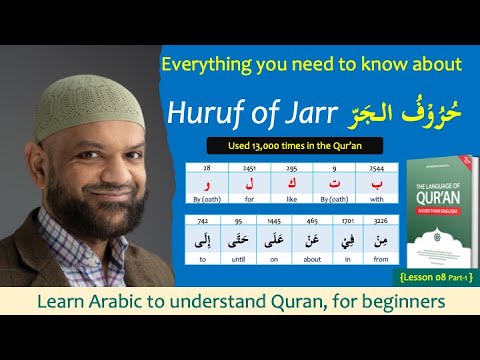 Click to play
Introduction
All the grammatical theory from Lessons 1 to 7 now meets its most practical application: the prepositional phrase (مُرَكَّبٌ جَرِّيٌّ). This single construct — a preposition followed by a noun in jarr — appears in the Quran approximately 13,000 times. That means you will encounter at least one on every single line of the standard Mus-haf (which has 600 pages, 15 lines per page — approximately 9,000 lines).
Lessons 8 and 9 are therefore among the most high-impact lessons in the entire course. After mastering them, you will be able to recognise something on every line of the Quran. This lesson covers all the theory of how the murakkab jarri works, works through the preposition مِنْ in exhaustive detail with every type of noun, and introduces a critical new element: attached pronouns — the second set of pronouns you need alongside the 14 detached pronouns studied in Lesson 5.
Lesson Notes
What is a murakkab jarri?
A murakkab jarri consists of exactly two elements, always adjacent:
حَرْفُ الْجَرِّ + اِسْمٌ مَجْرُورٌ = مُرَكَّبٌ جَرِّيٌّ (preposition) (noun in jarr) (prepositional phrase) Nothing may come between these two elements. The ism after a harf of jarr is ALWAYS in jarr — no exceptions.
Examples:
- سَلَّمْتُ عَلَى إِمَامٍ — I gave salam to an imam
- سَلَّمْتُ عَلَى الْإِمَامِ — I gave salam to the imam
The prepositional phrase (عَلَى إِمَامٍ / عَلَى الْإِمَامِ) is the murakkab jarri. It does not make a complete sentence on its own — it is a phrase (مُرَكَّب), a building block.
The 17 haroof of jarr — 11 used in the Quran
There are 17 haroof of jarr in Arabic. Only the 11 highlighted below appear in the Quran:
| Harf | Meaning | Used in Quran |
|---|---|---|
| مِنْ | from | yes — 3,226 times |
| إِلَى | to, towards | yes |
| عَنْ | from, away from | yes |
| عَلَى | on, upon | yes |
| فِي | in | yes |
| بِـ | by, with | yes |
| لِـ | for, to | yes |
| كَـ | like, as | yes |
| وَ (oath) | by (oath) | yes |
| تَـ (oath) | by (oath) | yes |
| حَتَّى | until | yes |
| رُبَّ | sometimes/many a | rare (literature/hadith) |
| حَاشَا | except | literature |
| مُذْ / مُنْذُ | since | literature |
| خَلَا / عَدَا | except | literature |
For this course, focus on the 11 Quranic ones. Lessons 8 and 9 work through each of them in turn.
A phonetic note on مِنْ
When مِنْ comes before a word beginning with a sukoon (i.e. with الـ), two sukoons meet and the rule of Arabic phonetics requires a helping vowel:
مِنْ + الْبَيْتِ → مِنَ الْبَيْتِ (fatha added to mim to avoid two sukoons meeting)
The word is still مِنْ — the fatha is just a phonetic helping vowel. Do not treat it as a separate word.
Forming the murakkab jarri — practice with all noun types
This table shows how مِنْ is used with every major category of ism:
Munsarif (fully declining):
| Type | With مِنْ | Translation |
|---|---|---|
| Indefinite masculine | مِنْ حَامِدٍ | from Hamid |
| Indefinite noun | مِنْ مُؤْمِنٍ | from a believer |
| Definite with الـ | مِنَ الْمُعَلِّمَاتِ | from the teachers (f.) |
| Broken plural | مِنْ كُتُبٍ | from books |
Ghayru munsarif (partly declining — no kasra in jarr):
| Type | With مِنْ | Note |
|---|---|---|
| Prophet's name | مِنْ إِبْرَاهِيمَ | fatha in jarr (NOT kasra) |
| Female name | مِنْ خَدِيجَةَ | fatha in jarr |
| Broken plural | مِنْ مَسَاجِدَ | fatha in jarr |
| Same + الـ | مِنَ الْمَسَاجِدِ | kasra returns with الـ |
Mabni (non-declining — ending does not change):
| Word | With مِنْ | Translation |
|---|---|---|
| مُوسَى | مِنْ مُوسَى | from Musa |
| هَذَا | مِنْ هَذَا | from this |
| الَّذِينَ | مِنَ الَّذِينَ | from those who |
Dual:
| Type | With مِنْ | Note |
|---|---|---|
| مُؤْمِنَانِ (raf') | مِنْ مُؤْمِنَيْنِ | dual changes to ayni in jarr |
| طَالِبَتَانِ (f. dual, raf') | مِنْ طَالِبَتَيْنِ | same rule |
| الْكِتَابَانِ (def. dual) | مِنَ الْكِتَابَيْنِ | tanween gone, ayni remains |
Sound masculine plural:
| Type | With مِنْ | Note |
|---|---|---|
| مُؤْمِنُونَ (raf') | مِنْ مُؤْمِنِينَ | una → ina |
| مُشْرِكُونَ (raf') | مِنَ الْمُشْرِكِينَ | same |
Sound feminine plural:
| Type | With مِنْ | Note |
|---|---|---|
| آيَاتٌ (raf') | مِنْ آيَاتٍ | atun → atin |
| الْمُؤْمِنَاتُ (def.) | مِنَ الْمُؤْمِنَاتِ | tanween replaced by kasra after الـ |
Attached pronouns — the second pronoun set
Detached pronouns (Lesson 5) — هُوَ، هِيَ، أَنْتَ etc. — are always in raf'. They cannot follow a harf of jarr. To say "from him," you cannot say مِنْ هُوَ — that is wrong in Arabic.
Instead, Arabic uses attached pronouns (الضَّمَائِرُ الْمُتَّصِلَة):
Attached pronouns: - Are ALWAYS written as a suffix — never standalone - Can be nasb or jarr — NEVER raf' - Are always definite - When attached to a harf of jarr, they are always majruur
The 14 attached pronouns — arranged by person, number, and gender:
| Person | Detached | Attached |
|---|---|---|
| 3rd m. sg. | هُوَ | ـهُ |
| 3rd m. dual | هُمَا | ـهُمَا |
| 3rd m. pl. | هُمْ | ـهُمْ |
| 3rd f. sg. | هِيَ | ـهَا |
| 3rd f. dual | هُمَا | ـهُمَا |
| 3rd f. pl. | هُنَّ | ـهُنَّ |
| 2nd m. sg. | أَنْتَ | ـكَ |
| 2nd m. dual | أَنْتُمَا | ـكُمَا |
| 2nd m. pl. | أَنْتُمْ | ـكُمْ |
| 2nd f. sg. | أَنْتِ | ـكِ |
| 2nd f. dual | أَنْتُمَا | ـكُمَا |
| 2nd f. pl. | أَنْتُنَّ | ـكُنَّ |
| 1st sg. | أَنَا | ـنِي |
| 1st pl. | نَحْنُ | ـنَا |
Attached pronouns with مِنْ — the full template
Memorise these in cycles of three. They are used ~9,000 times in the Quran:
مِنْهُ — from him مِنْهُمَا — from them two (m.) مِنْهُمْ — from them (m. pl.) مِنْهَا — from her / from it (f.) مِنْهُمَا — from them two (f.) مِنْهُنَّ — from them (f. pl.) مِنْكَ — from you (m. sg.) مِنْكُمَا — from you two مِنْكُمْ — from you all (m. pl.) مِنْكِ — from you (f. sg.) مِنْكُمَا — from you two (f.) مِنْكُنَّ — from you all (f. pl.) مِنِّي — from me مِنَّا — from us
Practice tip: Recite these in groups of three, three times a day (after Fajr, Dhuhr, and Maghrib for example), then write them once. A few days of this and they will be memorised permanently.
Summary
- The murakkab jarri consists of a harf of jarr immediately followed by an ism majruur. Nothing may come between them. The ism is always in jarr — no exceptions.
- There are 17 haroof of jarr; 11 are used in the Quran. Mastering them unlocks recognition of something on every line of the Quran.
- مِنْ (from) is the most common harf of jarr in the Quran, appearing 3,226 times. When followed by a word beginning with الـ, mim takes a fatha helping vowel: مِنَ الـ.
- Every category of ism behaves in jarr according to its own rule — munsarif takes kasra, ghayru munsarif takes fatha, mabni does not change, duals use ayni, sound plurals use iina/aatin.
- Detached pronouns (هُوَ etc.) are always raf' and can never follow a harf of jarr. Use attached pronouns (مِنْهُ، مِنْهَا etc.) instead.
- Attached pronouns are always written as a suffix, always definite, and when attached to a harf of jarr are always majruur. Memorise the مِنْ table as the master template.
Terminology Reference
| Arabic | Transliteration | Meaning | Type |
|---|---|---|---|
| حَرْفُ الْجَرِّ | harf al-jarr | a preposition that forces the following noun into the jarr case | particle (حرف) |
| مُرَكَّبٌ جَرِّيٌّ | murakkab jarrii | prepositional phrase — a harf of jarr plus the ism majruur that follows it | grammar term |
| اِسْمٌ مَجْرُورٌ | ism majruur | a noun in the jarr (genitive) case — the noun that comes after a harf of jarr | grammar term |
| مِنْ | min | from — the most frequently used harf of jarr in the Quran (3,226 times) | particle (حرف) |
| ضَمِيرٌ مُتَّصِلٌ | damiir muttasil | attached pronoun — a pronoun written as a suffix; can be nasb or jarr, never raf' | grammar term |
| ضَمِيرٌ مُنْفَصِلٌ | damiir munfasil | detached pronoun — a standalone pronoun (e.g. هُوَ); always raf', never used after a harf of jarr | grammar term |
| عَلَى | 'alaa | on, upon — a harf of jarr used in many examples throughout L07 | particle (حرف) |